

For students living in remote communities, pursuing a university education can involve challenges that extend beyond lectures, assignments and examinations. Unreliable internet connections, transportation costs, and the difficulty of accessing accommodation can make the journey particularly demanding.

For several graduates in the University of Guyana (UG)’s Class of 2026, those circumstances did not prevent them from completing their studies. Coming from communities in Regions Nine, Six and Two, they are preparing to graduate after navigating obstacles associated with distance, limited resources and personal responsibilities.
Among them is 32-year-old Teesha Ellis of Toka, a small community in Region Nine (Upper Takutu-Upper Essequibo), who will graduate with a Bachelor’s degree in Early Childhood Education from the Faculty of Education and Humanities.
A mother of three and the second of seven children, Ellis grew up in a household where her parents depended on farming to support the family.
After completing her studies at the Cyril Potter College of Education, she spent more than two years teaching before deciding to pursue a bachelor’s degree.
Studying from the Rupununi meant contending with unreliable internet access. Her university journey became even more demanding when she became pregnant, but she continued through morning sickness, coursework and childbirth, determined to complete her studies.
When she told her father that she wanted to attend UG, he asked whether she was sure she would make it through.

Her response was firm: “I know I’m going to make it through.”
Having achieved that goal, Ellis now has a message for young people from her community.
“Don’t let being way down in the Rupununi, in the hinterland, stop you from going and getting your degree,” she said.
Rachel Leacock, 25, from Sand Hills in the Upper Berbice River, also knows the difficulties associated with pursuing higher education from a remote community.
She will graduate with a Distinction in a Bachelor of Education (Primary Education), becoming the first in her family to complete university.
The second-youngest of 12 children, Leacock grew up in a community where limited resources sometimes led young people to question whether university was a realistic ambition.
Rather than accept that perception, she wanted to demonstrate what was possible.
“I wanted to challenge that mindset, not just through words, but through my actions,” she said.
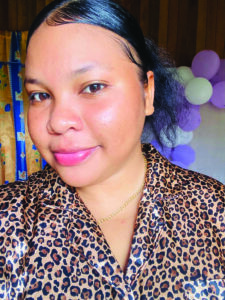
Poor internet access, sleepless nights and even hospitalisation during her studies tested her resolve, but she remained focused on the example she hoped to set for Indigenous young people.
Her mother will travel from Sand Hills to watch her graduate, making the occasion especially meaningful for the family.
Further along the coast, Kathyanna Gomez of Grant Success in the Lower Pomeroon River also overcame academic and geographical challenges to earn her qualification.
Gomez will graduate with a Bachelor of Science in Management from the School of Entrepreneurship and Business Innovation (SEBI), becoming the first in her family to earn a university degree.
Her parents moved the family to Georgetown to provide their children with better educational opportunities, making sacrifices that helped her reach university.
However, her path to graduation was not without setbacks. After failing mathematics at CSEC, she also failed the University’s mathematics entrance examination on her first attempt.
Determined to continue, she studied again and passed on her second attempt.
“I refused to allow that setback to define my academic future,” she said.
Financial difficulties continued to weigh on her family until the introduction of free tuition at UG brought some relief.
“I was so happy that I could ease the financial burden on my parents,” she said.
Returning to Pomeroon for her final two years presented another challenge. Unreliable internet access often forced her to leave home in search of a stronger connection to attend classes and complete examinations.

Despite those difficulties, Gomez remained focused on completing her degree.
“I never allowed my circumstances to become an excuse to give up,” she said.
The challenges of accessing higher education from the Pomeroon River are also reflected in the experience of 27-year-old Talesha Hudson.
Hudson, who is from the Pomeroon River, will graduate with an Associate Degree in Applied Exploration Geology from the Faculty of Engineering and Technology, becoming the first among her four siblings to earn a university qualification.
Coming from a community where farming and gold mining are familiar livelihoods, she initially expected to follow a similar path.
However, she began considering the long-term opportunities a university education could provide, particularly the possibility of securing employment that would allow her to support her parents as they grow older.
One of her greatest challenges was travelling between the Pomeroon and Georgetown, with one-way transportation costing more than GY$20,000.
Finding suitable accommodation also proved difficult, while the loss of her grandmother and sister in February this year added to the personal challenges she faced during her studies.
Throughout the experience, she said she drew encouragement from her mother, brother and friends and credited God for seeing her through. (Information and photos submitted by the Department of Events, Conferences and Communication (DECC), University of Guyana)
Discover more from Guyana Times
Subscribe to get the latest posts sent to your email.