

The Guyana Energy Agency (GEA) has completed a two-week certification programme for auto electricians and mechanical technicians, aimed squarely at closing the skills gap opened by the rapid arrival of electric and hybrid vehicles into the local market.
Held at the Mahaicony Technical and Vocational Training Centre (MTVTC), the training unfolded in two stages: a Level Three course from September 14 to 18, followed by a Level Four course from September 21 to 25.
Successful participants will receive certification from the Institute of the Motor Industry (IMI), a UK-based body whose credentials carry weight across the international automotive trade.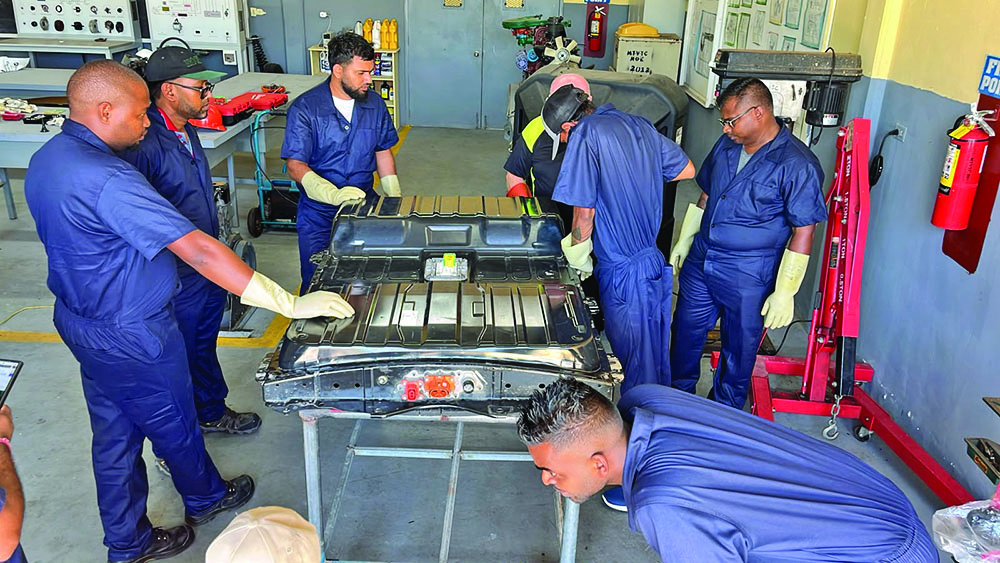
This is GEA’s fourth cohort under this programme, and 27 auto electricians and mechanical technicians participated. The push to train local technicians comes as Guyana’s EV fleet grows at pace.
GEA Chief Executive Officer Dr Mahender Sharma revealed in February 2025 that more than 220 electric vehicles had been imported into the country over the preceding five years, with 44 of those arriving in 2024 alone. By September 2025, GEA reported the total had climbed past 280, suggesting the pace of importation has accelerated well beyond the previous year’s rate.
That growth has been aided by Guyana’s tax incentives for EVs, which remain exempt from customs duty, excise tax, and VAT regardless of the vehicle’s age or power rating. The market has also gained a new entry point: in April 2025, GT Automotive launched as the exclusive Guyana dealer for BYD, introducing five electric and hybrid models to the local market.
It is a trend that has not gone unnoticed by the people doing the training.
Director of the UK-based REVAMP Training Company, Stephen Burr, led the instruction alongside fellow REVAMP educator James Sampson, who told the Guyana Times that the sheer volume of new vehicles arriving is the clearest justification for the programme.
“There’s such an exponential growth now of EVs coming into Guyana with BYD and other manufacturers. They’re seeing a lot of new vehicle types, some of the older types of EVs and hybrids. Of course, the maintenance of that is critical in helping you remain safe.” He told this publication.
That growth, Burr explained, is about more than keeping vehicles on the road; it is about keeping the technicians who service them safe, given the high-voltage systems involved in EV battery work.
“As vehicles increase, there will be a need for the technicians to repair and maintain these EVs as well,” he said. “That’s really the driver for training them technically and to support the younger Guyana technicians who are a little more entrepreneurial and wish to develop businesses in the repair of this equipment.”
That safety-first approach played out directly in the workshop. According to a GEA press release, Level Four participants worked through a hands-on high-voltage battery exercise, learning to safely open an EV battery pack, identify and diagnose faulty cells, and carry out proper repair and reassembly procedures, practical application of the safe-isolation and battery-handling principles built into the course curriculum.
Interest in the programme far exceeded the spots available. GEA made the selections of candidates for the programme.
“There were a lot of applicants, nearly 100,” Burr said.
He added that REVAMP and GEA are already looking toward a further cohort, one that would bring in roughly 41 applicants who didn’t make it into this round. “We’ve already trained over 100 technicians over the last four years. In the next programme, we’ll see another cohort of potentially 41 additional who didn’t make it on this round of training,” he said.
REVAMP’s initial Guyana training took place roughly four years ago, with earlier cohorts trained at other facilities before this year’s sessions shifted to MTVTC, a site Burr singled out for its practical workshop capacity.
“We trained the rest of them down here… because they have the fantastic facilities that we can utilise to lift the car, to take batteries off, and all of the things we need to do,” he said.
Most of the technicians who came through this year’s programme had a strong technical foundation.
“I would say 75 to 80 per cent of the students were from a technical background… Some have university degrees, not master’s-level degrees. Some were just technicians who work on heavy vehicles as well as some of the smaller light vehicles,” Burr said.
He also pointed to a use for these skills beyond four-wheeled vehicles. Electric bikes and scooters, he explained, run on much of the same underlying technology as EVs, just at a smaller scale and lower voltage.
“The technology of electric bikes is very, very similar to what’s on the vehicle on a smaller scale. Although the voltages are not considered high voltage, as these vehicles are, the theory and the mechanism of maintaining them are very similar,” he added.
The programme reflects a broader push by the Government of Guyana, channelled through GEA and its international partners, to build the local technical capacity needed to support a vehicle market that, by every available measure, is only accelerating.
Discover more from Guyana Times
Subscribe to get the latest posts sent to your email.