

…urged to use knowledge to transform communities
University of Guyana (UG) Registrar Dr Nigel Gravesande has challenged the university’s newest graduates to use the knowledge and qualifications they have acquired to address real-world challenges and contribute to development in Guyana, the Caribbean and, particularly, their local communities.
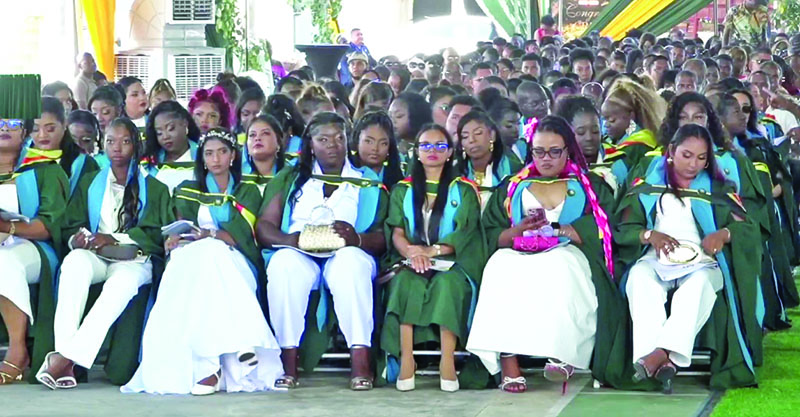
He made the call on Wednesday at the graduation ceremony for 998 students of the Faculty of Education and Humanities at the University of Guyana.
Gravesande reminded the graduands that their degrees represent more than personal academic achievements but also carry a responsibility to serve the wider society.
“Earning your degree is not just a personal academic milestone. Instead, it reflects that such an achievement comes with a duty to engage in public service, foster innovation, and transform your community,” he said.
He urged the graduates to ensure that their research, culture and scholarship benefit Guyana and the wider Caribbean, while also making meaningful contributions on the international stage.
“Remember always that as UG graduates, you are now equipped to lead in a rapidly changing world while remaining deeply rooted in Guyanese and Caribbean identity,” Gravesande said.
Importance of support systems
Meanwhile, Global Education Specialist and Senior Associate at Childhood Education International, Dr Amlata Persaud, in her address, placed emphasis on the importance of support systems in education and the responsibility of educators to create opportunities for children, regardless of their circumstances.
Persaud encouraged the graduates to recognise the people who supported them throughout their academic journeys, including parents, spouses, children, friends, colleagues, teachers, and mentors.
She noted that children do not develop or learn in isolation but within interconnected environments involving their families, schools, communities and wider society.
Drawing on her own experiences, Persaud spoke about the role her family played in helping her overcome challenges and pursue her education.
She identified her mother as her strongest advocate, recalling how she refused to allow the absence of a teacher or other resources to prevent her from accessing opportunities.
“She believed in my potential, she sought help, she made connections, and she built a network of support that helped me to persevere. And that support has never stopped,” she said.
Persaud also acknowledged her parents and sisters as her foundation, describing them as her strength, advisers and greatest supporters.
However, she cautioned that not every child has access to similar support networks, with some families facing financial pressures and other barriers that make it difficult to advocate for their children’s educational needs.
Look beyond the classroom
Against this background, she urged the graduates, particularly those entering or continuing in the teaching profession, to look beyond the classroom and understand the circumstances affecting their students.
“Get to know your students and the worlds that they inhabit. Build genuine partnerships with families. Recognise their strengths, understand their challenges, and connect with colleagues and communities to help fill the gaps where support is needed,” she advised.
While acknowledging that teachers cannot meet every need, Persaud said they could help establish a network of care and opportunity around each child.
She also underscored the professional expertise required in teaching, arguing that the profession involves far more than simply transmitting information.
According to her, effective teaching requires an understanding of pedagogy, curriculum, child development and different learning needs, as well as the ability to assess students, adapt instruction and create environments in which children feel safe and motivated to learn.
She encouraged the graduates to bring the spirit of inquiry they developed at university into their professional practice by experimenting, reflecting, collaborating, and contributing to the advancement of education.
Genuine human development
Persaud further reminded the graduands that education remains central to national development, particularly as Guyana undergoes rapid economic transformation.
While acknowledging the opportunities emerging from new industries and infrastructure development, she cautioned that economic growth alone does not guarantee genuine human development.
She noted that building roads, bridges, schools and hospitals must be accompanied by values, integrity, critical thinking, leadership, and a shared sense of responsibility.
Educators, she said, have an important role in shaping the country’s future, not only through the children they teach but also through their leadership, research, innovation, and contributions to schools and communities.
“You are not simply preparing others to build Guyana’s future; you’re helping to build it yourselves,” she told the graduates.
Persaud also described education as a fundamental human right, arguing that a child’s opportunities should not be determined by where they are born, their family circumstances or the resources available to them.
She said education had transformed her own life by opening doors, challenging her thinking and expanding the possibilities available to her.
Reflecting on the intellectual influences that shaped her professional outlook, Persaud acknowledged thinkers such as John Dewey and Maxine Greene, whom she encountered while studying at Teachers College, Columbia University. She also referenced Guyanese historian and academic Walter Rodney, whose work emphasised the connection between knowledge and the transformation of society.
Their contributions, she said, reinforced the importance of education in encouraging critical thinking, challenging assumptions and enabling people to shape their collective future.
Persaud also encouraged the graduates to remain humble and committed to lifelong learning, reminding them that students, colleagues, families, and communities also have knowledge and experiences from which educators can learn.
She urged them to remember the sense of achievement they experienced at graduation, particularly during difficult periods in their careers, when the demands of teaching might become overwhelming.
The graduation of the 998 students is part of the University of Guyana’s 60th Convocation, which saw more than 3700 students graduate across the institution.
Discover more from Guyana Times
Subscribe to get the latest posts sent to your email.