


…challenges countries to join biodiversity fight
Vice President Bharrat Jagdeo has called on countries that have not yet joined Guyana’s Global Biodiversity Alliance to do so, arguing that biodiversity conservation is not only an environmental imperative but also delivers economic, climate and social benefits.
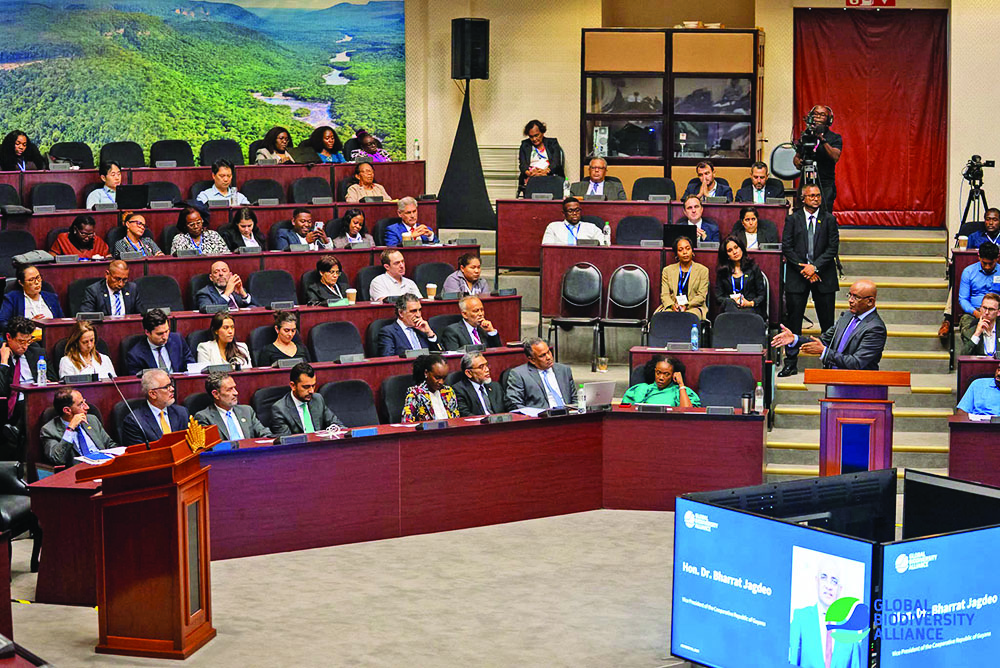
Jagdeo made the appeal Friday while addressing the opening of the second annual Global Biodiversity Alliance Conference at the Arthur Chung Convention Centre, Lilliendaal, where His Majesty King Charles III was a guest during his historic 2-day state visit to Guyana.
The Vice President highlighted the rapid growth of the Alliance, which has expanded from 17 members to 142, but stressed that it is not intended to compete with or replace the United Nations Convention on Biological Diversity (CBD) or its Conference of the Parties (COP).
“The Alliance cannot supplant the UN Convention on Biodiversity. That’s a point we need to make right up front,” Jagdeo said.
He said the Alliance should instead support the targets and decisions of the UN Convention on Biodiversity.
“We just saw the conclusion of COP17 in Armenia. And I’m sure all of you have been following the outcome of that meeting. And it’s not a great outcome that we can speak of,” he said. The COP17 is reported to have been “concluded with minimal agreements”.
Jagdeo said the Alliance’s role must therefore be interpreted as supporting the convention, its targets and mechanisms.
He identified two major challenges facing biodiversity financing: the absence of a functioning market for biodiversity credits and inadequate public funding.
“First of all, there is no market for biodiversity credit currently. Not a compliance market, not even a major voluntary market. That’s a fact. Two: that public funds are not at scale,” he said.
Jagdeo said expanding participation in the Alliance was also important to create a stronger sense of urgency around biodiversity loss, which he believes has slipped down the international agenda amid concerns over inflation, food security, conflicts, energy prices and artificial intelligence.
“Most of the world is focused on energy prices now and food security, cost of living, the regional conflicts, AI challenges; and somehow climate initiatives and biodiversity initiatives have drifted away from being topical or the primary risk to civilization,” he said.
However, he pointed to global risk assessments showing that environmental threats remain among the most serious long-term risks facing the world.
Citing the World Economic Forum, Jagdeo said immediate concerns include misinformation, conflicts and societal polarisation, but the longer-term outlook is dominated by environmental risks.
“Look how this changes in the next ten years,” he said. “Number one: extreme weather events; two: biodiversity loss and ecosystem collapse; three: critical change to earth systems; and four: natural resources shortages…That is what we’re heading towards.”
Jagdeo said the Alliance could help mobilise countries, policymakers and technical experts around biodiversity, before degradation reaches irreversible levels.
He also proposed that members dedicate resources to addressing the technical and policy questions surrounding biodiversity credits.
“Hundreds of questions are being raised as to why a biodiversity credit may not work,” he said. “We need now to give answers to those.”
He suggested that working groups emerging from the Alliance undertake focused technical work that could inform negotiators and influence international discussions.
Jagdeo also called for practical examples demonstrating how biodiversity initiatives can generate measurable value.
“The fourth task is to show examples,” he said. “Good examples where we can get together as a group; the private sector, university, government… and show the world that this can work.”
He said successful projects could help demonstrate how conservation and sustainable development can be pursued simultaneously, while building confidence among governments, investors and communities.
Jagdeo further called for greater use of artificial intelligence (AI) to support research, analysis and decision-making in the biodiversity sector.
While noting that AI might eventually make speechwriters and politicians “redundant”, he said the technology could help policymakers process large quantities of information and develop more effective conservation models.
Ultimately, Jagdeo said, the Alliance must focus on practical solutions rather than declarations.
“We need to focus it on a few areas where we can help to move what’s happening at the global level forward,” he urged.
Discover more from Guyana Times
Subscribe to get the latest posts sent to your email.