


– warns region vulnerable to global fuel instability
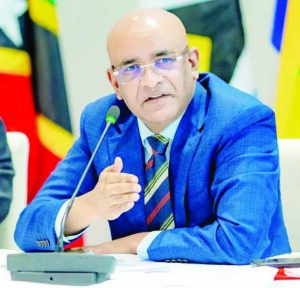
With Caribbean countries injecting a large portion of their Gross Domestic Product (GDP) into fuel importation, coupled with the instability of the global fuel supply, the conversation on alternative energy sources has been reignited, with Vice President (VP) Bharrat Jagdeo calling for investments in renewable energy to cut the region’s high energy bill.
“When you look at the cost of energy for this region, many of us are using more than 10 per cent of gross domestic product to import fuel energy. The big countries of the world are using a smaller share of their gross domestic product. At one time, it was 25 per cent of GDP that we were using, or the equivalent of 25 per cent of GDP, to meet our energy needs… We have to fix that. And therefore, we have to work to invest in renewable energy to cut that energy bill, to cut the climate crisis or not,” Jagdeo stated.
He was, on Thursday, addressing regional officials at the opening of the 124th Special Meeting of the Council for Trade and Economic Development (COTED) – Environment and Sustainable Development, hosted by the Caribbean Community (CARICOM) Secretariat in Georgetown.
But even as he is pushing for renewable energy, Jagdeo recognises that the region is still heavily dependent on fossil fuels – something that makes Caribbean countries vulnerable to the instability of the global fuel supply chain.
“We are far away from weaning ourselves off fossil fuels … And so, unless prices stay high for fossil fuels, which may then give a stimulus to search for renewable energy to replace it, we are in deep trouble,” the Guyanese VP stated.
Jagdeo pointed to the recent disruptions to the global supply chain caused by the ongoing war in the Middle East, which has already seen economic instability in some countries and the diversion of funds from development activities into subsidising fuel.
“We are going to definitely lose economic output. And now that you have shortages of gas, it’s going to affect the airline industry and affect sectors like tourism, and soon it will come close to the region, and we’ll lose jobs,” he asserted.
To this end, Jagdeo further noted that this situation requires regional leaders to shift their approach, as well as the conversation on fossil fuel. This, he noted, is especially important when it comes to the debate between fossil fuel and no fossil fuel.
“The fact is that we will need fossil fuel. We need to reframe that debate for us to make progress into what we have been arguing for quite a while now, an equation to get to net zero, so that we treat net zero as a balance. And if we treat it as a balance, there are many solutions in the equation which we have to explore that would ultimately lead to that net zero, which is the balance that we are seeking to achieve. So, it means renewable energy, energy efficiency, new technology, and yes, cutting some fossil fuel… And unless you are very deliberate, you will get caught up in the same never-changing, almost circular arguments, where we restate the problem over and over again,” he stated.
According to Jagdeo, Caribbean nations have overemphasised the impact of climate change on the region at these international climate change platforms but rarely present solutions.
“Your quest has to be a search for solutions, given the reality of the global environment. And the reality is that… we need fossil fuel well into the conceivable future because alternative energy will not displace the increase in demand for energy globally. That’s the reality,” Jagdeo posited.
Rising tensions in the Middle East have placed renewed global focus on the Strait of Hormuz amid an escalating conflict involving Iran, Israel, and the United States. The ongoing military exchanges, including airstrikes on critical energy infrastructure and retaliatory attacks, have heightened fears of disruptions to one of the world’s most critical oil transit routes.
The Gulf region supplies about 20 per cent of the global oil – nearly 60 per cent of which goes to Asia, where countries are grappling with severe fuel shortages and rising costs. With fuel prices hovering just over US$100 per barrel, the global economy is also facing the impact.
In the Caribbean, countries are facing rising costs, job losses, and potential instability, especially those that are heavily reliant on imports, air transport, and tourism.
Discover more from Guyana Times
Subscribe to get the latest posts sent to your email.