

As the Guyana Government work on preserving indigenous languages, Education Minister Sonia Parag has underscored the importance of teaching the younger generation outside of the classrooms. She made this comment on Saturday during the Heritage Village Day celebrations at Bumbury Village in Region One (Barima-Waini). This year’s Amerindian Heritage Month is being held under the theme, “Observing Our Cultural Heritage During Our Diamond Jubilee: Honouring Our Traditions, Culture and Contributions.”
With both Heritage Month and Education Month celebrations coinciding in September every year, Minister Parag posited that the two are intrinsically linked. “We can’t speak of education without speaking about the culture of our people because we are uniquely positioned in the Caribbean…because of our six ethnicities; one being those of Amerindians – our indigenous people… So, today while we celebrate, we can’t speak about education without speaking about our culture; the culture of our [first] people,” she noted.
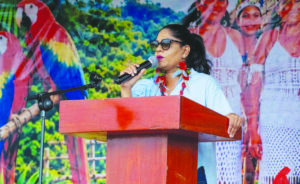
A key area of the indigenous culture is their language. In fact, the Government is currently exploring the possibility of introducing the Lokono (Arawak) language into the primary-school system as part of efforts to preserve Indigenous languages and traditions that are disappearing in some communities. “We are currently working with the Ministry of Amerindian Affairs to ensure that we preserve the Arawak language. So that’s something that is important. And as we go along, I think it is also important that we preserve our culture because education isn’t just in a classroom. It is exactly what is taught to us through our culture. It is those experiences that we can pass on to generations that will come after us. And if we’re going to preserve our culture, it means those of us who know the culture would have to [pass it on],” the Education Minister stated. But even as they explore ways to do this, Minister Parag is of the view that social media can be utilised to engage the younger generations. “Many people use social media as a negative tool or a tool or a vehicle for negative information, more than they do for positive information. If we can use social media, such as videos being produced in our hinterland or Amerindian villages, that can preserve our culture to ensure that generations down the line will be able to benefit from that, then you are doing something positive on social media that can have a positive benefit. And so, when you think about education, don’t just think about what a classroom is offering,” Parag emphasised.
Formal education system
Only recently, Amerindian Affairs Minister Sarah Browne-Shadeek revealed that her Ministry is currently working with the Education Ministry to determine how the language could be incorporated into the formal education system, possibly beginning at the primary level. Speaking during an appearance on the Starting Point podcast earlier this month, Browne-Shadeek surmised that greater connectivity, social media and other outside influences have contributed to the erosion of aspects of Indigenous culture in some communities. “As a Ministry, we have acknowledged that, in some villages, whether it’s by outside influence, social media or us being more connected to the outside world, our culture in some areas is, it’s sad to see, dying,” she had noted. The Amerindian Affairs Minister pointed to Region Nine (Upper Takutu-Upper Essequibo) as an area where Indigenous culture remains strong within communities that practise traditional ways of life and speak their languages. In contrast, she identified the Lokono or Arawak nation as an area of particular concern, noting that many Lokono communities are situated in locations with easy access to the coast. For Browne-Shadeek, the threat to the language is also personal. “I am Lokono, I grew up in one of the largest Amerindian villages, and I can’t speak my language. It’s sad to see, not by choice, but because the people around me didn’t speak it and growing up, nobody taught me the language,” she related. The Minister said the challenge extends beyond language to the passing down of traditional skills and stories within families, drawing on her own experience as a mother. She said efforts are underway to bring the language into a formal setting. Browne-Shadeek also pointed to the role of cultural groups in preserving traditions, saying her Ministry continues to support groups that are actively promoting Indigenous culture. She noted that in some areas only a small number of such groups remain. In one Region One sub-district, she said, there are approximately three cultural groups among some 11 villages, while similar challenges exist in parts of Region Eight (Potaro-Siparuni).
The discussion comes as Guyana observes Amerindian Heritage Month throughout September, with activities showcasing the traditions, achievements and contributions of the country’s First Peoples.
Discover more from Guyana Times
Subscribe to get the latest posts sent to your email.