


…says 50% bill reduction will come after power plant is fully online
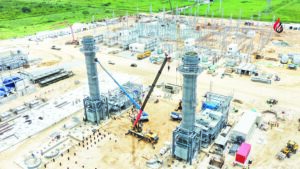
The highly anticipated Gas-to-Energy (GtE) Project is set to come onstream by the end of this year, delivering some 57 megawatts (MW) of electricity while the remaining power will be delivered during the first half of 2027, when Guyanese will start to benefit from lowered rates. A 300 MW combined cycle power plant is one of the main components, alongside a Natural Gas Liquids (NGL) facility, of the GtE Project that will bring natural gas from the Stabroek Block offshore to the Wales, West Bank Demerara (WBD) site. After missing several delays in the past, the contractor, United States (US)-based Lindsayca, has committed to start delivering the gas-powered electricity by this yearend. “By the end of this year, we’ll see 57 megawatts. At least of one the turbines will be spinning and generating 57 megawatts and in the first quarter of 2027, we’ll have up to 228 megawatts,” Prime Minister (PM) Brigadier (Retired) Mark Phillips, disclosed during a press conference on Friday at his Camp Street, Georgetown, office.

The power generation component will utilise four SGT-800 gas turbines paired with heat recovery steam generators (HRSGs) and steam turbines operating in a combined-cycle configuration to produce generation capacity of approximately 300 MW. While the gas turbines are slated to all come online by mid next year, the full 300 MW capacity will be reached until the end of 2027 once the final combined-cycle configuration is completed. The system has been engineered with built-in redundancy, allowing individual turbines to operate independently and be phased onto the national grid, which will ensure continuous and reliable power supply as well as a 50 per cent reduction in electricity costs. According to PM Phillips, Guyanese will start benefitting from this reduction in electricity prices once the project is fully online – an election promise made by the governing People’s Progressive Party/Civic (PPP/). “We said 50 per cent reduction at the end of the project and the project we’re talking about is Phase One. Phase One ends when we get 228 megawatts of power, and then you’ll get the full] 300 come from the steam [turbines] afterwards. So, when we achieve that, that’s Phase One,” he explained.
Currently, customers are receiving power from the national grid at $43.43 per kilowatt-hour (kWh) for residential use and $56.38 per kWh for commercial use. The PM noted these figures will be slashed in half when the GtE Project is fully operationalised. “[It will be] divided by two and that will be the new rate. So, the people of Guyana have to look forward to, whatever you’re paying now, you will pay half of that,” he posited. “It’s a manifesto promise made in the 2020 Manifesto…and it was repeated in the 2025 Manifesto. And the PPP/C, we have a history of delivering on our Manifesto promises to the people of Guyana. So, at the end of it all, electricity rates will reduce by 50 per cent minimum.”
Benefits already being seen
The GtE Project is a key part of the Guyana Government’s energy transition agenda, which has already seen renewable sources such as solar and hydropower being used for power generation across the country. In fact, Public Utilities and Aviation Minister Deodat Indar pointed out during Friday’s press conference that the benefits are already being seen from these investments, especially in the hinterland regions. “We have already reduced cost of electricity in Bartica [Region Seven, Cuyuni-Mazaruni] by 25 per cent. We’ve also reduced costs in Region One [Barima-Waini) by 30 per cent because we had solar that was complementing and displacing use of diesel. That savings, we used it and transferred it to consumers,” the Minister explained. Similar, Indar noted that the solar farms and mini-hydropower projects in Lethem, Region Nine (Upper Takutu-Upper Essequibo) is also yielding benefits.
Only recently, Head of the Guyana Energy Agency, Dr Mahender Sharma, reported that the 0.7 MW Moco Moco Hydropower Plant and 1.5 MW Kumu Hydropower Station have cut the use of fossil fuel for electricity generation in Region Nine by more than 20,000 drums. Nevertheless, it was noted that once the GtE Project comes on stream, the Government will phase out fuel-generated electricity including from the two Turkish power ships that are operating in the Demerara and Berbice Rivers, adding over 90 MW to the national grid. Only a few months ago, the Government renewed the contract with Turkey-based Karpowership to continue producing power at a rate of $9.5 per kW/h. “At the point when the Gas-to-Energy comes on board and we have generative capacity to offset that we’d be the first to put those [contracts] out…because we’ve been using gas as the feedstock… Those vessels that we rent there, we use HFOs (High Fuel Oil), which is very expensive…So, we’d be the first to review those contracts based on the clause that they have for exist. But for now, if we didn’t have those two [power ships] this whole country would be in power outages,” the Public Utilities Minister stated. Currently, peak demand is approximately 242.64 MW with generation capacity at 256 MW, which will further increase to 280 MW by the end of August as more assets come on stream to accommodate the country’s growing electricity needs.
Discover more from Guyana Times
Subscribe to get the latest posts sent to your email.