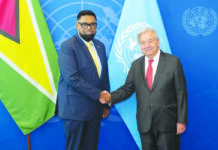


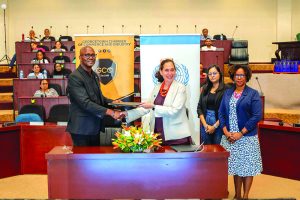
Aiming to promote the private sector as a key stakeholder in advancing the United Nations (UN) Sustainable Development Goals (SDGs), the Georgetown Chamber of Commerce and Industry (GCCI) and the UN on Saturday signed an agreement to reinforce their partnership.
This signing coincided with one of the GCCI’s final events within their second National Small Business Week – the conclusive seminar that engaged key business leaders on the importance of digital marketing, strategic collaboration, business regulation, and maintaining compliance, among other topics.
The GCCI-UN agreement seeks to serve as a way to ensure capacity-building support is provided in advancing economic diversification, enhancing employability, and most notably, enabling SDG alignment.
UN Resident Coordinator in Guyana, Ye?im Oruç noted the UN’s eagerness to collaborate with the GCCI as Guyana continues to exhibit immense potential and rising development. “It is my absolute privilege to be signing this agreement on promoting the Sustainable Development Goals through strategic partnership between the GCCI and the UN with a view to promoting even more partnerships…,” Oruç said.
The SDGs are a series of goals within a comprehensive agenda that some 193 countries, including Guyana, have committed to achieving by 2030 to ensure peace and prosperity. The private sector plays a pivotal role in attaining this UN-led vision.
With small and medium-scale enterprises comprising up to 70 per cent of Guyana’s private sector, Oruç acknowledged the unique stresses their owners face in trying to maintain, sustain and grow their businesses in light of the impacts of the COVID-19 pandemic and the Russian invasion of Ukraine.
She further urged the need to build inclusive and resilient work environments as this agreement ensues.
Meanwhile, GCCI President Kester Hutson noted that a prominent obstacle facing the private sector also includes the scarcity of semi-skilled and skilled labour, resulting in a considerable deficit across multiple sectors.
“To address this pressing issue, a strong public-private partnership is essential to devise streamline processes and expedite necessary procedures while embracing modern technology. This approach can prove instrumental in alleviating the burden on businesses seeking skilled expatriate labour,” Hutson said.
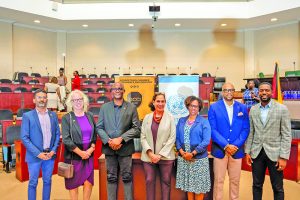
He added that businesses and the nation at large will then be able to create a thriving environment that enhances workforce diversity and expertise, leading to greater competitiveness, productivity, and economic development.
“The signed [agreement] with the UN plays a vital role in facilitating collaboration and streamlining the entry process for these skilled workers, thereby encouraging the seamless integration of ex-pat talents to further drive progress and growth,” Hutson said.
This agreement between the UN and GCCI is only the beginning of a series of collaborations between the international organisation and Guyana this year. “Later this year in September, [President Dr Irfaan Ali] will be going to the UN General Assembly where he will be participating in the Sustainable Development Goals Summit,” Oruç said.
“I trust that he will be telegraphing some of these really amazing developments out of Guyana and encouraging more and more young people and women to come into Guyana’s economic development and prosperity prospects,” she said.
Meanwhile, in October, Oruç added, the UN and other key partners present at the GCCI seminar are also intending to host a Sustainable Development Partnership forum with the private sector.
Discover more from Guyana Times
Subscribe to get the latest posts sent to your email.