– as recycling plant judged unprofitable
The Guyana Government is exploring several initiatives aimed at better managing the country’s solid waste, including imposing a ban on single-use plastics, according to Local Government and Regional Development Minister Priya Manickchand.
During a recent appearance on a recent programme, Minister Manickchand explained that significant consideration must be given to such a move due to the widespread impact it would have.
“Some of the things we can look at are banning single-use plastics and really changing how we import plastic. Of course, all those things have a cost. So, these are not just things you can impose on a population,” she pointed out.
At the time, the Minister was responding to a question about the possibility of a recycling plant in Guyana for bottles and cans. However, she noted that studies so far have found that there is not sufficient waste being produced locally to support the establishment of a recycling facility.
“A lot of the language I’m hearing from recycling providers is that our volume is so small that for it to be profitable for them… So, it’s chicken and egg here. We’d have to be producing a lot more plastic waste, which is not something we necessarily want to do.”
“But if they were to open a recycling plant here that is even just of medium size, it would work only for one day every month, given the [low] volume of plastic waste that we produce. And people don’t find that to be profitable. So, we have to find other ways,” Manickchand asserted.
Single-use plastics refer to straws, plastic cups, plastic spoons, forks, knives, plastic food containers, plastic bags, or plastic bottles – all items used on a daily basis.
Based on reports, the world produces over 400 to 460 million tonnes of plastic each year, with nearly half, roughly 200 to 230 million tonnes, designed as single-use plastics. In Guyana, it was previously estimated that around 7000 to 10,000 tonnes of single-use plastics and waste containers end up at landfill sites every year.
Single-use plastics have a low recycling capacity, are made of polyethylene (PET), and are environmentally persistent, which means they take thousands of years to break down.

Additionally, they are made from crude oil, natural gas, and what are known as petrochemical derivatives, which pose threats to the environment, human health, and marine life. Plastic pollution is threatening the ecosystem, biodiversity, and health at a pace and scale never seen before.
Earlier this year, Manickchand stated that several models are being examined to recycle and reuse waste. These efforts, she explained, aim to convert garbage into useful outputs such as energy and fertiliser, with plans to expand these systems nationwide beyond existing sites such as the Haags Bosch Sanitary Landfill at Eccles, East Bank, Demerara.
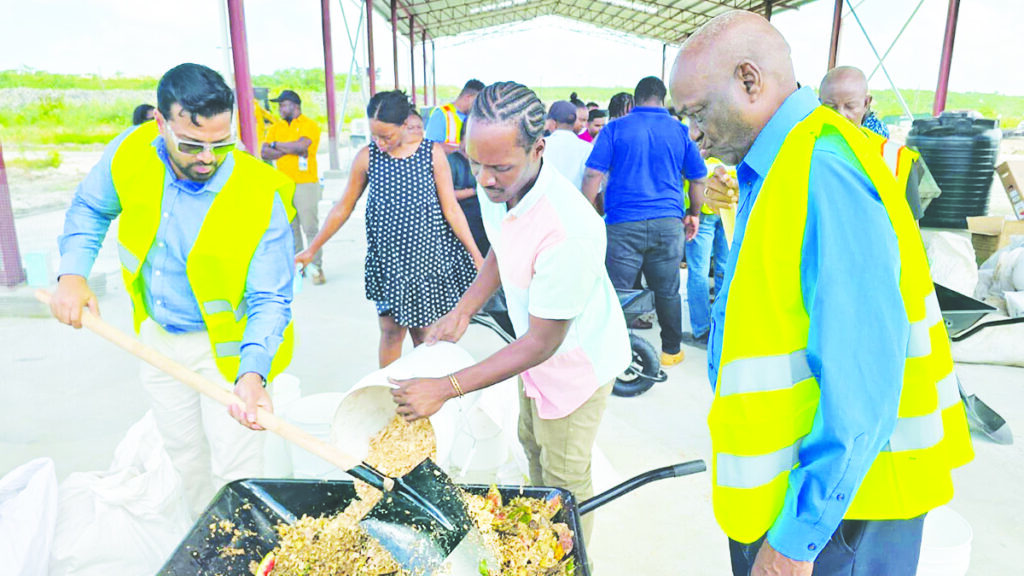
Back in February, the Local Government and Regional Development Ministry launched the Recycling and Composting Centre at the Haags Bosch site, marking a significant milestone in efforts to strengthen sustainable solid waste management practices nationwide.
In addition, there were also training sessions aimed at building national and local capacity in organic waste diversion through practical, hands-on training combined with technical instruction – all focusing on reducing the volume of organic waste sent to landfills and promoting environmentally responsible alternatives.
The ministry anticipates that the Recycling and Composting Centre, along with the accompanying training programme, will serve as a model for similar initiatives across the country.
Plans are already in place for the programme to be replicated in other regions, supporting Guyana’s broader environmental and climate objectives while fostering collaboration among key stakeholders in the waste management sector.
Meanwhile, as part of its nationwide solid waste management programme, the Guyana Government has distributed garbage trucks to all Neighbourhood Democratic Councils (NDCs) and municipalities across the country.
To date, one truck has been delivered to Port Kaituma in Region One, while Region Two has received 10 trucks. Region Three is now fully equipped with 14 trucks distributed across its NDCs, including those previously delivered to Wakenaam and Leguan. Region Five received a total of 10 trucks. In Region Six, 19 trucks have been distributed, while Region Nine has received one.
Municipalities have also benefited from the programme, with trucks delivered to Mabaruma, the three municipalities across Region Six, and one in Region Nine.
In the past, Guyana’s Environmental Protection Agency (EPA) was gearing up to ban single-use plastics in the country, with several public consultations held on the availability of alternatives and the timelines for implementation. However, the agency subsequently shifted gears, noting that such a ban would have to be a phased approach and part of a long-term strategy to manage plastic pollution.
Just last year, Executive Director of the EPA, Kemraj Parsram, underscored the importance of curbing plastic waste products that are being disposed of wantonly in communities across Guyana.
In an interview to commemorate the June 2025 World Environment Day, Parsram pointed out that Guyana’s Low Carbon Development Strategy (LCDS) 2030, launched at the end of 2022/early 2023, seeks to address this issue with a “circular economy” policy.
A circular economy is a model of resource management that aims to minimise waste and maximise the lifespan of products and materials. It shifts away from the traditional use-and-dispose practice and, instead, emphasises reuse, repair, remanufacturing, repurposing, and recycling.
The EPA head explained that this approach reduces environmental impact, conserves resources, and even creates new economic opportunities. In the same breath, however, Parsram noted that the agency cannot do it alone, adding that every citizen has a role to play and must change their attitude toward the environment, especially how they dispose of garbage.
The EPA has since embarked on an awareness campaign to change public attitudes, starting with actions to eradicate littering at the seawalls and extending to broader national behavioural shifts. Enforcement efforts are also part of these plans.
Discover more from Guyana Times
Subscribe to get the latest posts sent to your email.