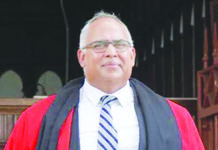


United Kingdom (UK) Member of Parliament (MP) David Lammy has hailed Guyana’s growing influence on the global climate stage, saying the country is helping to reshape international discussions through its environmental leadership and commitment to sustainable development. Lammy, who is of Guyanese descent, was the feature speaker during the latest edition of Conservation Conversations, hosted by the Environmental Management Consultants (EMC) Foundation, where he discussed the link between geopolitics and conservation. He said while thousands of conservation programmes around the world are working alongside local and Indigenous communities to protect human rights and the environment, many require long-term funding commitments to remain effective. “The truth is that there are many thousands of wonderful conservation programmes around the world aligned with local Indigenous communities and preserving human rights and they really are making a difference, but they need long-term fundamental funding commitments to thrive,” Lammy said. He noted that conservation initiatives often influence global discussions and policy decisions beyond their size and scale, adding that Guyana is increasingly playing a critical role in that space.
“In international forums, they change the conversation and influence policy far beyond their size and scale, and that’s where I see Guyana increasingly important, playing this very crucial role because, of course, it is a country that is part of the Caribbean and a central part of South America,” Lammy said.
“Guyana is no longer simply a country of immense natural wealth; it is becoming a country of immense environmental significance, and I’m very proud to see the work done in collaboration with the UK that Guyana is making on many fronts,” he added.
Lammy highlighted several initiatives that have strengthened Guyana’s standing in global climate and conservation efforts, including the Low Carbon Development Strategy (LCDS) 2030, the country’s “30 by 30” conservation target, the expansion of protected areas, the Global Biodiversity Alliance led by President Dr Irfaan Ali, and ongoing efforts to strengthen the rights and opportunities of Indigenous peoples.
He said Guyana demonstrates that economic development and environmental protection do not have to be competing priorities. “So Guyana is a nation that the world is now looking at anew, a nation that demonstrates that economic development and environmental stewardship do not have to be opposing forces,” Lammy said. “There shouldn’t be a zero-sum game between climate and the cost of living. As President Irfaan Ali recently said, if we manage proper development, environmental stewardship can go hand in hand, and they’re not mutually exclusive,” he added. Lammy said Guyana is among a growing number of developing countries showing that economic progress and environmental responsibility can advance together, positioning the country as an important voice in global climate discussions.
Lammy also emphasised that addressing climate change requires shared solutions, noting that the future of the environment depends on cooperation between Governments, communities and institutions. He said the global energy transition requires new approaches and described the need for countries to adopt what he called “progressive realism” — being ambitious in their goals while remaining practical in their approach. According to Lammy, countries must work together through stronger partnerships and multilateral cooperation to address emerging challenges, while adapting to a changing global landscape where energy security, clean energy and resilient supply chains have become increasingly important.
He added that climate action is also a matter of justice, highlighting the need to consider the experiences of vulnerable and underrepresented communities.
Discover more from Guyana Times
Subscribe to get the latest posts sent to your email.