


…warns against policy “backsliding”
Vice President (VP) Bharrat Jagdeo has pointed to Guyana’s experience under the Low Carbon Development Strategy (LCDS) as evidence that economic growth, climate resilience and environmental protection can be pursued together.
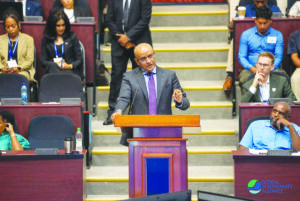
Addressing the second annual Global Biodiversity Alliance (GBA) Conference on Friday at the Arthur Chung Convention Centre (ACCC), Liliendaal, Jagdeo said Guyana has recorded the world’s fastest economic growth rates in recent years while maintaining commitments to forest protection and biodiversity conservation.
The VP, who was previously recognised as a Champion of the Earth for formulating a national policy framework launched in 2009, said Guyana has remained committed to its environmental credentials despite the pace of economic change.
“It would be easy to be distracted in a country that is moving so fast,” Jagdeo said, “but we have remained firm in terms of making sure that as we change, we keep our environmental credentials intact.”
He pointed to Guyana’s emergence as a major oil producer while maintaining a no-flaring policy, imposing a carbon tax on unscheduled flaring and continuing to support carbon pricing globally.
Guyana has also committed to protecting 30 per cent of its land and marine resources by 2030, Jagdeo noted.
He said biodiversity-related benefits are already being generated through conservation financing under the LCDS.
Over 3,000 projects have been completed in 252 Indigenous villages, he said, with approximately 20 per cent of LCDS funds going directly to those communities, while much of the remainder has supported adaptation initiatives.
“The key success there is the capacity we have built in these villages to implement projects,” Jagdeo said.
He said the investments have helped build local capacity while demonstrating how environmental financing can improve livelihoods and preserve natural resources.
Jagdeo also pointed to investments in canals, embankments and agricultural expansion as examples of how climate and biodiversity strategies can be linked to broader economic objectives.
“We can link climate protection, climate proofing the country with also economic objectives,” he said.
He argued that protecting forests for climate reasons also produces biodiversity benefits because intact ecosystems protect species and ecological functions.
“If the forest has a unique biome, and if we don’t, although we are protecting the forest now through conservation, from maybe using climate funds, we’re getting climate funds to protect the forest, they have a major biodiversity effect too, by protecting the biome of the forest,” Jagdeo said.
“It doesn’t, if we can use climate funds to do that, then you get an additional benefit. That is why there are linkages between these concepts that we can’t artificially separate,” he added.
Warned against policy “backsliding”
Jagdeo also warned against policy “backsliding” that could undermine conservation gains made over the past two decades.
Drawing on negotiations surrounding forest carbon under the REDD+ framework, he said developing countries had fought for the principle that countries preserving forests should be rewarded rather than disadvantaged.
He expressed concern about emerging views in some parts of Europe that countries with extensive intact forests should not receive compensation at the same level as countries restoring degraded forests.
“We made the argument that it will create perverse incentives,” Jagdeo said.
He explained that rewarding countries only after forests have been destroyed could encourage destructive behaviour while disadvantaging countries that had maintained conservation policies.
“The demand is always there to cut the trees down,” he said. “It’s easy to transition to doing that.”
Jagdeo urged countries to remain vigilant to ensure that conservation continues to be recognised and valued internationally.
He said Guyana would continue to push for stronger technical collaboration and policy development.
While there is no final conclusion on what biodiversity credits should be, Jagdeo said Alliance members could dedicate resources to resolving the technical and policy questions surrounding the development of biodiversity financing mechanisms.
He also encouraged countries that have not yet joined the Alliance to become part of the effort, arguing that conservation delivers benefits beyond protecting wildlife and ecosystems by strengthening climate resilience, maintaining natural resources and reducing future environmental costs.
Discover more from Guyana Times
Subscribe to get the latest posts sent to your email.