


As Commonwealth nations gathered in Antigua and Barbuda for the 28th Heads of Government Meeting, Guyana has underscored that access to quality eye care should be a fundamental development priority as it is linked to education, productivity, equality, and economic growth.

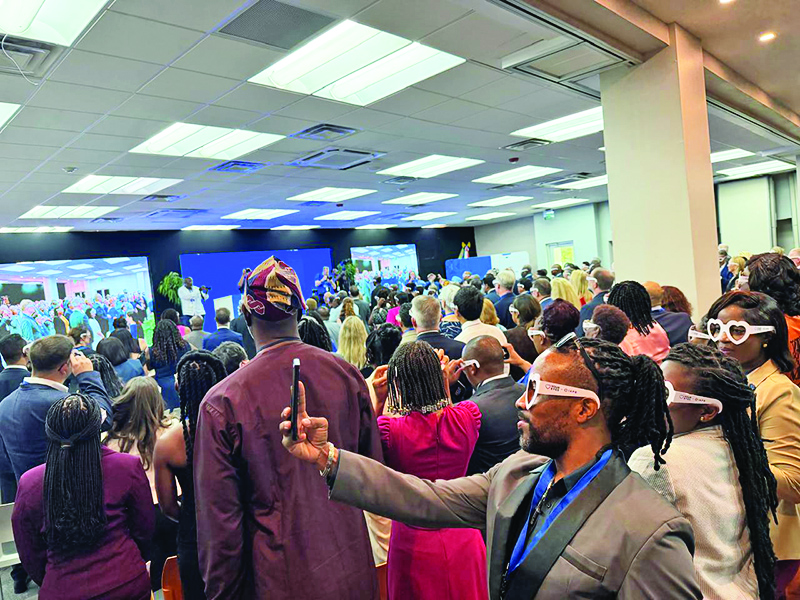
“Guyana is honoured to co-host this Summit because we believe that the ability to see clearly should never depend on where you live, how much you earn, or whether you can afford treatment,” Foreign Affairs Minister Hugh Todd said as he delivered an address, on Guyana’s behalf, at the Global Eyecare Summit, held on the side-lines of the Commonwealth Heads of Government Meeting (CHOGM). Guyana co-hosted the summit along with Antigua and Barbuda, Bangladesh, Ireland, Nigeria, the International Agency for the Prevention of Blindness, and the World Health Organization (WHO).
Standing in for President Dr Irfaan Ali, who was at another CHOGM engagement, the Foreign Affairs Minister outlined Guyana’s extensive investments in eye care and called for stronger national, regional, and global efforts to ensure that preventable vision impairment no longer limits opportunity. He noted that President Ali believes that untreated vision problems can have lifelong consequences that extend far beyond the healthcare sector.
“For us, eye health is not simply a health issue. A child who cannot see clearly cannot learn to the best of his or her ability; a worker whose vision is impaired cannot contribute as productively or safely as possible; and a person denied access to eye care because of poverty or geography is denied an equal opportunity to participate fully in society,” he said.
Todd said that the Government understands that vision impairment that could otherwise be prevented or treated often entrenches existing disadvantages, limiting educational attainment, restricting economic opportunities, and widening inequalities, and it is why much resources are channelled to eye care.
“Preventable vision impairment can therefore perpetuate educational disadvantage, restrict economic opportunity, and deepen social inequalities,” Todd posited, adding that “investing in eye health is consequently an investment in human capital, productivity, inclusion, and the overall development of our nation.” Government, Todd said, believes that economic development cannot be regarded as successful if segments of the population are excluded from participating fully in national life because of avoidable health barriers.
Integral component
“Guyana is undergoing one of the most significant periods of transformation in our history. We are building new industries, creating new opportunities and investing heavily in our people. But development is meaningful only if every citizen can participate,” he told the forum where Heads of State were present.
As a result, the Government has treated eye care as an integral component of its development strategy.
Guyana’s national eyecare programmes, launched in 2024, provided free eye examinations for schoolchildren and pensioners, as well as financial support for spectacles for those who required them. By 2025, the programme had been expanded to cover all citizens regardless of age, and it is growing, Todd boasted to applause by attendees.
“By August this year, we had completed more than 237,000 eye examinations, and more than 200,000 people had received assistance with spectacles,” he said.
The Government has also prioritised early detection among children by taking screening services directly into schools.
“We’re bringing screening directly to our schools so we can detect vision problems early, before they become barriers to learning. So far, we’ve screened 100,000 school children across Guyana.”
No backlogs
The restoration of the National Ophthalmology Hospital at Port Mourant, Berbice was highlighted as a major achievement in expanding access to specialised eye care services.
The facility had previously experienced years during which surgical services were no longer being provided, but the Government has since returned the institution to operation, allowing it to offer cataract and other eye surgeries free of charge to citizens from every region.
“We have also restored our National Ophthalmology Hospital at Port Mourant. After years in which surgical services had ceased, the hospital is once again providing cataract and other eye surgeries free of charge to citizens from every region of Guyana.”
And while there had been a waiting list for surgeries, Todd said that he was pleased to announce that the surgical waiting list at our National Ophthalmology Hospital has now been cleared of backlogs.
However, the Government signalled that it intends to take eye-care services beyond fixed healthcare facilities, with President Ali directing an immediate expansion of outreach programmes into hinterland and remote communities to reach residents who face barriers to accessing healthcare, rather than waiting for them to seek treatment.
Future initiatives
He also outlined a number of future initiatives aimed at strengthening Guyana’s eye-care system and expanding its reach.
Among these is a diabetic eye-screening programme intended to integrate regular eye examinations into routine diabetes management. The Government also plans to continue investing in the training of eye-care professionals through scholarships and specialised education opportunities.
Particular emphasis, he said, will be placed on encouraging participation from persons living in hinterland and underserved communities, a move aimed at strengthening the country’s healthcare workforce while improving service delivery in regions that have traditionally faced shortages.
Technology was also identified as a key component of Guyana’s future eye-health strategy, with plans to integrate eye-care services into the country’s expanding telemedicine network, which already connects more than 130 communities. The initiative is expected to make specialist advice more accessible to residents in remote areas who face geographical and transportation challenges.
The Government also plans to conduct a national survey on avoidable blindness to guide decision-making, better target resources and monitor progress.
Todd stressed that preventable vision impairment requires collective action, noting Guyana’s collaboration with Antigua and Barbuda and other CARICOM states to strengthen regional cooperation through shared expertise, workforce development, pooled resources and technology.
He also called on Commonwealth countries to move beyond declarations and deliver practical outcomes by expanding access to eye care, reaching underserved populations, strengthening healthcare workforces and integrating essential eye services into universal health coverage.
He urged Governments and stakeholders to focus on reaching populations that remain excluded from services, expanding access to care, strengthening health workforces and embedding eye care within universal health coverage systems.
“Let this Summit be remembered as the moment when the world moved beyond recognising the problem and committed to solving it. Let us give every person the opportunity to see clearly, live independently, and fully participate in the future we are building together.”
Discover more from Guyana Times
Subscribe to get the latest posts sent to your email.