

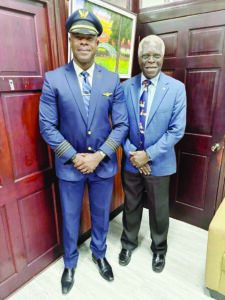
Tears flowing from his eyes at 35,000 feet was not something Captain Rawle Roberts expected. Yet, as the United Airlines Pilot guided his aircraft toward Guyana, cutting through the winds, something deeper was cutting through his heart.
It was the memories of the very land that he had left in June of 1989.
Captain Rawle Roberts, a Pilot with United Airlines and a retired member of the military, is Guyanese by birth. Having been away from Guyana for many years since the 90s, he recently returned, bringing with him a wealth of experience and a deep desire to give back to the land he still loves.
Born in Berbice at the old New Amsterdam Hospital, Roberts spent his early years immersed in the culture and community of the region. He attended St Mary’s Primary School, where his formative experiences were grounded in the traditions of Berbice.
He described himself as “a child of the river”, noting that the people who raised him – his cousins and sister – played a vital role in shaping who he is today. “I would be nowhere without their love, guidance, and support,” Roberts stated.
Speaking with this publication, Roberts revealed that although he migrated from Guyana at around 12 or 13 years old, returning has stirred up a vision in him – to share the secrets to success in the aviation industry with the upcoming generation of aspiring Guyanese Pilots.
Reflecting on his return, Roberts described the emotional impact, particularly when he glimpsed the Berbice River.
“I initially left the country in the early 90s. But for some reason, actually flying the aircraft back myself; with passengers and touching down, I got pretty emotional. I saw a picture in my cousin’s office of a place in the Berbice River that I hadn’t seen since the 1980s. That completely broke me down. It made me realise that I have a deeper connection to the land than I actually knew.”
He continued: “So yes, I do miss it, and I will be coming back periodically to help as much as I can – to donate my time, give lectures, and support young people coming up in aviation. I broke down crying in my cousin’s office because it was just a picture of the Berbice River. I recognised the place instantly. My sister asked, ‘Why are you crying?’ and I said, ‘I don’t know.’ It was a surreal feeling flying back home for the first time a few days ago.”
Roberts also shared that his fascination with aviation began much earlier in childhood while growing up in Block 40, Stanleytown, Berbice. He recalled playing in the streets, rolling a tyre with a stick, and looking up in awe at aeroplanes passing overhead.
A few years later, he experienced his first flight from what was then Timehri International Airport on Guyana Airways to New York City. From that moment on, he said he was hooked on aviation, describing it as the start of a lifelong passion.
Highlighting the demands of the profession to Guyanese Pilots, Roberts explained that becoming a Pilot requires intense dedication and discipline.
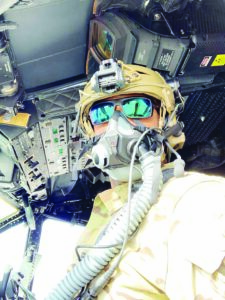
“A significant amount of studying started in the military. I was a military Pilot, with many hours of work, including combat hours in Iraq and Afghanistan, and I transitioned from flying helicopters to fixed-wing aircraft. The studying process is absolutely intense. Sometimes it gets to the point where you doubt yourself – ‘can I do this? Am I ever going to understand this?’ But you have to trust the process and invest the time.”
Overcoming Fear
Only recently in Guyana, a Pilot died after an Air Services Limited (ASL) aircraft reportedly crashed shortly after taking off from Mahdia, Region Eight (Potaro-Siparuni).
The single-engine Cessna aircraft, bearing registration number 8R-YAC, was being operated by a Nicaraguan national, Captain Ryder Castello, who had approximately 20 years of flying experience.
Roberts addressed the fears such incidents may create among aspiring Pilots. However, he dismissed discouragement by emphasising safety statistics and perspective, stating:
“There will be incidents, and sometimes you see headlines about aviation accidents, but when you look at the percentages, they are few and far between. For those who want to pursue aviation, stay focused. Ask for help – that is one of the biggest things I can say. Reach out to people who have been there and done that.”
He also highlighted the wide range of benefits that Pilots can achieve, using his journey as inspiration.
“It’s a hard road, but it’s rewarding. I had a chance to speak with Mr Egbert Fields about this, and I told him I’d be willing to donate as much time as possible to speak with young aspiring Pilots and show them that there is a way. Yes, it is difficult at times, but you have to trust the process and put in the work. If this is something you love, aviation is very rewarding – not just personally, but also financially for your family.”
Discover more from Guyana Times
Subscribe to get the latest posts sent to your email.