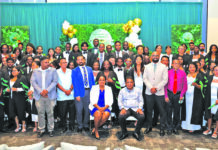
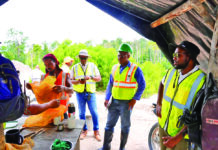
The Guyana-based Canadian-funded Justice Education Society (JES) project was praised for its contribution to the criminal justice system and Indigenous communities in Guyana. Director of Public Prosecutions (DPP) Shalimar Ali-Hack expressed delight at the impact of the project during the closing ceremony recently, marking the project’s achievements over the past ten years since JES commenced its operations. A Memorandum of Understanding (MoU) was signed between the Home of Affairs and the Global Affairs Department of the Government of Canada for the start-up of JES in 2022. The DPP recalled her first meeting with the officials from JES and highlighted the need for training for all parties within the criminal justice system, including investigators, prosecutors and the judiciary.
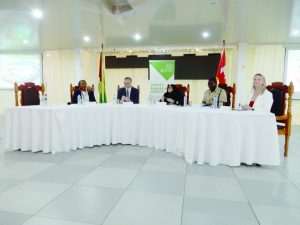
“When only one of these parties is trained, then we have difficulty with the others. I know that they would have found it strange that my request and recommendations were never only for the prosecutions…but prosecutions won’t be successful without good investigations and a judiciary that understands the law…I have seen improvements in the systems in the GPF (Guyana Police Force), including the recording of caution statements, the storage of exhibits, the Investigation Planning and Supervisory Forms, and the conduct of the investigations gained through the training.” In more tangible ways, JES has provided the GPF with storage containers to store exhibits; without these, the DPP noted that the prosecution would not have the exhibits in court because they could not be found by the Police or were damaged. She expressed her profound gratitude to JES for introducing and providing the recording equipment for taking caution statements.
“These two have made drastic improvements in the investigations and prosecutions of criminal charges.” In addition to the equipment, JES also provided the GPF and the Ministry of Health with sexual assault evidence collection kits called “rape kits”. Touching directly on the benefits to the judiciary, the DPP recalled the role played by former Chancellor of the Judiciary, Madam Justice Yonette Cummings, who was instrumental in implementing virtual courts to ensure speedier court hearings in the hinterland communities. Prior to this, the hinterland courts sat once or twice per month.
Throughout the past five years, the JES Project has also concentrated its programme on the improvement of Indigenous communities, mainly in Regions One to Nine, where community outreach meetings were held and the DPP’s office participated. Ali-Hack noted that because of these outreaches, there are improvements in Police responses to reports of crime in the Indigenous communities, and more importantly, that more crimes are now reported. “There are more reports than there used to be before the training started.
These are all tangible improvements I have seen, and I’m happy to have been a part of this justice improvement.” In keeping with its hallmark of “Strengthening Justice for Women, Girls and Indigenous People in Guyana”, Police ranks, teachers and health workers in Indigenous communities were trained on cultural sensitivity. JES’s country representative Lisa Thompson related that its focus was on supporting the institutionalisation of a trauma-informed, gender- and culturally sensitive approach to the application of justice for the Indigenous people and improving their knowledge of the laws in relation to Sexual and Gender-Based Violence (SGBV). Through JES’s support and partnership, the communities of Santa Rosa in Sub-Region One, the Macushi Research Unit at Bina Hill, North Rupununi, and the Wapichan Wizzi Women’s Movement in South Rupununi have been able to develop over 60 public education and information audio and video messages aimed at fighting SGBV.
These were done in Wapichan, Macushi and English and are used by various village councils, civil society and community advocates. Head of Development Cooperation at the Canadian Embassy Adam Loyer noted that since the implementation of the JES Project in 2022, his government was pleased to have contributed to the advancement of knowledge, both at the institutional and community levels, as it pertains to combating sexual and gender-based violence in Guyana. JES has trained over 2000 persons at community and institutional levels. Beneficiaries include 23 Judges, 20 Magistrates, 70 Police Prosecutors and State Counsel, and 550 Police Officers. While at the community level, JES worked in collaboration with 13 village councils and over 75 Indigenous communities in Regions One and Nine.
Discover more from Guyana Times
Subscribe to get the latest posts sent to your email.