


The Guyana Mining School and Training Centre Inc (GMSTCI) is continuing to expand and diversify its capacity-building programmes beyond traditional miner training, targeting critical skills gaps within Guyana’s mining and mineral exploration sectors through specialised training for university students and Amerindian communities.

The initiative is aimed at addressing the shortage of skilled labour with the practical competencies required by the industry.
Speaking in a telephone interview with this publication, GMSTCI Instructor, Garvin Douglas, explained that the institution is broadening its approach to capacity building by collaborating with the University of Guyana (UG) to ensure geology students graduate with not only theoretical knowledge but also practical, industry-relevant skills.
“The main thing is improving capacity,” Douglas said, explaining that the training is intended to bridge the gap between what students learn in the classroom and the technical skills they will need when they enter the workforce.
The GMSTCI also recently concluded a nine-day Community Mines Ranger Training in Kangaruma Village, Region Seven, with 10 participants successfully completing the programme, while its Prospecting for Gold Workshop for students of UG’s Applied and Exploration Geology Programme is scheduled to conclude with a practical field exercise next week.
The two initiatives form part of the institution’s continued efforts, under the auspices of the Ministry of Natural Resources and the Guyana Geology and Mines Commission (GGMC), to strengthen local human resource capacity and improve the technical competencies of persons entering or already working within the mining sector.
Organised by GMSTCI, with technical instruction in collaboration with the Geological Services Division of GGMC and support from the United Nations Development Programme (UNDP), the short course covers Map Reading and Navigation using GPS, QGIS and Prospecting.
Douglas explained that the Prospecting for Gold Workshop is a compilation of several individual courses offered by GMSTCI to different groups within the mining industry. Through the collaboration with UG, these courses are being combined to provide students with a broader range of practical skills before they enter the workforce.
“One of the key deficiencies of the mining sector is with regards to skilled labour, so we have essentially diverted our attention from not focusing only on miners, but in collaborating with the University so that when these students leave the geology programme, they’re not only filled with bookwork, they actually have tangible skills that are relevant to the industry,” he explained.
He noted that geology students receive considerable theoretical instruction at university but are not always exposed to the practical field procedures routinely required in mining and mineral exploration operations.
Everybody needs to know how to use a map
The collaboration is intended to ensure that students become familiar with industry practices before entering employment, rather than having to acquire all of these competencies through on-the-job training.
“In mining, everybody needs to know how to use a map, they need to know how to use a GPS. They need to know how to use GIS and they also need to know how to do prospecting. These are things that you don’t learn at the university, so our job is to come in and provide that training to fill that gap because the knowledge is needed,” Douglas stated.
The technical training, which commenced on July 1, 2026, and is scheduled to conclude on November 6, 2026, involves students from UG’s Associates and Bachelor’s Applied and Exploration Geology Programme.
Students have been receiving training in map interpretation, GPS navigation, Geographic Information Systems, geological field mapping, stream sediment sampling, gold panning, soil sampling and augering, rock sampling, and proper field sampling procedures.
Douglas said the intention is to give students opportunities to apply what they have learned in an actual field environment, where they can gain firsthand experience with the procedures and conditions associated with mineral exploration.
The programme’s practical component is scheduled to take place at Karrau, Region Seven, on November 2, where participants will undertake fieldwork involving geological observations, GPS navigation, prospecting and sampling.
During the exercise, students will collect actual samples, follow established field procedures and subsequently prepare a report based on their findings.
According to Douglas, this kind of exposure is particularly important in ensuring that graduates are better prepared to contribute to the sector from the time they enter the workplace.
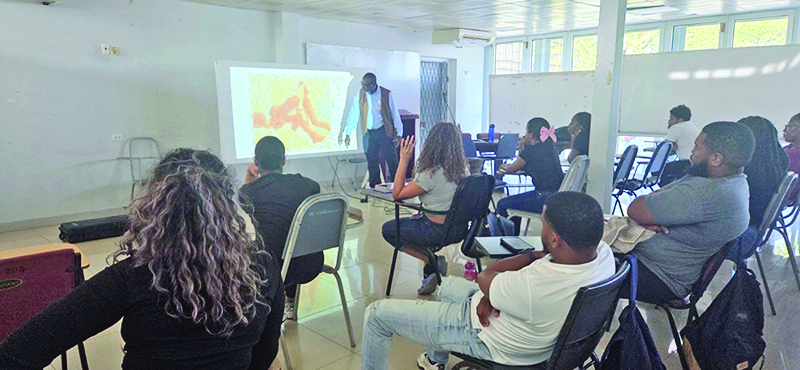
“That’s one of the main things that we’re trying to offer these students, which is actual field experience and exposure to the sector, which you typically don’t get currently at the university,” he said.
He added that the collaboration is expected to make students more confident in applying their academic knowledge, while equipping the mining industry with a pool of locally trained personnel possessing practical technical competencies.
Community Mines Ranger Training
Meanwhile, GMSTCI is also continuing its Community Mines Ranger Training, which targets Amerindian villages with titled lands where mining activities take place.
Douglas explained that these rangers serve as a link between their respective communities and GGMC, assisting mines officers with monitoring and reporting mining activities and ensuring that operations within titled Amerindian lands are conducted in accordance with the mining regulations.
He noted that Amerindian villages, through their Toshaos and village councils, have responsibilities for managing the resources within their titled lands. The Community Mines Ranger initiative therefore seeks to equip selected residents with the knowledge and skills needed to assist in overseeing mining activities within their communities.
The recently concluded training in Kangaruma ran for approximately nine days and involved 10 participants.
During the programme, participants received classroom instruction in map reading and GPS navigation, Occupational Safety and Health (OSH), and mining regulations. They subsequently applied their knowledge during a practical mine-site inspection at Merme Creek, Kangaruma.
The exercise also involved reviewing relevant mining documents, including licences, permits and operational records associated with mining activities on the community’s Amerindian titled lands.
Douglas explained that the training is intended to prepare residents to function effectively as Community Mines Rangers, assisting GGMC’s mines officers in monitoring activities and reporting any matters relating to compliance with mining regulations.
The programmes, he noted, are part of GMSTCI’s wider approach to ensuring that capacity building within the mining sector reaches beyond miners to include university students and communities with direct responsibilities for managing natural resources.
He further disclosed that the institution’s training programmes are offered free of cost, with the Government covering the expenses. Participants who successfully complete the programmes also receive certificates signed by the Commission.
Established in 2012 under the Companies Act, GMSTCI is wholly owned by GGMC, and operates under the auspices of the Ministry of Natural Resources through the Commission. The institution was publicly launched on August 15, 2013, at the Guyana Forestry Commission Training Annex.
Through its continued training initiatives, GMSTCI is seeking to strengthen the availability of skilled Guyanese personnel, improve practical competencies and address labour deficiencies across different areas of the mining industry.
Discover more from Guyana Times
Subscribe to get the latest posts sent to your email.