

With sweeping powers to ensure transparency, accountability and reform, a high-level five-member panel was named by President Dr Irfaan Ali on Sunday to lead the Commission of Inquiry (CoI) into the MV Barima tragedy, which occurred on Saturday, July 18, 2026. The appointment of this distinguished team of regional and international legal and maritime experts was made under Section 2(1) of the Commissions of Inquiry Act and is in keeping with an earlier commitment by the Guyanese Head of State for an independent probe into horrific ferry accident.
Among those appointed is former Belizean Justice of Appeal and distinguished legal expert, Godfrey Phillip Smith, who has been selected to head the CoI. Smith currently serves as the CARICOM High-Level Representative for Law and Criminal Justice and is the Ad Hoc Justice of Appeal at the Eastern Caribbean Court of Appeal. He is also a partner at ByronSmith, Arbitrators & Litigation Support Services (St Lucia) and Senior Partner at Marine Parade Chambers, LLP, Attorneys-at-Law. 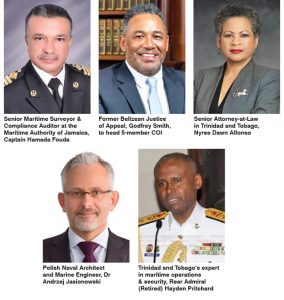
The former High Court Judge previously served as one of the commissioners who examined the turbulent events of Guyana’s 2020 General and Regional elections. Also appointed on the Commission is Captain Hamada Fouda, an internationally respected maritime safety specialist with more than 35 years of experience in marine regulation and casualty investigations. Captain Fouda specialises in marine casualty investigations, vessel safety and international maritime compliance. Since 2019, he has led investigations into marine accidents under the International Maritime Organisation (IMO) Casualty Investigation Code, identifying causes and recommending measures to prevent future incidents. His expertise will support the Commission of Inquiry as it examines the circumstances surrounding the MV Barima tragedy and develops recommendations to strengthen maritime safety. Meanwhile, Trinidad and Tobago Senior Attorney-at-Law, Nyree Dawn Alfonso, was also appointed to sit on the Commission that will probe the recent ferry accident.
Alfonso is the Managing Partner of N.D. Alfonso & Co. and brings more than 36 years of experience in commercial, maritime, insurance and public law. She is admitted to practice in Trinidad and Tobago, Guyana, Grenada, St Lucia and the Eastern Caribbean Supreme Court (St Kitts and Nevis). Widely recognised for her expertise in Admiralty and Maritime Law, Alfonso has represented clients in complex ship arrests, maritime disputes, salvage operations, collisions, marine casualty claims, marine insurance matters and arbitrations. She has also advised international shipowners, insurers, Protection and Indemnity (P&I) Clubs and the Government of Trinidad and Tobago on maritime matters. The high-level CoI panel also includes Dr Andrzej Jasionowski, a forensic naval architecture and marine engineering expert, out of Poland. Dr Jasionowski holds a PhD in damaged vessel hydrodynamics from the University of Strathclyde, United Kingdom (UK), awarded in 2002. He has specialised since 1995 in the application of advanced numerical techniques for stability, hydrodynamics, oil film lubrication, thermodynamics of liquefied natural gas (LNG) mixtures, ship flooding simulations, probabilistic assessments of time to sink and capsize, holistic risk quantification, and shaft alignment. According to his CV, he routinely applies the finite element method (FEM), Lagrange collocation (LC), boundary element method (BEM), and non-uniform rational B-spline (NURBS) collocation methods to the forensic analysis of collisions, groundings, unsafe ports, elasto-thermo-hydrodynamic assessments of design defects, and complex cryogenic cargo operations.
He also advised on new building and other disputes regarding ship weight, fuel oil consumption, shaft alignment, stern tube (journal) bearing failures, cranes (slewing) bearing failures, structural integrity impairments, propulsion, stability, ship capacity, unsafe ports, LNG boil off and heat losses. In addition, decorated Trinidad and Tobago Rear Admiral (RADM) Hayden A Pritchard, has also been named to serve on the Commission.
Pritchard is a retired military professional with over 38 years of experience in security and maritime operations, policy development, change management and public and security sector reform. He is also renowned for his experience in maritime safety, logistics, port and ship development and personnel management. He ended his military career as Chief of Defence Staff, head of his country’s military. The Rear Admiral is also well recognised for leading successful projects in port and maritime operations, security organisational development, ship design, business continuity and crisis management. According to President Ali during his announcement of this distinguished panel on Sunday, the necessary legal instruments required to give effect to this decision are currently being formalised. Upon completion, he said the Commission will commence its work in accordance with the provisions of the law.
The Commission will have to determine its own procedures and methods of work consistent with its mandate. “The terms of reference of the Commission of Inquiry will be establishing the full circumstances surrounding the tragedy, including the causes and all other factors relating to the loading of the vessel, the boarding of passengers, conditions on board, the capsizing and sinking of the MV Barima, and any other related matters,” the Head of State said.
The team will also be comprehensively reviewing all aspects of the search, rescue, and recovery operations, including the adequacy, coordination and effectiveness of the response by all agencies and stakeholders involved. They will also have to evaluate the extent to which applicable laws, regulations, standards and operating procedures governing ferries were complied with, while further determine whether any acts of negligence, misconduct, dereliction of duty, or other failures by any individual, entity, or institution contributed to or caused the disaster. Moreover, the Commissioners will be tasked with inspecting the condition and maintenance history of the vessel, including its seaworthiness, analysing the influence of weather, sea conditions, tides, currents, navigation, communications and other environmental or operational factors that may have contributed to the incident. Further, they will have to appraise the competence, qualification, training and conduct of the vessel’s master and crew, including compliance with established maritime safety and emergency procedures. The five-member team will also have to scrutinise passenger management, including embarkation procedures, manifest preparation, the possible overcrowding of the vessel, the stowage of cargo, availability and use of life-saving equipment and adherence to passenger safety requirements. At the end of their investigation, the Commissioners will recommend any legislative, regulatory, institutional, and operational reforms, together with any other measures, necessary to strengthen maritime safety, improve emergency preparedness and response and reduce the likelihood of similar tragedies occurring in the future. MV Barima was en route to Port Kaituma, Region One (Barima-Waini) with 179 people onboard, when it capsized and sank off the Essequibo Coast in Region Two (Pomeroon-Supenaam).
While at least 76 persons survived the horrific boat accident, 73 persons have been confirmed dead and another 30 still missing. Search and recovery operations are continuing to locate those persons still unaccounted for and move the sunken ferry, which is lying on the seabed some nine miles off the Essequibo Coast, closer to shore so that divers can better access inside the vessel.
Discover more from Guyana Times
Subscribe to get the latest posts sent to your email.