

…says “it’s totally dark”, navigating by touch
As the search and recovery operation continued offshore, where MV Barima sank after capsizing with 179 people onboard last weekend, the French divers who have been supporting local efforts say the harsh conditions in the Atlantic are making it difficult to navigate the wreckage. Since they arrived in Guyana on Monday, the team from the French Guiana Army has executed approximately 15 diving operations to the sunken vessel, which is lying on its side on the seabed about nine miles off the Essequibo Coast in Region Two (Pomeroon-Supenaam). The ferry was located two days after capsizing by local fishermen and later confirmed by authorities. So far, 76 persons have been rescued and 73 bodies recovered, while 30 persons are still unaccounted for. Updating anxious family members, who have gathered at Charity on the Essequibo Coast since last week to await news of their missing loved ones, the French divers explained that the weather and the environmental conditions are making it dangerous for them to get into the sunken ferry.
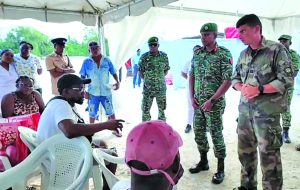
“There are very, very hard environmental conditions, especially because of the tide and the currents. On the wreck, it’s totally dark, so it’s very difficult for us to navigate through the wreck. We have to feel the wreck, and it’s like we are blind. So, it’s too dangerous for us to enter into the wreck. And because of the many ropes and the hammocks, it’s very difficult to see where we are going,” one of the divers recently told the families. Since last week, the technical teams, both local and foreign, have been trying to reposition the vessel. The aim is to get the ferry into a floating position in order to bring it closer to shore so that the divers can safely get inside with the hopes of recovering those missing persons.
Rough Atlantic conditions
This publication understands that the divers, both local and foreign, managed to successfully attach cables and ropes to the sunken ferry on Wednesday. However, those closely involved in the recovery operation explained that when they tried to pull the vessel, the cables and ropes kept bursting. Despite the rough Atlantic conditions and some divers even becoming sick, the teams are still continuing their efforts to both move the vessel as well as enter the wreckage. “So, there was a rope on the wreck. We just followed the rope, arrived on the wreck and tried to navigate by searching the characteristics of the wreck. So, we were able to follow the lines of the wreck and try to feel if there was a door or window or hammocks or whatever. [But] it’s quite in the mud. It’s totally dark, so it’s very, very difficult to search for something,” the French diver explained. Only a few days ago, President Dr Irfaan Ali, who had been on the ground in Charity all last week, informed families that if efforts to right the sunken vessel into a floating position failed, then a decision would have to be made on salvaging the wreck. This, he pointed out, however, is a last resort. “The other option, which we don’t want to get to and we’re trying to avoid as far as possible – and that would have to be discussed with family members – is to try for a full salvage of the vessel. That has the challenge of disrupting whatever is there. But we’re hopeful that we don’t get to that [stage]. If we get to that, all of us together will have to make a decision as to the best option [forward],” the Guyanese leader had indicated to relatives last week.
However, during the recent briefing, the families enquired from the French divers about the possibility of salvaging the ship. In response, the lead diver from the foreign team related that, “It’s very, very hard to do such a thing… I think it’s very difficult because the wreck is not very strong, so it’s difficult to take it.” A part from the French Guiana Army, Guyana is also receiving support from other regional partners, including the Brazilian navy, and the Trinidad and Tobago Coast Guard, which have deployed maritime assets and personnel to aid in recovering efforts.
Emergency response operation
Only Friday, Prime Minster (PM) Brigadier (Ret’d) Mark Phillips, who is leading the Guyana Government emergency response operation, indicated that these recovery efforts will continue “for as long as necessary” to not only bring closure to those grieving families but also to show dignity and respect to the 30 persons who perished in the tragedy and are still unaccounted for. Asked on Saturday how long the foreign teams will remain here to support this recovery mission, the PM told the Guyana Times that there was no timeline set for their stays here. “They didn’t say how long they are here for, but I guess at some stage, we’ll have a meeting and we’ll have to decide…when we’ll stop or [when] the involvement of the foreign teams will stop. So, they’re still here, and they’re still diving,” Phillips had related.
The MV Barima departed the Georgetown stelling at about 15:00h on Saturday, July 18, on its scheduled voyage to Port Kaituma, Region One (Barima-Waini) carrying 179 persons, including 18 crew members and cargo. According to officials, the vessel encountered rough sea conditions off the Essequibo Coast near the mouth of the Pomeroon River late that night. Survivors have recalled that the ferry began tilting to one side before capsizing, throwing passengers into the water in less than a minute. A distress signal transmitted at approximately 23:01h was received by aviation authorities, triggering a large-scale multi-agency emergency response that still continues. Addressing concerns raised in the aftermath of the disaster, blood samples were taken from the captain and crew members for testing. Authorities released the results showing positive tests for cannabis and subsequently arrested the captain and two crew members. Another official from the Transport and Harbours Department (T&HD), which manages ferry services, was also detained as part of the police investigation. Subsequently, the Government, in its initial probe into the issue, uncovered that more people were aboard the vessel than had been recorded on the original passenger manifest. That information, along with the manifest, was immediately made public and resulted in several managers at the T&HD being sent off on suspension. Meanwhile, in keeping with an earlier commitment for an independent probe, President Ali has named a five-member distinguished panel to lead the Commission of Inquiry (CoI) into the MV Barima tragedy.
Discover more from Guyana Times
Subscribe to get the latest posts sent to your email.