


As stakeholders continue preparing young people for opportunities in Guyana’s new and emerging sectors, Chairperson of the Board of Industrial Training (BIT), Kathy Smith, has urged them to recognise that academic qualifications alone are not enough.
In fact, she emphasised the importance of equipping young people with critical problem-solving abilities, teamwork skills, and other workplace competencies needed to succeed in today’s evolving job market.
“Employers consistently say to me that qualifications alone are not enough when they’re hiring persons. Madam Chair mentioned to you that I’m a leader in the Private Sector. I chair one of the oldest Private Sector organisations in Guyana, and employers are saying this to me: that qualification alone is not what is needed,” Smith, who is also the President of the Georgetown Chamber of Commerce and Industry (GCCI), expressed last week while addressing participants of the National Youth Skills Forum hosted by the Ministry of Labour and Manpower Planning.
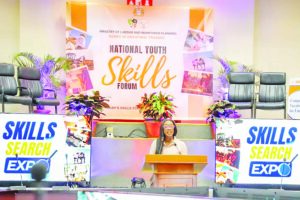
“They want the people to communicate effectively. They want them to communicate with confidence. You now have to learn how to do that. You have to listen more than you talk. You have to be willing to ask yourself, ‘Am I in the right room? Am I in the right space? Do I have the right set of people around me?’… So employers want you to communicate. They want you to use your voice. Some of you can start thinking about toastmasters,” she encouraged.
Smith also noted that employers want employees who can work in teams.
“A lot of you want to get ahead, but somebody said to you, ‘You have to get ahead by yourself.’ Not so, not so. Guyanese, young Guyanese, start learning how to work in a team. Start pulling yourself together with one common goal, whatever you want to achieve,” she noted.
The GCCI President added that employers want workers who are capable of solving problems.
“I say to myself, ‘I do not pay them because they come to work 8am and leave 4:30pm. I pay them because of the value that they’re adding to my company, the problems that they’re solving.’ So, try and start learning how to solve problems. That would be one of the biggest assets for you when you get into employment,” she emphasised.
Digital Skills
Moreover, the Private Sector leader informed the young attendees that as they pursue higher education, they must understand that digital skills are no longer optional in today’s job market.
“A lot of you would go and do the business administration, communication, and all those things you’re thinking about. Engineering and all of those things. But you’ve got to take into consideration that there is a movement and that movement is affecting all of us. AI. Digital transformation. Digital literacy is now a core workplace skill. Whether in construction, we see contractors are using it. I myself am a contractor, and if you call me to say you have an issue with your concrete, I just don’t want to look at the concrete anymore. I have a machine that I can push into the concrete to tell the moisture level of the concrete. So no longer am I just going there and winging the assessment. So digital technology is being used all over,” Smith highlighted.
She further pointed to opportunities in digital technology being created across all sectors of the economy.
“Healthcare, agriculture, manufacturing, finance, technology, everyday work, and digital transformation are needed. So, I want you, young people, when you get into programmes, just not to look at it as a by-the-way programme. I want you to focus on digital transformation,” the BIT Chairperson urged.
“If you look at what the Government of Guyana is doing, they’re building one of the largest data centres within the Western Hemisphere. All of that would need your help once you focus on a digital transformation,” she further noted, adding that the green economy is also creating new employment opportunities.
“It’s already creating jobs in Guyana. Renewable energy… Electrical vehicles. You have seen that around. environmental management. Sustainable construction. All those fall within the green economy,” she explained.
Once-in-a-generation
Emphasising that Guyana is undergoing a “once-in-a-generation transformation”, Smith further noted that BIT will continue to adapt its programmes to keep pace with the country’s rapidly changing economic landscape.
“BIT exists to bridge the gap between skills and employment. So, our ambition at the Board of Industrial Training is not simply to reduce that gap, but ultimately to eliminate that gap. So, what is that gap? Again, skills and employment. Skills and employment. What Guyana is going through is unprecedented. We are accustomed to the agriculture sector, the construction sector, and the mining sector. Now there’s a sector called the oil and gas. Guyanese didn’t have the capacity nor the experience. So, organisations like the Board of Industrial Training see it fit to push programmes that can propel you into oil and gas when you want to go there. Because I know you are talking about the money that oil and gas have, right? So, we are continuously improving our programmes to better align with the needs of employers and the future of work,” the BIT Chairperson noted.
Discover more from Guyana Times
Subscribe to get the latest posts sent to your email.