


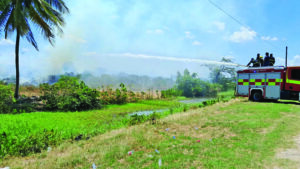
Grass fires across Regions Five (Mahaica-Berbice) and Six (East Berbice-Corentyne) have surged by a staggering 469 per cent during the first nine months of 2026, with the Guyana Fire Service (GFS) warning that unattended burning, particularly on agricultural lands and open fields, continues to pose a serious threat to communities, buildings and motorists.
The alarming increase comes as Guyana observes Fire Prevention Month, with firefighters intensifying their public awarene

ss campaign amid a sharp rise in emergency calls across the two regions.
Statistics provided by the GFS revealed that 256 grass fires were recorded between January and September this year, compared with just 45 during the corresponding period in 2025, an increase of 211 incidents.
Overall fire calls almost doubled, climbing from 264 during the first nine months of 2025 to 532 for the corresponding period this year, representing an increase of 102 per cent.
Divisional Fire Officer Clive McDonald, whose division covers Regions Five and Six, has expressed concern over the frequency of grass fires, attributing many of the incidents to persons setting vegetation alight and subsequently leaving the fires unattended.
During an interview with the Guyana Times on Saturday, McDonald explained that firefighters have been responding to numerous grass fires, with hot, dry conditions adding to the challenges confronting the Fire Service. He explained that some of the fires originate on agricultural lands, particularly rice fields, where farmers burn vegetation in preparation for cultivation. However, these fires sometimes spread beyond their intended boundaries, engulfing neighbouring fields and threatening nearby communities.
McDonald further added that what residents commonly describe as wildfires are often grass fires that have spread across open lands. While some occur in remote areas where they pose little immediate danger to life or property, others spread towards populated communities, forcing firefighters to intervene.
He noted that smoke from burning vegetation can create dangerous conditions for motorists when it drifts across public roads, significantly reducing visibility.
According to him, some grass fires have also threatened buildings, including schools along the Corentyne Coast, although firefighters were able to intervene and prevent the flames from spreading to those structures.
As such, he stressed that residents must exercise greater responsibility when burning vegetation, warning that fires can quickly spread beyond their intended boundaries and endanger surrounding areas. The Fire Officer also explained that firefighters sometimes employ specialised techniques, including counter-firing, to contain fires in open areas. However, he cautioned members of the public against attempting such techniques, explaining that they require professional knowledge and an understanding of factors such as wind direction and fire behaviour.
Garbage Fires
Meanwhile, the statistics reveal a significant increase in rubbish fires, which climbed from 63 during the January-to-September period in 2025 to 92 this year, representing an increase of 46 per cent.
In contrast, the number of house fires remained relatively stable, with 68 recorded during the first nine months of 2026, compared with 67 during the corresponding period last year.
Despite the dramatic increase in grass fires and overall fire calls, the number of persons left homeless as a result of fires declined considerably.
According to the figures, 41 persons were left homeless between January and September this year, compared with 105 during the corresponding period in 2025, representing a reduction of 61 per cent.
Nevertheless, property damage remains a concern. The GFS also recorded 46 properties as completely damaged during the first nine months of 2026, compared with 49 during the corresponding period last year.
An additional 12 properties were classified as severely damaged this year, compared with 18 in 2025, while 37 sustained slight damage, up from 33 last year. The statistics also recorded one death during the first nine months of 2026.
Another significant development highlighted by the figures is the substantial increase in fires classified as deliberately set. A total of 344 such fires were recorded between January and September this year, compared with 109 during the corresponding period last year, representing an increase of 216 per cent.
Fires classified as malicious also increased, moving from 32 in 2025 to 46 this year, an increase of 44 per cent.
The Fire Service records deliberate and malicious fires as separate categories, with the former not necessarily indicating an intention to cause destruction.
McDonald also expressed concern about fires at abandoned buildings, where persons sometimes enter to remove materials. He explained that some individuals frequent abandoned structures to extract copper from electrical wiring, using fire to burn away the insulation.
According to the Fire Officer, these activities can result in fires being left unattended, creating the potential for flames to spread throughout the structures. He urged residents to remain vigilant whenever suspicious activities are observed around abandoned properties and to report such occurrences to the Fire Service.
Public Cooperation
Against this backdrop, the Fire Service is intensifying its prevention activities throughout October, seeking greater public cooperation in reducing the number of incidents. This year’s Fire Prevention Month campaign places particular emphasis on the safe charging of electronic devices, especially those powered by lithium-ion batteries.
McDonald explained that these batteries, commonly found in mobile phones and other rechargeable equipment, can pose fire hazards when improperly charged or used contrary to manufacturers’ specifications.
He warned that overheating can trigger a phenomenon known as thermal runaway, during which a battery can generate intense heat and potentially ignite.
With rechargeable electronic devices now forming an integral part of everyday life, he stressed the importance of following recommended charging practices and exercising caution when handling such equipment.
However, McDonald emphasised that fire prevention extends beyond electrical safety and requires a collective effort involving Government agencies, communities and individual citizens. He explained that the Fire Service cannot effectively prevent fires without the cooperation of the public, particularly in communities where agricultural burning and the disposal of rubbish by fire remain common practices.
The Divisional Fire Officer said firefighters are intensifying their public education efforts throughout Regions Five and Six, encouraging residents to adopt safer practices and report potentially dangerous situations.
McDonald stressed that preventing fires cannot be the responsibility of firefighters alone, reminding residents that “fire prevention is everybody’s business.” (Andrew Carmichael)
Discover more from Guyana Times
Subscribe to get the latest posts sent to your email.