

…immigration services continue as “back track” passenger traffic spikes
Days after the suspension of the ferry service between Guyana and Suriname, the Government of Guyana stated on Tuesday that the proposal for an alternative vessel to operate the route was turned down by the Maritime Authority in Suriname (MAS).
Although rejected, the Guyanese Government is seeking to propose another alternative vessel to the Surinamese authorities, even as engagements continue simultaneously with MAS to ensure the current service can resume, even on a short-term basis.
On this note, the Government added that officials have been in constant daily contact with their Surinamese counterparts to resolve the issue. However, the immigration service is still being provided to persons travelling to Suriname by small boats.
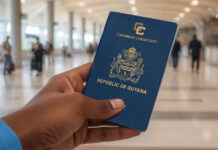
Such persons, according to a missive, are required to report to the immigration office at the Moleson Creek Terminal for immigration processing upon departure.
“Upon arrival in Suriname, they are required to report to the Immigration Office in New Nickerie. When departing Suriname, persons must report to the respective immigration offices,” the release added.
The Government, nevertheless, reiterated that the responsibility for maintenance and drydocking of the MV Canawaima falls under Suriname.
In light of this, over the past days, two technical inspections were carried out by maritime experts from both Guyana and Suriname on the MV Canawaima.
“Both countries’ experts concluded that the vessel can remain in operation until it goes into drydock within the next three months. Despite these assurances provided in writing, the Maritime Authority in Suriname (MAS) insisted that certain matters which would have been addressed during drydocking should be undertaken immediately,” the Government added.
The Government of Guyana supports the safe travel of the public and maintains that public safety is a priority while adding that the inconvenience this situation is causing to users of the service is fully understood.
Meanwhile, one of the difficulties which initially confronted passengers seeking an alternative way across the Corentyne River was the absence of an arrangement on the Surinamese side to facilitate immigration processing for persons using the small-boat service.
That resulted in passengers becoming stranded at Moleson Creek on Saturday, including travellers who were attempting to return to French Guiana through Suriname.
Some said they had been unable to continue their journeys because, although small boats were available to take them across the river, there was no arrangement in place for them to complete the required immigration procedures.
However, on Monday, authorities in Suriname gave the go-ahead for an arrangement to facilitate those travellers. Since then, passengers have been able to have their travel documents processed at the official ports before using the small boats to cross the Corentyne River and continue their journeys between Guyana and Suriname.
The Springlands–Nickerie route, commonly referred to as the “back track”, has three operators using speedboats to transport passengers across the river.
With the Canawaima out of operation and the immigration arrangement now in place, operators say passenger traffic on the route has increased significantly.
Owner of Golden Gloves Boat Service, Muhammed Murcalin, said the situation has returned to some level of normalcy following the introduction of the immigration arrangement.
“Since the ferry breakdown, or the closure of the ferry, we get fluctuating passengers, which is something very good the Government introduced to get the people stamped, because the people were stranded for a couple of days without food, without a place to sleep, money ran out and every single thing,” Murcalin explained.
He said operators had assisted several stranded passengers, but before the new arrangement, persons who crossed the river still faced the difficulty of having to return to complete immigration procedures.
“We do a lot of assistance. We assisted a lot of people to get over to Suriname, but they had to come back and get stamped. But things work in a normal position now. The situation gets normal,” he said.
According to Murcalin, close to 200 passengers are now travelling back and forth across the river daily, compared with fewer than 120 when the ferry was operating.
He estimated that about seven trips are made from the location on an average day, although boats do not necessarily have to be filled before leaving. “Sometimes you get a full boatload, a half boatload. But the moment you come with your wife or two members of the family, you charter the boat and go,” the operator explained.
Murcalin said there is no rigid fare being applied to every passenger, particularly given the circumstances in which some travellers found themselves after the ferry service was suspended. “Most of the time, you charge $5,000. But some people get $4,000, $3,500. They accept it because they don’t have any more,” he said.
He also noted that there is currently a greater flow of passengers coming into Guyana, which he attributed in part to the school vacation period in Suriname and families travelling during the break.
The increased use of the small-boat service comes as Guyana and Suriname continue efforts to resolve the disruption to the regular ferry link.
While the immigration arrangement has provided an alternative for passengers, the MV Canawaima remains out of operation, with Guyana now seeking to put forward another alternative vessel after its first proposal was rejected by the Surinamese maritime authorities.
Meanwhile, on Monday, the Suriname-Guyana Chamber of Commerce said the disruption is affecting passengers, businesses, transport operators and the movement of goods between Guyana and Suriname and has renewed concerns about the reliability of the critical cross-border link.
Discover more from Guyana Times
Subscribe to get the latest posts sent to your email.