
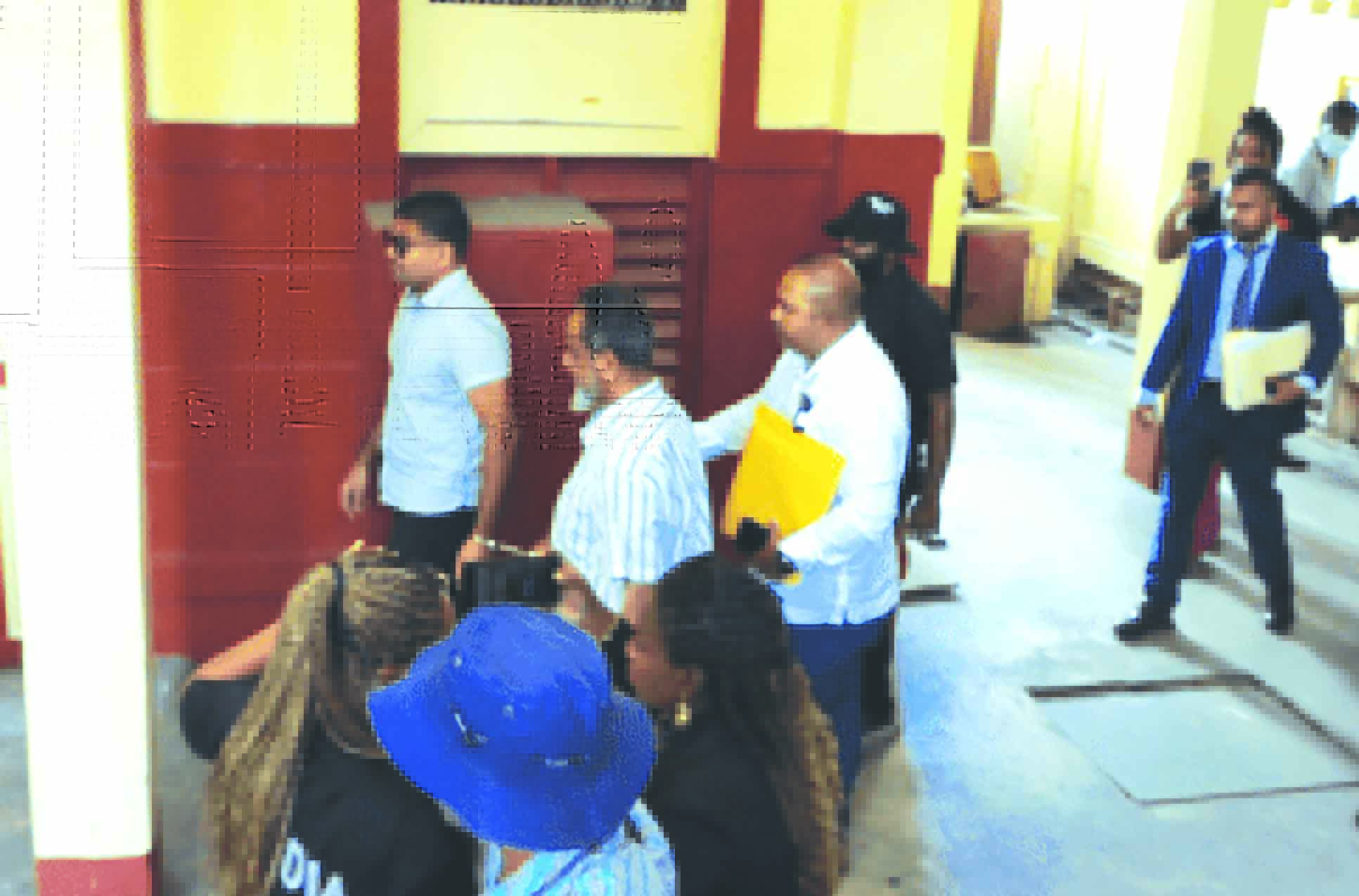
The extradition proceedings involving United States (US)-indicted businessmen, Nazar Mohamed and Azruddin Mohamed, returned to the Georgetown Magistrates’ Courts on Monday, before Magistrate Judy Latchman. In court, the father and son duo’s legal team pressed ahead with a constitutional challenge to the recent amendments to the Fugitive Offenders Act. The defence argued that the legislative changes are unconstitutional, contending that they infringe upon the Mohameds’ right to liberty and undermine their ability to access a fair and impartial legal process. Their attorneys have formally asked that the constitutional issues be transferred to the High Court for a definitive ruling. Magistrate Latchman has set Wednesday, December 10, for delivering her decision. However, according to Prosecutor Terrence Williams, the constitutional challenge mounted by the father-son duo against recent amendments to Guyana’s extradition laws is “frivolous and vexatious”. “The main argument was that the constitutional issues do not arise for the consideration of the law of Magistrate. The application is frivolous and vexatious because, first of all, there are no real constitutional issues and they certainly do not arise for consideration at this time. First, because many of these rights which they rely on expressly exclude extradition from consideration and also because the Magistrate has a certain duty to perform and the duty that she has to perform does not include the considerations that the defendants have raised,” Williams said. The argument for the Mohameds is the legality of Guyana’s 2009 amendments to the Fugitive Offenders Act. “Well, after Parliament passed the amendment to reaffirm the decision of the Court of Appeal in King and Justice Barlow’s decision in Marvin Williams is the first and, as far as we know, on the pronouncement on the amendment. It itself reaffirmed what the Court of Appeal had previously said in King. So it was important for us to put that before the Court. Well, it is that the defendants raised an issue which would not normally have arisen in an extradition proceeding before the Magistrate. In fact, they raised it to the press and not to the court. And so, we heard about it and so we were able to provide a diplomatic note which dealt with that issue,” the prosecutor said.
Diplomatic note/ re-extradited to a third country
The diplomatic note issue referred to by the prosecutor was later explained by Attorney General (AG) and Legal Affairs Minister, Anil Nandlall. In an interview broadcasted by Newsroom on Monday, Nandlall explained that the defence’s claims regarding constitutional breaches and an allegedly “deficient” extradition treaty with the US have already been conclusively rejected by Guyana’s courts.
“The very deficiencies that they are saying that our treaty has, those two Court of Appeal rulings examined the very argument at the very contentions and ruled that the treaty has no such deficiencies. This is a 1935 treaty. The two decisions I am referring to were given over 30 years ago. And we have been extraditing people to the US over the last 30 years on a regular basis, using the same treaty, because we have two decisions of the Court saying that the treaty is not deficient as they are now alleging. The point I am making is that none of the arguments are new. They are well-trodden paths that we have traveled before and we have rulings coming from higher courts which rulings are binding on the Magistrate,” the AG explained.
Further, Nandlall revealed that the defence claimed the treaty lacked a safeguard preventing the Mohameds from being tried in the US for offences other than those for which they are extradited or from being re-extradited to a third country.
The AG debunked such claims, noting that the treaty already provides such safeguards, a position affirmed by the Court of Appeal. But out of caution, Guyana sought and received a written diplomatic assurance from the US. “Out of an abundance of caution and to put their fears at rest, right, and not to embark on unnecessary long litigation, we got from the US an assurance in writing that should these people be extradited, they will not be tried for offences other than that for which they have been extradited. Neither would they be extradited to a third state without the permission of the Government of Guyana because that is what they are complaining about. And in order to offer them due process, to allay their fears, and to avoid unnecessary argumentation and unnecessary litigation, though we don’t need it, the Americans have given the assurance. That removes the foundation from their complaint because that in essence is the only thing they have complained about in substance,” he added. The Mohameds remain $150,000 bail each as the case continues.
Indicted by US grand jury
The father-son duo, who are now fighting their extradition, have been indicted by a grand jury in the US District Court for the Southern District of Florida on 11 criminal charges ranging from wire fraud, mail fraud and money laundering, primarily connected to the export of gold to the US by their company, Mohamed’s Enterprises. The Mohameds are accused of conspiring to defraud the US and Guyanese Governments between 2017 and June 11, 2024. The father-son duo is accused of using a scheme to unlawfully obtain property by transmitting communications via interstate and foreign commerce in violation of US laws.
According to the US prosecutors, the goal was to enrich themselves and defraud the Government of Guyana by evading taxes and royalties on gold exports. They allegedly reused Guyana customs declarations and official seals on multiple shipments to make it appear that taxes and royalties had been paid when they had not. The indictment stated that Mohamed’s Enterprise would pay taxes and receive official Guyana Revenue Authority (GRA) and Guyana Gold Board (GGB) seals for one shipment, then reuse those same seals and documents on subsequent, untaxed shipments. The indictment further alleges that the Mohameds arranged for empty wooden boxes bearing intact GRA and GGB seals to be shipped from gold buyers in Dubai to Miami and then sent to Guyana. These boxes were then used to export gold while falsely appearing to have cleared customs and tax obligations. US authorities allege the scheme resulted in more than US$50 million in lost taxes and royalties to the Government of Guyana. Additional indictments detail similar conduct involving shipments of gold, emails allegedly from Nazar Mohamed requesting the sealed boxes from Miami, and exports of over 165-kilograms (kg) of gold per shipment destined for Dubai. Charges six to nine focus on mail fraud, referencing the shipment of sealed empty boxes from Dubai to Miami, while charge 10 addresses money laundering, which alleges that the Mohameds knowingly transferred funds within the US with the intent to promote unlawful activity. The other charge has to do with Azruddin Mohamed purchasing and importing a Lamborghini sports car to Guyana in 2020. The indictment alleges he directed someone to purchase the car for US$680,000, then falsify the invoice to state a value of US$75,300 to understate import taxes. The US Government is seeking forfeiture of certain assets connected to the accused. If convicted, most charges carry a maximum sentence of 20 years in prison and fines of up to US$250,000, while the money laundering charge carries a fine of US$500,000 or the value of the laundered property. The indictment follows sanctions imposed over a year ago by the US Government on the Mohameds, their businesses and Guyanese Government Permanent Secretary (PS) Mae Thomas in relation to the same allegations. The sanctions are related to the evasion of taxes on gold exports, with the Office of Foreign Assets Control (OFAC) noting that between 2019 and 2023, Mohamed’s Enterprise omitted more than 10,000-kg of gold from import and export declarations and avoided paying more than US$50 million in duty taxes to the Government of Guyana. Since the imposition of the sanctions, the Guyana Government had suspended the licences of the Mohameds’ various businesses, highlighting that the US-sanctioned businessman is a risk and a threat to Guyana’s financial stability, sovereignty and diplomacy. Subsequently, several Government entities and local businesses, including commercial banks, have cut ties with the Mohameds.
Discover more from Guyana Times
Subscribe to get the latest posts sent to your email.