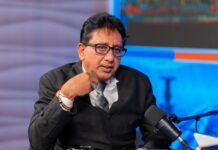


Senior Superintendent of Police Prem Narine on Monday denied that President Dr Irfaan Ali or anyone acting on his behalf instructed him to monitor United States (US) sanctioned and indicted, Azruddin Mohamed, as Defence Attorney Siand Dhurjon pressed the Special Branch Unit head over alleged political surveillance. The extradition case involving the US-sanctioned man and his father, Nazar Mohamed, is ongoing before Chief Magistrate Judy Latchman at the Georgetown Magistrates’ Courts. Under sustained questioning, Narine rejected a series of suggestions that the police had been used to monitor the Mohamed family because of their political activities. Dhurjon specifically put to Narine that he had been instructed by President Ali to keep Mohamed under surveillance. “That is not true,” Narine replied. When asked whether the instruction had begun in 2024, Narine again rejected the suggestion.
“That’s not true.” The exchanges came after Dhurjon sought to establish whether Narine’s relationship with the President and his professional advancement under the People’s Progressive Party/Civic (PPP/C) Government could have influenced his handling of matters involving the Mohameds. Prosecutor Herbert McKenzie repeatedly objected to that line of questioning, arguing that several of the issues raised by the defence were irrelevant to the extradition proceedings. Dhurjon had questioned Narine about his interactions with President Ali, including whether the two men had met at police functions and at a masjid in Queenstown. Narine said that he had encountered Dr Ali at police functions since he became President, estimating that such encounters occurred two or three times a year. He also confirmed that he had seen the President at the Queenstown Masjid, but rejected the suggestion that he frequently conversed with the President there.
McKenzie objected to the questions about the mosque, while Dhurjon argued that the relationship was relevant to the credibility and conduct of the witness.
The court ultimately disallowed several of the questions. Dhurjon then put a broader allegation to Narine; that Special Branch Unit had been used to monitor Mohamed and his family and associates long before the US extradition request.
At one point, Narine initially declined to answer a question about surveillance, citing the United Kingdom’s (UK) Official Secrets Act. The court subsequently compelled him to answer and he confirmed that Mohamed had been monitored.
However, Narine denied that the surveillance was politically motivated or carried out at the direction of the President. Asked who had instructed him to keep Mohamed under surveillance, Narine said: “No one instructed me.”
Dhurjon followed up by asking whether Narine had simply decided to do so himself.
“No,” Narine responded. “I had a reason to do it.” He further denied that anyone had recommended or suggested that Mohamed be placed under surveillance.
The defence also alleged that Special Branch Unit had deployed substantial resources to monitor US-sanctioned Azruddin Mohamed during his political activities in 2025. Dhurjon suggested that more than 15 vehicles had been used to monitor the US-sanctioned and indicted Mohamed and members of his family. Narine said he was not aware of this. He also denied knowledge of three Toyota Allion cars registered to the Ministry of Home Affairs that Dhurjon suggested had been used for surveillance. “The entire suggestion is wrong. I don’t know that vehicle,” Narine said when asked about one of the surveillance vehicles.
Dhurjon also questioned whether surveillance had been conducted during the election period before Mohamed became Opposition Leader and before the extradition request.
Again, Narine said he could not recall. The defence sought to link the alleged surveillance to the arrest of Mohamed and his father on October 31, 2025, the day after the US requested their extradition. Narine confirmed that both men were under Special Branch Unit surveillance on the day of their arrest. When asked how police located Mohamed, Narine explained that he had to make checks at several locations before determining where to find him.
He said he made telephone inquiries to establish his whereabouts.
The prosecution has maintained its objections to several aspects of Dhurjon’s questioning, while the defence has argued that the issues are relevant to its case concerning the circumstances surrounding the extradition proceedings.
Further cross-examination of Narine was adjourned to today.
US federal grand jury indicted
The US-sanctioned Mohamed and his father are facing extradition proceedings in Guyana after the US formally requested their surrender on October 30, 2025.
A US federal grand jury in Florida indicted the two men on allegations including wire and mail fraud, money laundering, conspiracy and customs violations linked to an alleged US$50 million gold export and tax-evasion scheme. US prosecutors alleged that the men evaded taxes and royalties on more than 10,000 kilogrammes (kg) of gold through falsified customs declarations and reused export seals.
The US indictment also alleges that Azruddin Mohamed evaded more than US$1 million in Guyanese taxes in connection with the Lamborghini’s importation.
They have denied the allegations. The US is seeking their extradition so they can face prosecution. Pending the outcome of the extradition proceedings, the two men, who were arrested on October 31, 2025, were each granted $150,000 bail and ordered to surrender their passports and report to the Ruimveldt Police Station as directed by the court. Both Azruddin Mohamed and his father, Nazar Mohamed, were sanctioned by the US Department of the Treasury in June 2024 under the Global Magnitsky sanctions programme over alleged involvement in corruption.
Discover more from Guyana Times
Subscribe to get the latest posts sent to your email.