


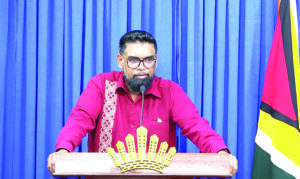
As Guyana pursues the development of its natural gas resources, President Dr Irfaan Ali says that there are significant interests from major players in the United States to build onshore facilities that would utilise that gas.
The Head of State made these remarks at a press conference on Friday, where he told Guyana Times that the country’s priorities are monetising the natural gas resources found offshore, especially the prolific Stabroek Block, estimated at 17 trillion cubic feet (tcf), as quickly as possible while also creating the opportunities to build out the onshore facilities that would enhance its development.
Already, President Ali noted that there have been immense interests from the US
“The interest, especially from the US, has been incredible in terms of some of the onshore build-out that can come based on that gas,” he told this newspaper.
The Guyanese leader reminded that during the inaugural Berbice Gas Summit held in Georgetown in November 2025, “…we saw interest from hyperscale data centres, massive urea plants, energy facilities, and, name it, the whole petrochemical industry.”
At that summit, President Ali made it clear that Guyana must monetise its gas resources by 2030, transforming Berbice in Region Six (East Berbice-Corentyne) into an innovation and industrial hub with the establishment of large-scale facilities.
Currently, the country is gearing up to tap into its offshore resources with the highly anticipated Gas-to-Energy Project (GtE), which will pipe the natural gas from the Stabroek Block onshore for a 300-megawatt (MW) power plant and a Natural Gas Liquids (NGL) facility at Wales, West Bank Demerara.
Some 250 kilometres of 12-inch pipelines have already been laid to bring the gas onshore by this year’s end. However, only 40 per cent of the pipeline’s capacity will be used by this first phase of the GtE Project, and the Government is pursuing GtE Phase Two, which will see a second 300-MW power plant and NGL facility constructed right at the Wales site to fully optimise the pipeline.
However, this Gas-to-Energy initiative is different from the gas development in Berbice, which is a potentially large-scale project to bring the non-associated natural gas from the Stabroek Block to support a major industrial hub in the eastern part of Guyana.
The Guyana Government has been touting the development of a second gas project in Region Six (East Berbice-Corentyne) to support large-scale industrial growth with power plants, a data centre, and an alumina plant, among other heavy industries.
Suriname collaboration
But as Guyana focuses on developing its own gas potential, President Ali has repeatedly emphasised that the infrastructure it is building out will also help neighbouring countries like Suriname shorten their time to monetisation and benefit from shared opportunities.
In fact, the Guyanese leader pointed out during Friday’s press conference that “…the conversation with Suriname is important to see how they will treat their gas. Of course, we are working towards having our pipeline to see whether they will feed into our pipeline. If that happens, of course, the project goes up to a higher scale with massive additional opportunities.”
According to Ali, discussions in this regard are ongoing with Surinamese authorities.
Only back in March, President of ExxonMobil Guyana Limited (EMGL), Alistair Routledge, disclosed that the pipeline that will bring gas from offshore to Berbice could cost an estimated US$2 billion – double the cost of current infrastructure that was laid since 2024 for the Wales GtE project.
Routledge had noted that while they are yet to work out the specifications of the new pipeline, there are talks ongoing with the Suriname Government on sharing the pipeline. “It could be economies of scale to do that,” Routledge stated.
In fact, at the Guyana Energy Conference and Supply Chain Expo held in Georgetown earlier this year, President Ali declared that Guyana is looking for “like-minded partners” and directly appealed to Suriname to join Guyana in scaling up the second gas project planned for the Berbice region, which borders the Dutch-speaking nation.
Suriname’s Oil, Gas, and Environment Minister Patrick Brunings, who attended the Energy Conference, acknowledged and highlighted the scope for potential collaboration in advancing the region’s energy transition.
Currently, ExxonMobil is operating four developments in the Stabroek Block offshore Guyana – Liza Phase One, Liza Phase Two, Payara, and Yellowtail – with its fifth project, Uaru, on schedule to come onstream later this year and the sixth, Whiptail, slated for start-up in 2027. All of these projects produce what has been described as “black crude”.
However, the seventh project, Hammerhead, slated for 2029, and the eighth development, Longtail, expected in 2030, are pegged as major gas development projects.
As part of its aggressive energy agenda and efforts to monetise the country’s natural gas resources, the Guyana Government has selected United States energy firm Fulcrum LNG Inc to work in a tripartite arrangement with ExxonMobil to develop the Berbice gas project.
“What we are doing now is to try to find the best formula, looking at all the proposals on the table, from Exxon, from the partners, what Fulcrum’s idea is, and also what the reality of the global system looks like. We have two things that we want to do. We want to ensure we can monetise as quickly as possible. But at the same time, we also want to build out the onshore facilities as quickly as possible so that we can leverage that gas to create the greatest multiplier effect for Guyana’s development [and] for our regional positioning,” President Ali told the Guyana Times during Friday’s press conference.
Discover more from Guyana Times
Subscribe to get the latest posts sent to your email.