

– Pres Ali on Guyana’s oil wealth driving development without compromising environmental commitments
President Dr Irfaan Ali has once again defended Guyana’s booming oil and gas industry, saying that the monies earn from this sector is being used to propel national developing and diversify the economy without infringing on the country’s environmental commitments.
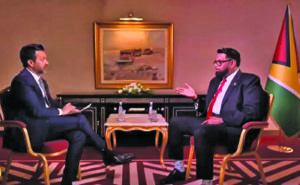
The Head of State recently sat down for an interview with Al Jazeera in Qatar during which he was asked about balancing the massive tension between fossil fuel extraction and the country’s environmental credentials.
“We don’t see a conflict,” President Ali declared. The reality, he explained, is that Guyana is blessed with immense natural assets. This includes its massive forest, which covers 85 per cent of the country and has one of the highest biodiversity densities in the world, as well as oil and gas resources that can allow it to realise not just national aspirations but also support the regional growth. Even with the latter, the Guyanese Leader made it clear that the country has not step back on its environmental commitments. In fact, he noted that they have expanded the Low-Carbon Development Strategy (LCDS). The now dubbed LCDS 2030 is the national framework that seeks to balance economic growth with environmental preservation, climate resilience and low-carbon energy transition. He added too that Guyana did not step back on its commitment to global targets, and is now even leading a worldwide biodiversity conservative and preservation initiative – the Global Biodiversity Alliance (GBA), which now has more than 140 partners signed on since its launch in July 2025. “So, you can look at it that way or look at it in a sense that if we never had this energy resource, if we never had the petroleum, we would have had this asset and presiding over high levels of poverty in the region, like many countries who don’t have this asset. We would have had this beautiful environmental product that no one wants to pay for, that no one wants to value, whilst at the same time you have to find money to build sea defences for a country that is six feet below sea level, a country that needs massive investment in drainage and irrigation, a country that needs massive investment in flood protection. Who will bring those resources? Where would you get those resources,” President Ali questioned.
Economic expansion & transformation
The Head of State further pointed out his administration’s commitment to economic expansion and transformation. Key to this, he emphasised, is the diversification of the economy, and building out of the infrastructure to create opportunities for housing, quality education, health care services – all of which are being done using revenues earned in the burgeoning oil and gas sector. “When you look at the non-oil economy growth, [it] is pushed because of the investment in oil and gas… I want the story of Guyana to be written 10 years from now, 20 years from now, as the most powerful food producer in the world; as a country that is using its natural resource, which includes environmental services and biodiversity services; as not only a custodian of these important services, but one of the most powerful countries in terms of environmental services, biodiversity services, eco-tourism, nature-based tourism. Because our natural assets surround these opportunities,” he posited. After discovering oil in 2015, Guyana started producing light sweet crude in the offshore Stabroek Block, which is operated by United States (US)-based ExxonMobil and its coventurers. Currently, Exxon has four Floating Production Storage and Offloading (FPSO) vessels operating in the Stabroek Block: Liza Destiny (Liza Phase One Project), Liza Unity (Liza Phase Two), Prosperity (Payara Project), and One Guyana (Yellowtail Project), which together are producing approximately 900,000 of oil per day. The US oil major is now gearing to fire up its fifth offshore project, the Uaru Development, later this year following the arrival of the Errea Wittu FPSO in local waters last month. Using the Errea Wittu, which was constructed by Japanese-owned MODEC, the US$12.7 billion Uaru project targets more than 800 million barrels of recoverable oil in the Stabroek Block. The FPSO is designed to produce approximately 250,000 barrels of oil per day (bpd) – the largest vessel to operate offshore, taking the country’s output to more than one million barrels per day when it comes on stream by year end. In the prolific Stabroek Block, ExxonMobil holds a 45 per cent interest while co-venturers Chevron has a 30 per cent stake and CNOOC with the remaining 25 per cent.
Discover more from Guyana Times
Subscribe to get the latest posts sent to your email.