

…farmers forced to pump water, install sprinklers as groundwater levels fall
By Andrew Carmichael
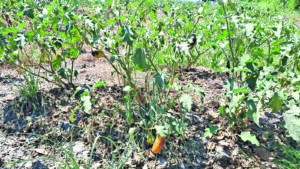
Cracked earth, wilting leaves and blossoms falling prematurely are becoming increasingly visible on farms in Berbice as farmers battle hot, dry conditions and the growing challenge of securing enough freshwater to keep their crops producing. Across the farms visited, the effects were visible beyond the farmers’ accounts. Under the afternoon sun, sections of cultivated land had hardened into rough, broken clumps, while vegetation in other areas had turned brown and brittle. Balanjay plants remained standing and bearing fruit, but several showed drooping and curled leaves against the dry soil. Long irrigation lines stretched across one cultivation, underscoring farmers’ growing dependence on manually getting water to their crops. Nearby trenches also showed the effects of the dry spell, with exposed banks and reduced water levels, while livestock grazed along a canal, another reminder of how important those remaining freshwater supplies could become if the dry weather persists.
Practical challenges
For farmers Rickford George, Inderjeet Seeram and Lakeroy Singh, the conditions are translating into practical challenges on their farms, from falling production and greater irrigation demands to additional pumping and fuel costs and concerns about the quality and availability of freshwater. Agricultural Scientist Reynard Ward in an interview with the Guyana Times explained that the dry season is closely linked to changes taking place below earth. During an examination of conditions on farms, Ward pointed to cracked soil and curling leaves as evidence that plants are already experiencing significant water stress. According to Ward, although the rainy season ended only about a month ago, groundwater resources are beginning to decline, reducing the moisture available within the root zone of plants. “The farms are showing the effects; the trees are showing the effects of the dry weather. Leaves are beginning to shrivel, and that is because groundwater levels have dropped significantly. The root zone of the plants is suffering from extreme drying out,” he explained. He pointed to cracks developing in the soil as another indication of the increasingly dry conditions. The scientist warned that crops which successfully made it through the previous rainy period could still suffer losses if adequate moisture is not maintained during fruit development. “As you can see, the ground is cracking, an indication of very dry conditions. While the trees survived the last rain season, fruits around the tree, these fruits require sufficient water and nutrients to become marketable in the months ahead,” Ward said. He said farmers should irrigate their farms to prevent soil moisture from falling below levels required to sustain their plants. If that happens, he warned, crops could reach the stage of permanent wilting and eventually die. But for the farmers trying to follow that advice, getting sufficient water onto their lands is becoming an increasingly important part of their daily operations.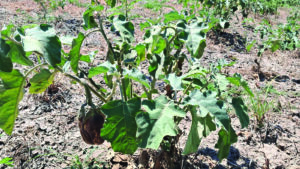
Saltwater worries
George, who has been farming since 2010, cultivates watermelon, egg plants, tomatoes and ochro, among other crops. For him, one of the major concerns during dry periods is not simply obtaining water, but obtaining freshwater that can safely be used on his crops. George explained that during wetter periods the water available to him is suitable for irrigation, but as the dry season takes hold, saltwater becomes a problem. “When the dry season comes in, the salt just raises at the bottom. But when the rain falls, everything is okay,” he related. The farmer normally depends on water from a nearby trench to irrigate his cultivation. Getting that water onto his farm, however, is not always straightforward. “When the water starts, sometimes at two o’clock in the morning, I just take water from the trench, bring it over to the water plant when the vehicles stop running on the road,” he explained. The saltwater problem being experienced by George is particularly significant as farmers are being advised to pay attention not only to the quantity of water available during the dry period but also to its quality. Prolonged dry conditions can increase the risk of saltwater intrusion into creeks, trenches and other waterways used for agricultural purposes. George is also seeing changes in the crops themselves. He pointed to blossoms dropping from his balanjay plants, affecting their ability to bear as they normally would. “The blossoms, the blossoms are dropping,” he said. The challenges come on top of the high cost of maintaining a cash-crop operation. George said agricultural inputs are significantly more expensive than when he began farming and recalled being able to obtain better yields in earlier years. Crop rotation is among the methods he uses to keep the farm productive, moving between crops rather than relying continuously on one. “When you plant one thing, you have some consistently, you have some that run down. So, I just rotate the crops to get a better yield,” he explained. But during the dry period, his most immediate need is much more basic. Asked what assistance he would want, George said maintaining an adequate supply of freshwater in the trench would make a substantial difference. “The most I could ask for is that they could help me maintain this trench here with the sweet water. I’m good to go,” he said.
‘You have to get water’
A short distance away, cash-crop farmer Inderjeet Seeram is facing his own battle with the heat. Seeram grows crops including balanjay and squash, and said the change in conditions is affecting production. Compared with periods when rainfall was more favourable, he is no longer getting the same level of output from his cultivation. The reduction in production is also being reflected in what some produce fetches on the market. Seeram said squash, which could previously sell for approximately $140 to $200 each during periods of better production, is now fetching around $500 in some instances. But higher prices do not necessarily translate into easier circumstances for the farmer. Producing the crop itself is becoming more demanding as the soil dries and plants require a dependable supply of water. For Seeram, that means pumping. He explained that he relies on water from a nearby creek and uses a pump to move that water to his cultivation. Sprinklers are then used to distribute it to the plants. It is a system that has become critical to keeping the farm going in the heat. Without water, his assessment of what would happen to the crops was straightforward: they would dry out. “You have to get water for them crop there. You got to get water to supply them,” he said. Seeram said sprinklers help him provide the moisture the plants need as conditions become drier. “So I put sprinklers on them too,” he explained.
His experience demonstrates the dependence that can quickly develop on pumps, nearby waterways and irrigation equipment when rainfall can no longer provide the moisture crops need naturally. And should the creek or another source fail to provide usable water, farmers such as Seeram would have limited alternatives for sustaining their crops. “If you don’t get water, you don’t get out,” he said, making clear that continued production is tied directly to access to water. For farmers accustomed to adapting to changing conditions, irrigation has therefore become less of an option and more of a necessity.
More work, less production
For Lakeroy Singh, the dry conditions affect an operation that goes beyond cash crops. Singh is involved in rice cultivation, cash crops and livestock, giving him several areas to consider as temperatures rise and rainfall becomes less dependable. His cash crops include balanjay, tomatoes and peppers. Singh said the increasingly dry weather means the crops are not receiving the amount of water they require, and he expects that to translate into lower production. “No, the production is going to drop because you are not getting enough water. The weather is too hot. It is getting too hot, and the weather is getting dry,” he said.
Keeping the cultivation going now requires more frequent watering. In some cases, Singh said, crops have to be watered twice daily. That brings another challenge: the cost and work involved in getting water onto the farm. With rain no longer doing the job, pumps have to be used, and those pumps require fuel. The result is a difficult equation for the farmer: additional work and expenditure at a time when production itself is expected to decline. “You have to pump water and get water, and get fuel,” Singh explained. Like Seeram, Singh has turned to sprinklers as part of his preparations. “We put up sprinklers,” he said, explaining that the system is being used to get water into the farm. His livestock add another dimension to the challenge. During prolonged periods of intense heat, maintaining reliable freshwater supplies becomes important not only for crops but also for animals. Across the three farming operations, the circumstances differ, but water is the common thread. For George, it is ensuring that the water reaching his crops remains fresh rather than salty.
For Seeram, it is being able to pump sufficient water from the creek and distribute it with sprinklers. And for Singh, it is the additional labour and fuel required to water crops frequently while also managing rice and livestock.
Farmers urged to prepare
Their experiences come as the Ministry of Agriculture has been urging farmers to prepare for prolonged dry conditions rather than waiting until water becomes critically scarce. Among the measures being encouraged are careful water management and the establishment of reliable water-storage systems. Farmers are also being advised to clear on-farm drains and irrigation channels to allow water to move efficiently when supplies are available. For livestock farmers, maintaining adequate shade and steady water supplies is being emphasised as temperatures remain high. The Ministry has also urged farmers to remain alert to changes in the quality of water available from creeks, trenches and other irrigation sources, particularly as prolonged dry conditions increase the possibility of saltwater intrusion.
Agriculture Minister Zulfikar Mustapha has indicated that freshwater supplies across the agricultural regions remain sufficient for the time being, even as the authorities continue to monitor conditions. Regional canals are also being utilised as reservoirs to retain freshwater so that supplies can be made available as the dry period progresses. Farmers have additionally been encouraged to work with agricultural extension and agency officers to identify measures suited to their particular crops, livestock and locations.
Keeping moisture in the soil
Ward, meanwhile, said irrigation is only one part of managing farms through an extended period of dry weather. While farmers naturally focus on getting water onto their lands, he said attention should also be paid to preventing the moisture already in the soil from being lost too quickly. One way of doing that, he explained, is to avoid unnecessarily leaving the soil completely exposed.
While farmers traditionally remove weeds from around their crops, Ward said vegetation covering the soil can act as a barrier and help slow the rate at which moisture is lost.
“While this farm may seem to have green vegetation and dry vegetation, it is wise to leave the weeds on the ground as they act as a barrier to prevent excessive moisture loss,” he explained. Where farmers choose to clear that vegetation, Ward recommends putting the cut material to another use rather than simply removing it from the cultivation. “If farmers clear their land, it is wiser to take the grass and form a mulch around the plant roots and put the grass so that moisture will be lost at a slower rate,” he advised. Mulching places a protective layer of organic material over the soil, helping to reduce evaporation and retain moisture around the root zone for longer. That could become increasingly important for farmers who may have to stretch available irrigation supplies across their cultivations if the dry weather persists. Ward also urged farmers to pay close attention to what their plants are telling them rather than waiting until severe damage has occurred. On one of the farms, he pointed to leaves which had lost their normal shape and were curling inward. “As you can see here, the leaves are wilting. The leaves are supposed to be flat and straight but they’re all curved and that’s a sign of significant water stress,” he said. Those signs were evident across sections of the farms visited, from hard, cracked soil beneath the plants to dry vegetation and leaves curling under the heat, yet farming continues.
Pumps are being put to work, sprinklers are being installed, and farmers are drawing on the water still available in creeks, trenches and canals to keep their crops alive. For George, Seeram and Singh, the dry conditions are being experienced differently, but each ultimately arrives at the same requirement: access to a reliable supply of freshwater. And as the dry period continues, how well that water can be conserved, moved and kept fresh could help determine not only what survives in the fields, but how much of what farmers are cultivating eventually reaches the market.
Discover more from Guyana Times
Subscribe to get the latest posts sent to your email.