The Guyana Government on Wednesday called for greater international support to help developing countries strengthen their policing capabilities, including through technology transfer, specialised training, and enhanced capacity-building initiatives.
The call was made by Home Affairs Minister Oneidge Walrond at the Fifth United Nations Chiefs of Police Summit (UNCOPS 2026) – Session Two: Innovation and New Technologies in United Nations Policing.
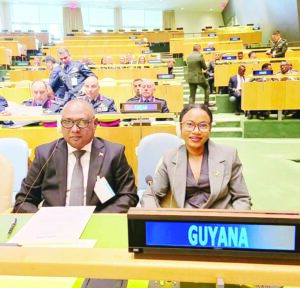
She explained that Guyana recognises that technology is transforming the security landscape and creating new opportunities for more effective, accountable, and citizen-centred policing, adding that the Government has been making the necessary investments under the Guyana Police Force Strategic Plan 2022–2026.
The Guyana Police Force Strategic Plan 2022-2026 is designed to serve as a roadmap in a continuous effort to deliver effective and efficient law enforcement services that meet the highest ethical and professional standards of contemporary policing.
The strategic plan is built upon six core pillars: operations (intelligence-led policing), partnership (community engagement), developing people (specialised training), infrastructure (modern facilities and technology), performance (data-driven, predictive analytics), and professionalism (accountability).
Through this plan, Walrond highlighted that “the Government of Guyana has prioritised digital transformation, data-driven policing, enhanced intelligence capabilities, and the modernisation of law enforcement infrastructure. Current initiatives include expanding electronic crime reporting systems, using digital forensic tools, improving criminal intelligence management, and strengthening cybersecurity capabilities to address emerging threats.”
She further noted that Guyana values regional and international partnerships in advancing innovation, explaining that through collaboration with CARICOM IMPACS, INTERPOL, the Regional Security System (RSS), the United Nations, and bilateral partners, the country continues to strengthen information-sharing mechanisms, capacity-building programmes, and technological capabilities to combat transnational organised crime, cybercrime, trafficking in persons, and other evolving security threats.
Notwithstanding these advancements, Walrond highlighted that significant challenges remain in that developing countries often face resource constraints, limited access to emerging technologies, cybersecurity vulnerabilities, and the need for specialised training to ensure the ethical and responsible use of artificial intelligence and other advanced policing tools.
She emphasised that bridging the digital divide while maintaining public trust, accountability, and respect for human rights remains a critical priority.
“Guyana therefore recommends increased international support for technology transfer, sustainable funding mechanisms, specialised training, and the development of common standards and safeguards for the responsible use of artificial intelligence in policing. We further encourage the United Nations Police Division and its partners to facilitate greater knowledge-sharing and technical assistance among Member States, particularly Small Island Developing States and developing countries,” Minister Walrond expressed.
She asserted that through collective action and innovation, “we can build safer, more resilient, and more effective policing institutions for the future”.
Walrond is currently leading Guyana’s delegation to the summit, being held at the United Nations Headquarters.
The delegation comprises Deputy Commissioner of Police Ravindradat Budhram, Permanent Representative of Guyana to the United Nations Ambassador Carolyn Rodrigues-Birkett, Deputy Permanent Representative Ambassador Trishala Persaud, Second Secretary Abosede Hazlewood, and Second Secretary Kayshav Tewari.
UNCOPS 2026 brings together Ministers, Chiefs of Police and senior representatives of regional and professional policing organisations to engage on strengthening international peace, security, and development for all through the unifying power and enabling role of national and United Nations policing.
Discover more from Guyana Times
Subscribe to get the latest posts sent to your email.