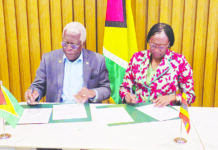


The Guyana Energy Agency (GEA) has completed its fifth Electric Vehicle (EV)/Hybrid Maintenance and Repairs training programme, adding 25 locally trained auto electricians and mechanical technicians to the pool of professionals being prepared to service the country’s growing electric mobility fleet. The latest cohort completed the training between September 14 and 18 and September 21 and 24, 2026, at the Mahaicony Technical and Vocational Training Centre (MTVTC). The programme is part of the Government’s wider effort to expand technical and vocational training while developing the skills required to support the transition to electric and hybrid vehicles. At a closing ceremony, GEA Chief Executive Officer (CEO), Dr Mahender Sharma, urged the graduates to maintain discipline, diligence and commitment as they move from the training environment into the workplace.

He encouraged the technicians to continue applying the knowledge and practical skills acquired during the programme, particularly as demand for specialised EV and hybrid vehicle maintenance services increases. The latest training brings to 102 the number of auto electricians and mechanical technicians trained by the GEA in EV and hybrid vehicle maintenance and repairs, according to Permanent Secretary (PS) in the Office of the Prime Minister (PM) Alfred King. The training programme is being implemented against the backdrop of increasing electric mobility in Guyana, with the Government also expanding the infrastructure required to support the growing number of EVs on the country’s roads.
Technical workforce
According to GEA in a social media post on Saturday, the programme combines classroom instruction with practical training, with participants learning how to safely work with the high-voltage systems found in electric and hybrid vehicles. Among the areas covered were the safe opening of EV battery packs, identification and diagnosis of faulty battery cells, and the procedures required for repairing and reassembling battery packs. The graduates are expected to receive internationally recognised certification from the Institute of the Motor Industry (IMI), covering Level 3 and Level 4 training. The certification is intended to provide participants with recognised technical qualifications as they enter or expand their roles in the emerging electric mobility industry. Director of the GEA Board, Dr Vivian Lam said the new cohort represents an opportunity to support greater adoption of electric and hybrid vehicles by ensuring that specialised technical expertise is available locally. He noted that the graduates could also explore entrepreneurship as investment and financing opportunities expand. Lam pointed specifically to increasing Government investments and institutions such as the Guyana Development Bank (GDB) which he said could create opportunities for graduates seeking to establish businesses or otherwise apply their specialised skills within the sector. He encouraged the technicians to consider how they could establish themselves in the industry, use their skills commercially and reinvest their knowledge and expertise.
Charging infrastructure
While developing the human resources needed to maintain EVs, Guyana is also increasing its charging infrastructure. King said Guyana currently has nine publicly accessible EV charging stations across Regions Three, Four, Five, Six and 10. These are located at Amazonia Mall at Providence; Giftland Mall on the East Coast Demerara (ECD); the S&R parking lot at Parika; the Eugene F. Correia International Airport at Ogle; the Cheddi Jagan International Airport (CJIA) at Timehri; Little Rock Suites in New Amsterdam; outside the GEA’s head office on Quamina Street, Georgetown; the MTVTC; and the Linden Electricity Company Inc (LECI).
The Government expects the number of publicly accessible charging stations to increase from nine to 24 by the end of 2026. The MTVTC station is also being used to demonstrate how renewable energy can be integrated with electric transportation infrastructure. The facility has a 60 kilowatt (kW) EV charger supported by a 15 kW grid-connected solar photovoltaic system installed as part of a solar carport.
The setup extends public charging infrastructure beyond Georgetown and the East Bank Demerara (EBD) corridor while demonstrating the potential to combine renewable energy generation with transportation services.
Charging demand increases
According to King, usage of the existing charging infrastructure has also increased significantly during 2026. Between January and July, the number of monthly charging sessions rose from 231 to 744. Over the same period, the amount of electricity dispensed each month increased from 4,186.48 kilowatt-hours (kWh) to 20,999.36 kWh. By the end of July, a total of 6,580 charging sessions had been recorded since the infrastructure was introduced, with 87,348.39 kWh of electricity dispensed. The Flash Charge EV application had also recorded 1,540 registered accounts by the end of July. King said the figures demonstrate that the development of electromobility requires more than the introduction of electric vehicles.
“These numbers tell us something important, people are using the infrastructure, and demand is increasing,” he said. He noted that the transition requires a wider supporting ecosystem, including reliable charging stations, renewable energy integration, electrical and safety standards, digital systems, trained technicians, informed consumers and institutions capable of continuing to develop the required skills.
Training demand
Guyana Times reported on September 25 that the GEA had completed a two-week certification programme at MTVTC, with training conducted at Levels 3 and 4. The report also noted that Guyana had recorded a steady increase in EV imports. GEA CEO Sharma disclosed in February 2025 that more than 220 electric vehicles had been imported into Guyana over the preceding five years, including 44 in 2024.
By September 2025, the GEA reported that the number had surpassed 280. The expansion of the local EV market has been supported by Government tax incentives under which electric vehicles are exempt from customs duty, excise tax and Value Added Tax, irrespective of the vehicle’s age or power rating. The local market has also seen the introduction of additional electric and hybrid vehicle models, including the entry of BYD vehicles through GT Automotive, which became the exclusive Guyana dealer for the brand in April 2025. The growth has created a corresponding need for technicians who understand the specialised systems used in electric and hybrid vehicles. During the earlier training programme, REVAMP Training Company Director Stephen Burr told Guyana Times that the increasing number of EVs entering Guyana was driving the need for technical training. He noted that technicians must be equipped not only to maintain the vehicles but also to safely work with their high-voltage systems. Burr said the training was also intended to support younger Guyanese technicians interested in developing businesses around EV repair and maintenance.
Discover more from Guyana Times
Subscribe to get the latest posts sent to your email.