


…agreement reached as Govt moves to construct 3.5 km embankment
Disagreements among farmers had delayed the construction of a critical flood protection embankment at Big Biaboo, along the Mahaica River, Region Five (Mahaica-Berbice), Agriculture Minister Zulfikar Mustapha has disclosed. However, farmers attending a meeting Saturday agreed to the proposed works, clearing the way for the Government to advance plans to construct the approximately 3.5-kilometre (km) structure. The proposed embankment, measuring approximately 700 rods, is intended to provide greater protection against flooding, a recurring challenge for farmers in the area.

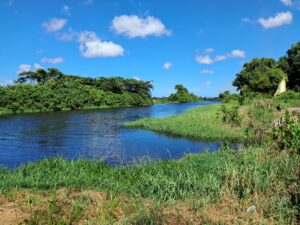
Farmers from Big Biaboo and several surrounding communities attended Saturday’s meeting, during which Mustapha announced interventions aimed at improving drainage and irrigation, strengthening farm infrastructure and increasing agricultural production.
Addressing concerns about flooding, the Minister expressed disappointment that disagreements among farmers had prevented the proposed embankment from proceeding, despite its potential benefits to the agricultural community. He explained that while some farmers supported the project, others opposed it, creating difficulties for the Ministry of Agriculture.
“And sometimes when you look at the situation, I just be so disappointed that the Government is making an effort. We are working with farmers and sometimes some of us go and criticise it and bring in other people to criticise the project,” Mustapha told the gathering. He added that the project should have been undertaken much earlier but encountered opposition from some farmers.
The Minister stressed that decisions concerning infrastructure intended to protect agricultural lands should be guided by the interests of the wider community rather than individual preferences.
“You hear the comrades say some people want and some don’t want. We have to decide what is better for the community, what is best for the community. Sometimes some people want to safeguard their own interests, right? So, if you all agree, I want to pronounce here today, if you all agree, now I will instruct Lionel and his team to build the embankment so that we avoid flooding in this area in the future, right?” he declared.
Mustapha was referring to National Drainage and Irrigation Authority (NDIA) Chief Executive Officer Lionel Wordsworth, who was present at the meeting.
Following the Minister’s appeal, farmers attending the meeting agreed to the proposed embankment, clearing the way for the Government to advance preparations for construction. Mustapha subsequently directed Wordsworth to proceed with the necessary technical arrangements, including preparation of the engineering design. The Minister explained that the scale of the project required the Government to follow established procurement procedures before construction could begin.
The announcement indicates that the project could be advertised for tender as early as October 25, subject to completion of the necessary preparations. The proposed embankment forms part of broader Government efforts to strengthen flood protection and drainage infrastructure in agricultural communities.
Mustapha disclosed that approximately $25 billion is being invested in high-level drainage canals and related infrastructure across Regions Three (Essequibo Islands–West Demerara), Five (Mahaica–Berbice) and Six (East Berbice–Corentyne). He explained that the investments are intended to improve drainage in low-lying agricultural areas where excess water has repeatedly affected cultivation and caused losses to farmers.
The Minister said the high-level canals are designed to discharge water directly into the Atlantic Ocean, reducing dependence on tidal conditions. In Region Five, two high-level drainage canals are being developed to improve drainage capacity and reduce pressure on existing internal canals serving agricultural and residential areas.
Mustapha also outlined embankment works extending from Mahaica towards Ithaca to help protect communities against water originating in the backlands. He expressed optimism that the major drainage works could be completed by the middle of 2027 and further disclosed that the completion of the drainage infrastructure in Region Five is expected to make approximately 55,000 additional acres of land available for agricultural development.
According to Mustapha, the expansion would create opportunities for farmers to increase cultivation and contribute to national food security. However, he warned that opposition to major infrastructure projects could undermine efforts to improve drainage and protect agricultural lands.
Referring to a separate high-level drainage canal project, Mustapha disclosed that the Government continued to encounter objections despite extensive consultations with affected persons. He said Wordsworth had visited the area more than 20 times to engage stakeholders before construction, but disagreements persist.
According to the Minister, work on that separate project remained suspended while the matter was being addressed.
Meanwhile, Mustapha announced that cash crop farmers would receive machinery assistance to improve infrastructure on their farms, particularly through the raising of planting beds to reduce the impact of flooding. Under the intervention, each farmer will benefit from three days of machinery services, with equipment operating for nine hours daily, amounting to 27 hours of assistance.
The Minister estimated that the intervention would cost the Government approximately $486,000 per farmer, taking into consideration machinery operations, fuel and other associated expenses. The Ministry of Agriculture, in its statement on the intervention, rounded the estimated value to approximately $500,000.
The assistance will be provided through machinery services rather than direct cash payments.
Mustapha committed to deploying three machines to the area within one week, indicating that they could arrive as early as Wednesday, October 21.
To coordinate the exercise, he requested that farmers establish a committee to work alongside the Ministry’s engineers in determining where the machinery should be deployed. A committee was subsequently formed during Saturday’s meeting.
The Minister said the arrangement would help ensure that the assistance was distributed fairly and that the machinery was not directed towards selected individuals at the expense of others. In addition to the embankment and machinery assistance, Mustapha committed to rehabilitating the community’s farm-to-market road. He explained that the road would be upgraded using crusher run as a more affordable alternative to expensive construction methods.
Mustapha also indicated that additional farm-to-market roads could be considered for inclusion in the 2027 national budget, although he stopped short of committing to every road requested by farmers.
The proposed rehabilitation is expected to improve access to farmlands and facilitate the transportation of agricultural produce.
With farmers now in agreement on the proposed embankment, the Ministry of Agriculture is expected to advance the engineering design and tendering process for the approximately 3.5km structure, while three machines are scheduled to be deployed to the area by Wednesday to begin assisting farmers with improvements to their agricultural lands.
Discover more from Guyana Times
Subscribe to get the latest posts sent to your email.