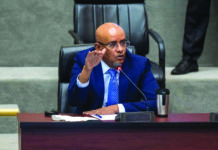


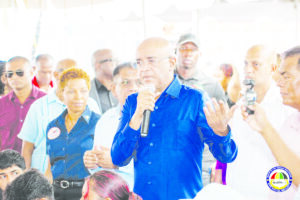
Vice President (VP) Dr Bharrat Jagdeo has announced that nearly 11,000 house lots will be made available to residents of Region Three (Essequibo Islands-West Demerara) by the end of next year. He made the announcement during his Public Day at the National Track and Field Centre in Leonora, West Coast Demerara (WCD), on Friday. Addressing scores of residents gathered at the event, Jagdeo said that nearly 11,000 people in Region Three who are awaiting house lots will be allocated land by the end of next year. He noted that the administration remains committed to clearing the housing backlog across the country, except in Region Four, where the volume of applications is too high to be addressed within the same timeframe.
In Region Four, allocations have only reached applicants who applied in 2020 and 2021, meaning newer applicants may still face a wait of three to four years. Region Three alone has close to 11,000 persons waiting for house lots, Jagdeo said, with the main obstacle being the shortage of available state lands. Much of the new housing development is being concentrated in Wales, where house lots have already been distributed. Jagdeo explained that it costs between $5 million and $7 million to develop a single housing block because the land involved consists of former cane fields that must be excavated, drained and connected by roads. He said developing the outstanding 11,000 house lots by the end of next year will cost billions of dollars, but assured residents that the investment will be made.
 Better understanding of housing allocation process
In an interview with this publication, Housing Minister Collin Croal expanded on the announcement. “For Region Three, we’re working over the next two years to clear all the pending applicants for 2025 and prior. We have to start somewhere, and so obviously the rest of this year will focus on the earlier years, and then next year to bring on par, as we said, over 11,000 pending applicants for Region Three.” He explained that the outreach would allow pending applicants to gain a better understanding of the housing allocation process, including when they may expect to receive their land. According to him, the initiative is intended to help residents understand the Government’s overall vision for the housing programme and housing sector, while also outlining the plans targeted for Region Three. However, he noted that the pace of allocations is dependent on the availability of land. “So a lot of applicants, are on the West Coast of Demerara, but we have competing interests for the West Coast of Demerara. Most of our allocations have been within the Wales area on the West Bank, and that’s also because the land became available from GuySuCo. But here on the West Coast, we still have active farming and sugarcane cultivation taking place. So we have not been able to get the amount of land we would have wanted because much of the other land is privately owned. So most of the persons will have to be allocated that way and some of the persons who are allocated, we wanted to know if they can come this way to switch, etc. But we’re developing Wales.” He said the Wales area is expected to become a major hub for employment, with factories and industries creating significant job opportunities for residents. He noted that substantial investments are being made in infrastructure, including the expansion of the four-lane highway to Parika and the development of an additional road network along the West Bank corridor to complement the existing roadway. According to him, Region Three is poised for major investments that will benefit residents as both the national and regional populations continue to grow. He added that increased vehicle ownership has contributed to traffic congestion, particularly along the West Coast corridor. He pointed out that commuters travelling through the area would have observed the heavy volume of traffic and emphasised that the Government is addressing the issue through road expansion projects and the construction of interconnecting roads alongside the main four-lane highway network.
Individual concerns, assistance
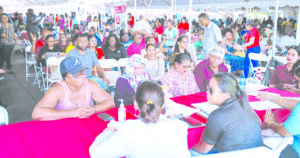
Meanwhile, during the outreach, Cabinet Ministers were engaged in addressing a number of issues raised by residents. This publication also spoke with Agriculture Minister Zulfikar Mustapha, who outlined the number of persons he had engaged and highlighted the importance of such outreach events. “You could see there are a number of persons here and various agencies are dealing with issues that people have. I think this is a very good way of allowing people to deal directly and interact directly with officials. Here, I would have already spoken individually with more than 100 persons. People raised issues and personal concerns, and almost 95 per cent of those issues were resolved right here this morning.” Meanwhile, he detailed some of the matters that were brought to the Government’s attention for resolution.
“Well, people came with individual concerns. Things like they need livestock assistance, they need drainage in their communities and around their surroundings. They need help with cash-crop farming, they need planting materials and they need shade houses. Those are individual requests, and those are most of the things we were able to help with. So generally, we haven’t had any major concerns regarding community projects because here we have a very robust programme involving farm-to-market roads, the rehabilitation of canals, the construction of bridges and sluices, and the repair of pumps, among other works.”
Discover more from Guyana Times
Subscribe to get the latest posts sent to your email.