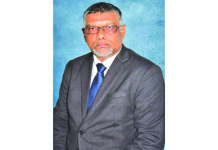


…high costs remain key hurdle for Guyana’s agri sector – Mustapha
Agriculture Minister Zulfikar Mustapha has emphasised the need to tackle the high cost of production in Guyana’s agriculture sector, noting that this issue has been identified as a key priority for local authorities.

He acknowledged that despite significant Government support, the cost of production of agricultural produce remains high.
“Cost of production is a big thing for us in this country. When you look at all the subsidies the Government is making and all the input costs, we still have a high cost of production,” the Minister lamented as he addressed graduands of the Guyana School of Agriculture (GSA) on Tuesday.
Mustapha charged the budding agriculture experts to make this a key focus in their careers ahead.
“Here is where you come in, as graduates of the Guyana School of Agriculture, where you will be employed as extension officers, where you will be working with farmers around the country. The objective is to reduce the cost of production, improve quality, and increase yield. Those are the three main objectives in the agriculture sector today,” he posited.
The Minister added that reducing the cost of production is key to building a modern agriculture system in the country.
“We want an agriculture sector that produces more, wastes less, adds greater value to its products, competes successfully in regional and international markets and creates opportunities for Guyanese at every level,” he noted.
The Agriculture Minister also underscored the importance of increasing productivity and yield to meet national demands and to supply export markets.
“As a country, as a sector, we must [be] able to respond to the demands in our country; we must [be] able to produce. Let me tell you what: if you look at some of the sectors now, in the agriculture sector, although we have increased production by more than 100 per cent in certain areas, we are still lacking in production because the demand keeps increasing,” he highlighted.
“We must [be] able to produce and ensure we satisfy the demand firstly internally and also be an exporter. This is how agricultural education can have the greatest impact. We must be able to translate what we learn in the classroom and what we have practised over time to the farmers on the farm so that they can also produce because the main objective, as I said, is to increase production and yield, produce better quality and help the farmers to overcome the challenges that they face,” the Agriculture Minister added, as he pointed to changing realities in the sector.
Change & technology
“The agriculture sector of today is not the same as it was several decades ago. Production methods are changing, technology is opening new possibilities, consumers are demanding higher standards, markets are becoming increasingly competitive, and climate change is placing new pressures on farmers and food production. Our educational institution must therefore continue to equip students with the knowledge, practical skills, and innovative thinking needed to respond to these developments,” he emphasised.
Moreover, the Minister highlighted that the future of agriculture is already rapidly changing.
“When you look at another ten years from now, the future of agriculture will be driven by science, technology, innovation, entrepreneurship and data. Success will depend on our ability to embrace modern production techniques, improve efficiency, reduce losses, manage resources responsibly, and develop products that meet the demand of the changing market. Those are things that we have to work to ensure that happen. That is why the Government is putting a large amount of resources into institutions like the Guyana School of Agriculture so that we can prepare our young people for the future ahead,” he posited.
In this regard, Mustapha highlighted that the GSA has evolved considerably since its establishment in 1963.
“From its original programme in agriculture, the institution has expanded into forestry, fisheries, agro-processing, animal health, and veterinary public health, and more recently, livestock production and management. This evolution reflects an important principle: agricultural education must respond to the changing needs of society,” he expressed.
According to the Minister, the GSA continues to adopt programmes to ensure its graduates successfully contribute to the sector’s growth.
Outside of the GSA, he noted that the Government continues to invest heavily in the agriculture sector, which grew by 11.5 per cent in 2025. Mustapha noted too that the national investments in the sector increased by $18.4 billion in 2020 to $113.2 billion in 2026.
“These investments are supporting the modernisation of production systems, the expansion of agricultural infrastructure, improved access to technology, stronger livestock and crop production, and the creation of new opportunities throughout the sector,” he noted.
Meanwhile, Mustapha reminded graduands that agriculture today offers opportunities in science, technology, business management, research, veterinary services, environmental management, logistics marketing, and entrepreneurship.
He further informed the graduating class that landing a job is not the only option after graduation, as he encouraged them to become “masters of your own destiny”.
“Our country needs skilled employees, but it also needs innovative employers, successful farmers, capable leaders and managers and entrepreneurs who are prepared to invest in the future of agriculture,” the Minister expressed.
The graduating class comprised 65 females and 37 males who completed studies across six programmes offered at the Mon Repos and Essequibo campuses. Of the 102 graduates, 66 earned either a Credit or Distinction, while ten students who were referred in 2025 successfully completed their programmes this year.
The graduating class represented nine of Guyana’s ten administrative regions, along with 12 students from CARICOM countries, including ten from Grenada and two from Saint Lucia. Two Grenadian nationals, Jacob Thomas and Adonis Jones, were also recognised among the year’s outstanding performers.
Among the outstanding graduates recognised during the ceremony was Analesia D’Aguiar, who received the Chairman’s Prize for being the best graduating student in the programmes offered at the Essequibo Campus. D’Aguiar completed the Certificate in Forestry programme with a GPA of 3.97, the highest recorded in the graduating class.
Marlon O’Donoghue received the Chief Executive Officer’s Prize for being the best graduating student in the two-year programmes offered at the Mon Repos Campus. He completed the Diploma in Agriculture programme with a GPA of 3.71.
Discover more from Guyana Times
Subscribe to get the latest posts sent to your email.