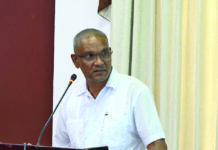


As countries in the Caribbean continue to place emphasis on food security and building resilience and economies of scale to combat their vulnerabilities to climate shocks, Guyana’s senior Minister with responsibility for finance, Dr Ashni Singh, has called on regional leaders to redouble efforts to ensure that the historical impediments affecting the free movement of goods and people across the region are removed.
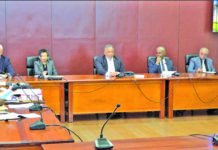
He made this plea on Tuesday at the One Caribbean Ministerial Dialogue forum convened by the Inter-American Development Bank (IDB) Group themed “Building Resilience through Regional Collaboration” in Port of Spain, Trinidad and Tobago (T&T).

At the time, the Guyanese Minister was leading an open-floor discussion on “Building Food Resilience”, which he pointed out is being hindered by the inability to freely move goods across and within the region.
“There are still, in some of our jurisdictions, some remaining regulations that impede free and easy trade in food products, in agricultural food products, and I think there needs to be a redoubled effort within our region to remove these barriers,” Dr Singh posited.
Currently, Caribbean Community (Caricom) leaders have adopted the objective of reducing the region’s food import bill by 25 per cent by 2025, which has now been extended to 2030 largely due to the shocks suffered over the last five years, with a clear mandate to reduce food imports in the region by an estimated 4.6 million tonnes by 2030 to build a resilient, competitive and climate-smart resilient agri-food system, which many countries have been focused on.
Internal impediments
But according to Dr Singh, there are still some remaining internal impediments, including sanitary and phytosanitary barriers to intra-regional trade. However, he noted that some countries have taken steps to address some of the barriers while also enhancing their own food systems.
“In each of our respective countries, each of us has been investing in one aspect or another in pursuit of the objective of the realisation of our objectives in relation to food security. In the Bahamas investments are being made in the area of climate-smart agriculture and the deployment of solar-powered and hydroponic farms. In Belize, financial support is being provided for small farmers and projects targeting sugar, rice, maize and soyabean. Jamaica is making significant investments in cold storage and the supply chain and in areas like water management and crop shifting,” Minister Singh outlined.
He also highlighted that in Guyana heavy investments are being made in more climate-resilient agriculture and, in particular, drainage and irrigation infrastructure for better water resources management and a more climate-resilient agricultural sector, and therefore, the food security agenda is foremost amongst the priorities in Guyana and across the Caribbean, with the objectives being to ramp up production and productive capacity.
“In Guyana’s case, this includes transport infrastructure to open up more productive land, building out farm-to-market roads to be able to bring our production more efficiently to markets, building out agro-processing capabilities so that we are no longer an exporter of primary agricultural produce but that we produce more value-added output and, in particular, unlocking the opportunities that lie in more intra-regional trade in agricultural products,” he added.
The Minister noted, however, that herein lies the issue in relation to transport infrastructure, especially the movement of goods across and within the region.
Dr Singh emphasised that food security is not only a humanitarian necessity but also a fundamental economic pillar for the Caribbean. He further explained that notwithstanding the region’s competitive agriculture advantages, there still remain significant vulnerabilities, including climate shocks.
The finance Minister went on to express deep appreciation for the IDB’s efforts through the One Caribbean initiative, noting that the bank’s support is vital for both public infrastructure and private sector growth in achieving long-term economic resilience.
“Agriculture and agribusiness are an important aspect of our productive economy and an important contributor to job creation and the creation and enhancement and improvement and enhancement of livelihoods for young people in the region,” Minister Singh concluded.
Bemoan restrictions
Dr Singh’s call comes as the Guyanese private sector continues to bemoan the restrictions that hinder free trade with some Caribbean nations, especially T&T.
In recent years, local businesses have encountered issues with products such as honey and diary items that were blocked during transhipment through the Twin-Island Republic due to phytosanitary restrictions.
However, just two weeks ago, President Dr Irfaan Ali and Prime Minister of T&T Kamla Persad-Bissessar discussed and agreed on a development, trade and economic agenda aimed at deepening bilateral relations between the two nations.
The two leaders discussed key areas, including food security and investment opportunities, energy integration, technology exchange, human capital development, and strengthening security. They also agreed to establish a working group to remove trade barriers and improve competitiveness.
This meeting was held in Port-of-Spain, where President Ali had travelled to deliver the feature address at the T&T Chamber of Industry and Commerce Annual Meeting on April 10.
Bureaucratic issues
In fact, the Guyanese leader, during his address at the T&T Chamber’s Business Meeting, called for the two countries to come together for a 72-hour period to iron out the bureaucratic issues that pose hindrances to a strong economic partnership.
“If we care about partnership, if we care about building consortiums. If we care about building a joint economic front between Guyana and Trinidad and Tobago, then we must care about fixing the problem, and let’s get in that room, lock ourselves up for 72 hours and fix the damn problem,” the Head of State declared.
President Ali, questioned by reporters in Trinidad following his remarks, declared that he and the Guyanese government are ready to sit down and fix these issues.
“It is needed. We all know it is needed. It is critically needed,” he emphasised.
Discover more from Guyana Times
Subscribe to get the latest posts sent to your email.