The anticipated legislation to establish a Guyana Development Bank (GDB) was officially laid in the National Assembly on Friday, with Minister with responsibility for Finance Dr Ashni Singh, presenting the Bill for its first reading. The proposed law sets out a comprehensive framework for the creation of the state-owned development finance institution aimed primarily at supporting small and medium-sized enterprises (SMEs) and advancing broader national economic development objectives.
The legislation sets the authorised capital of the bank at $40 billion while also granting the Minister authority, “by order subject to negative resolution of the National Assembly”, to amend the capital amount. It further provides that “The bank shall be exempt from the payment of tax on the profits and income of the bank.” In terms of lending, the Bill imposes a ceiling stating that “the bank shall not provide loans exceeding three million dollars to any person or enterprise”, although this limit may also be adjusted through ministerial order subject to Parliamentary scrutiny. According to the Bill’s explanatory memorandum, “This Bill seeks to establish the Guyana Development Bank as a statutory body corporate to provide financing and support for small and medium-sized enterprises in Guyana and to promote national economic development.”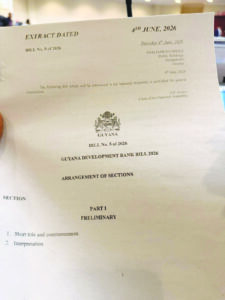
The memorandum outlines that the bank will be established as a body corporate with “perpetual succession and the capacity to sue and be sued” and will be mandated to promote and facilitate SME growth through financing and technical support. It also states that the institution will be restricted from engaging in activities such as deposit-taking from the general public and speculative trading. Under the proposed legislation, the bank will be governed by a board of directors of “not less than five and nor more than nine” directors, all of whom will be appointed by the finance Minister. The Minister will also be exclusively responsible for appointing the chairperson and deputy chairperson of the board. Directors will serve terms “not exceeding three years and may be reappointed” and will receive remuneration and allowances as determined by the minister.
“Development Bank Board of Directors to be based on qualifications, experience in finance, economics, banking and law,” the Bill noted. The Bill outlines that the Bank’s financial year will align with the Government’s fiscal calendar and that it must maintain proper accounts and records. These accounts are to be audited annually by the auditor general in accordance with existing audit legislation.
It also specifies that the institution “shall not be subject to the Financial Institutions Act”, instead being governed by its own enabling law and associated regulations.
Stronger enforcement provisions are included under the bill, with penalties for breaches. The legislation introduces offences relating to false information, obstruction, destruction of records, misuse of funds, and improper disclosure of confidential information. “Any person who commits an offence… is liable on summary conviction to a fine of not less than five million dollars and not more than 10 million dollars,” the Bill notes. It further went on to address corporations and representatives of corporations that are liable for offences.
“Where an offence under the Act is committed by a body corporate, the body corporate is liable on summary conviction to a fine of not less than $5 million and not more than $10 million,” it said.
“Where an offence committed by a body corporate under this Act is proved to have been committed with the consent or connivance of, or to be attributable to neglect on the part of, a director, manager, secretary, or other similar officer of the body corporate, that person also commits the defence and is liable to the penalty prescribed…”
The explanatory memorandum emphasises that the bank is intended to function as a development finance institution focused on SMEs, outlining that its core purpose is to “provide financing and support for small and medium-sized enterprises in Guyana and to promote national economic development”. It further details functions that include lending, collaboration with financial institutions and development partners and the provision of technical, managerial and advisory services to enterprises. The Bill will now proceed through the Parliamentary process, where it is expected to undergo further debate and scrutiny before being passed into law.
Discover more from Guyana Times
Subscribe to get the latest posts sent to your email.