


Vice President (VP) Dr Bharrat Jagdeo said on Thursday that the Government is considering investing in a massive national strategic fuel reserve to help insulate Guyana from volatile global oil prices and potential supply disruptions.
He made the disclosure in response to a question from the audience during the Guyana Manufacturing and Services Association’s (GMSA) 31st Annual Presentation Awards Ceremony.
Jagdeo said the Government is currently exploring the feasibility of establishing such a reserve, alongside the possibility of developing a small-scale refinery, as part of efforts to strengthen the country’s energy security and resilience.
“There’s two schools of thought…a refinery right here in Guyana or, alternately, a massive national strategic reserve, which the Government has been exploring,” he noted.
“With huge storage that can import fuel and keep at least, maybe, 6-8 months of fuel, which is what is available in many parts of the world,” he added.
Currently, Guyana’s reserve capacity caters for around six weeks to two months.
Jagdeo said having a larger reserve could help Guyana and its people in times of global volatility.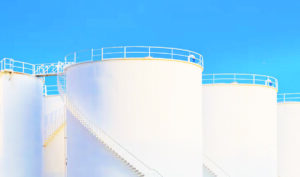
“So, even if you have a hurricane or you have up and down prices, you can draw that…that would allow us to procure cheaper too, if you procure in volume. So, we’ve been exploring this possibility,” the VP said, noting that it could reduce costs by 20-30 per cent.
This is not the first time Jagdeo has spoken about the possibility of building a modern fuel storage facility in Guyana. He previously floated the idea during a University of Guyana Economic Society Forum in April 2025.
At the time, he explained that “nationally, we have maybe a month of storage. So, after a month, if you don’t get products, you start running out. So, two things that will happen: if we can bring the bigger vessels, by dredging and building these bigger storage facilities, we can cut the purchasing price of our refined products between 20 to 37 per cent.”
Jagdeo had also explained that the high price for importing refined fuel products can be attributed to Guyana’s limited storage spaces, necessitating the need for more fuel trips. Additionally, the fuel also has to be imported in smaller quantities.
At that forum, the VP also noted that while there are pros for an oil refinery, there are also cons, including increased emissions, the necessity of providing tax concessions, and Guyana having to sell its crude to the refinery. Additionally, he had argued that a viable refinery costing around $700 million would be privately owned, which means the state does not directly get revenue from its operations.
Refinery
Nevertheless, at the GMSA event on Thursday, Jagdeo said the development of a small refinery remains an option Guyana can explore.
Earlier this year, it was reported that the Guyana Government and United States-based Curlew Midstream were ironing out contract details with respect to refining and storing locally produced oil. Talks have been ongoing between Guyana and the Bentonville, Arkansas energy infrastructure company since February 2025, but a deal is yet to be struck.
Back in February 2025, Curlew detailed that the partnership with the Guyanese Government will ensure Guyana’s continued move toward energy independence. In addition, it stated that the partnership will allow Guyana to store 750,000 barrels of gasoline, diesel, jet fuel, and heavy fuel oil in a modern fuel storage facility.
It was also reported that it will enable Guyana to meet 100 per cent of its domestic fuel needs while also supplying high-quality, non-sanctioned fuels to nations of the Caribbean Community (CARICOM).
The Guyana Government has also engaged the Dominican Republic on the possibility of establishing an oil refinery here. Back in 2023, Guyana and the Dominican Republic signed a Memorandum of Understanding (MoU) for, among other things, a 50,000-barrels-per-day oil refinery to be built here.
LPG
Meanwhile, during the GMSA event, the VP also highlighted Guyana’s potential to start exporting liquefied petroleum gas (LPG) once the Gas to Energy (GtE) project becomes fully operational.
“We’re only gonna be using a third of what we produce from GtE One and that is to supply the domestic market,” Jagdeo said, noting that the prices will be as much as 50 per cent lower.
Currently, a 20-pound cylinder costs around $5000, and once Guyana starts producing and selling LPG, it could cost $2500.
Located at Wales on the West Bank of Demerara (WBD), the highly-anticipated GtE initiative will see the construction of a 300-megawatt (MW) power plant and a Natural Gas Liquids (NGL) facility – both utilising the rich natural gas that will be piped onshore from the ExxonMobil-operated Liza Field in the offshore Stabroek Block. The Government anticipates that the gas production will initially reach 50 million cubic feet per day, delivering at least 5000 barrels of NGLs per day. The liquids will then be separated via the gas processing plant for sale as cooking gas locally as well as to supply dry gas to the power plant.
A second phase of the project would see another 75 million cubic feet of gas per day being produced for a second power plant and export use.
Already, 10 regional and international firms have submitted proposals to design, build and operate a cooking gas bottling facility through a Public Private Partnership (PPP) under a company to be called Guyana Gas Bottling and Logistics Company (GGBL).
a Gas Bottling and Logistics Company (GGBL).
Discover more from Guyana Times
Subscribe to get the latest posts sent to your email.