– Deonandan cops best Book of Fiction award; Payne gets Best First Book of Fiction award for “Leech”
Prime Minister Brigadier (Retired) Mark Phillips has reaffirmed the Government’s commitment to strengthening Guyana’s literary and creative sectors while underscoring the importance of ensuring that Guyanese stories continue to be told authentically and preserved for future generations. During his address at the 2025 Guyana Prize for Literature Award Ceremony on Friday evening, Phillips reflected on the longstanding role of storytelling in shaping how Guyana and the wider Caribbean understand their history, identity and experiences. He noted that much of the Caribbean’s early history was recorded through the perspectives of outsiders, while the experiences of its people were often overlooked or distorted. Guyanese and Caribbean writers, he said, helped to correct those accounts by bringing greater depth and dignity to the lives and experiences of their people. The PM highlighted the contributions of renowned Guyanese writers, including Edgar Mittelholzer, E.R. Braithwaite and Beryl Gilroy, while also pointing to the continued international recognition of contemporary Guyanese literature. Among those achievements, he noted Dr David Dabydeen’s nomination for the 2026 Nobel Prize in Literature, Subraj Singh’s regional win in the 2025 Commonwealth Short Story Prize, and Guyana Prize honoree Tessa McWatt’s 2026 OCM Bocas Prize for Caribbean Literature.
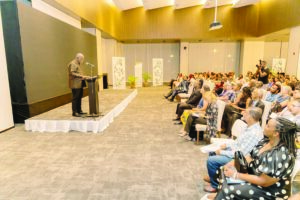
“These achievements remind us that Guyanese stories can travel. They reach classrooms, theatres, prize juries and readers far beyond our shores.”
Moreover, Phillips acknowledged, however, that writers across the Caribbean continue to face challenges, including small markets, high publishing and distribution costs, limited reviewing platforms and insufficient access to professional editing and mentorship. Against this backdrop, he underscored the importance of ensuring that Guyanese literature reflects the country’s full diversity. “We need stories from the coast and the hinterland, from villages and towns, from and about the diaspora, from those who left and those who stayed. We need work that preserves language and custom, examines difficult history, records contemporary change, and imagines futures that have not yet arrived.”
He also called for stronger support systems for writers, including workshops, reading groups, school writing clubs, public readings, editorial services, literary journals, and greater partnerships among writers, libraries, universities, publishers and the private sector. The Government, he added, has accepted its responsibility in helping to strengthen this environment. Since restoring the Guyana Prize, the Administration has made the competition annual, broadened its categories, introduced Youth Awards, and moved submissions and judging online, reducing costs and making participation more accessible to Guyanese writers at home and abroad. This support, he explained, forms part of a wider focus on developing the creative industries. Budget 2026 allocated $3.7 billion to Orange Economy initiatives, while a national stakeholder consultation earlier this year examined areas including training, financing, market access, policy support, and international competitiveness.
Nevertheless, he placed particular emphasis on nurturing young writers and encouraged all participants to continue developing their craft. “Keep writing and keep reading. Invest in yourself as we continue to find ways to invest in you.”
He further urged writers to remain open to rigorous editing and experimentation while continuing to draw from Guyana and the Caribbean without feeling confined by geography or expectation.
With Guyana undergoing rapid transformation, PM Phillips said writers also carry an important responsibility in documenting the period for future generations. “Tell those stories truthfully. Tell them with imagination and skill. Give future readers more than official dates and public events. Give them the private hopes, anxieties, contradictions and humour of the people who lived through this time.”
He congratulated the shortlisted and winning writers, as well as all those who submitted entries, and thanked the judges and organisers for their contribution to the continued development of Guyana’s literary community.
Awardees
Meanwhile, some of Guyana’s established and emerging literary voices were recognised as the winners of the Guyana Prize for Literature 2025, with awards presented across fiction, poetry, non-fiction, drama and youth categories.
In Fiction, Raywat Deonandan won Best Book of Fiction, while Somnauth Narine secured second prize. Jasmaine Payne received the Best First Book of Fiction award for ‘Leech’. Veteran Guyanese poet Maggie Harris captured Best Book of Poetry for ‘I Sing to the Greenhearts’. Scott Ting-A-Kee and Makeda Braithwaite were both awarded second prizes, while Phebe Wallerson was recognised for Best First Book of Poetry. Wallerson also received a second prize for ‘Songs From Sorrow Hill’. In the non-fiction category, Tessa McWatt won the top award for ‘The Snag’, while Joyce Trotman took second prize for ‘Dis Gyrl: The Enchanted Life of Aunty Joyce Trotman.’ The Drama category saw Seeta Shah Roath winning Best Play for ‘Kisna’. Shaphan Hestick placed second with River, Blood, Son, while Mosa Telford took third place for The Bell and the Bones. Young writers were also celebrated. In the Youth Short Story category, Juvelle Atherley claimed first place for ‘Salt Water Does Not Forget’, followed by Sieara Fernandes in second and Gabriella West in third for ‘Armonia’.
The Youth Poetry category produced joint first-place winners, with Mortimer Duke recognised for ‘Notes Towards an Incomplete Definition’ and Ariel Mohanlall for ‘Motion and Buckets’. Jessica Persaud placed third with ‘Oh Sea, Swallow My Pleas’, while Darshanic Tickapersaud received an honourable mention for ‘Ah Still Deh / By the Water Dat Doan Sleep’.
The Guyana Prize for Literature continues to provide a major platform for recognising literary excellence while encouraging the development of new generations of Guyanese writers.
Discover more from Guyana Times
Subscribe to get the latest posts sent to your email.