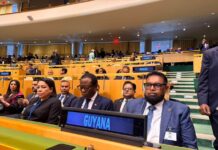
Says tariff not new, will not burden Guyanese exporters
The Guyana Government will be looking to engage United States (US) officials on finalising a reciprocal trade agreement following the Trump Administration’s imposition of a 12.5 per cent tariff on the country.
“Guyana will be pursuing an exemption from these replacement tariffs even while we remain focused on the finalisation of an Agreement on Reciprocal Trade that reflects the strength and maturity of the US-Guyana relationship. We are confident this process will continue on the basis of facts, mutual respect and shared interest,” Foreign Secretary Robert Persaud said in a statement on Friday.
The US Government on Thursday imposed a new wave of tariffs on 60 countries around the world, including Guyana, for failing to ban the importation of goods produced with forced labour. But according to the Foreign Secretary, this is not a new tariff.
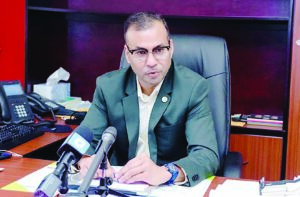
“This measure does not represent a new or additional burden on Guyanese exporters [sending goods to the US],” he said. Persaud explained that it effectively replaces the 10 per cent global reciprocal tariff that expired under Section 122 of the US Trade Act on July 24. In April 2025, the Trump Administration had imposed a 38 per cent reciprocal tariff on Guyana – a figure that was later slashed to 15 per cent, then an interim 10 per cent across the board, and now, to 12.5 per cent. Based on international reports, US trade experts say that the “forced labour” issue is being used as a legal justification to impose the tariff, which the US Supreme Court had previously ruled was illegal.
“It is important that this action be understood in its proper context. It arises from a domestic US legal and policy process, following the Supreme Court’s ruling earlier this year on the limits of executive tariff authority… It is not a judgement on Guyana, and Guyana was neither singled out nor treated differently from dozens of other economies navigating the same recalibration. In fact, 16 countries will face continued investigations, of which Guyana is not a part,” Persaud contended.
In addition to Guyana, the new wave of US tariffs was also imposed on Canada, the European Union (EU), Trinidad and Tobago, India and Venezuela, among others. Based on the new tariff schedule, which took effect on Friday, tariffs range between 10 and 12.5 per cent on various goods from 60 countries. Those countries that have taken steps to ban forced labour were fitted with a 10 per cent tariff, while those that fail to effectively prohibit the practice received a 12.5 per cent tariff. Nevertheless, the Foreign Secretary indicated that Guyana remains firmly committed to its partnership with the US and has been working closely with the United States Trade Representative (USTR) as well as other US counterparts.
Only earlier this month, the Permanent Secretary (PS) at the Foreign Affairs and International Cooperation Ministry, Sharon Roopchand-Edwards, participated in a public hearing hosted by the USTR on ‘Failure to Impose and Effectively Enforce a Prohibition on the Importation of Goods Produced with Forced Labour.’
During her presentation, Roopchand-Edwards contended that any allegations of forced labour must be addressed through lawful, evidence-based investigations.
“To date, the Government of Guyana is not aware of evidence demonstrating that goods produced through forced labour are being manufactured in, imported into, or exported from Guyana,” she told the July 7 hearing.
The PS also noted that Guyana and the US are engaged in discussions toward an agreement on reciprocal trade, including matters related to forced labour goods, arguing that imposing tariff penalties before those talks conclude would be premature and counterproductive – a position that was reiterated by the Foreign Secretary in Friday’s missive.
“Guyana will be pursuing an exemption from these replacement tariffs even while we remain focused on the finalisation of an Agreement on Reciprocal Trade that reflects the strength and maturity of the US-Guyana relationship. We are confident this process will continue on the basis of facts, mutual respect, and shared interest,” Persaud stated.
Last year, when the 15 per cent reciprocal tariff was imposed, the Guyanese government had engaged US authorities to reverse this. In fact, the senior minister with responsibility for finance, Dr Ashni Singh, had led a delegation to Washington DC to meet with the US trade representative, Ambassador Jameson Greer. Following that engagement, Vice President (VP) Bharrat Jagdeo indicated that documentation was submitted to the USTR regarding the tariffs, adding that the US authorities understood that the surplus was largely from oil exports.
“They know that it’s almost entirely from the export of oil into the US. So given that, I think…they’ve approached this matter differently… Now, unlike with some other countries, which I think they take a harder line with, they understood that the [Guyana’s] surplus is a result of the oil export, not any unfair currency practices or protective barriers in Guyana that have led to that situation which they accuse other countries of. So given that goodwill there and the understanding, I anticipate that we should have a favourable outcome,” Jagdeo told reporters at a press conference more than a year ago.
Currently, US-based oil major ExxonMobil and its co-venturers are conducting oil production activities offshore Guyana in the prolific Stabroek Block, where four Floating Production Storage and Offloading vessels (FPSOs) are currently pumping more than 900,000 barrels of oil per day. Plans are underway for a fifth FPSO to start production offshore Guyana later this year.
Discover more from Guyana Times
Subscribe to get the latest posts sent to your email.