


– says nation’s survival hinges on clear ruling
Guyana on Friday asked the International Court of Justice (ICJ) to deliver a clear ruling on the border controversy with Venezuela, as only a definitive one can safeguard its territorial integrity.
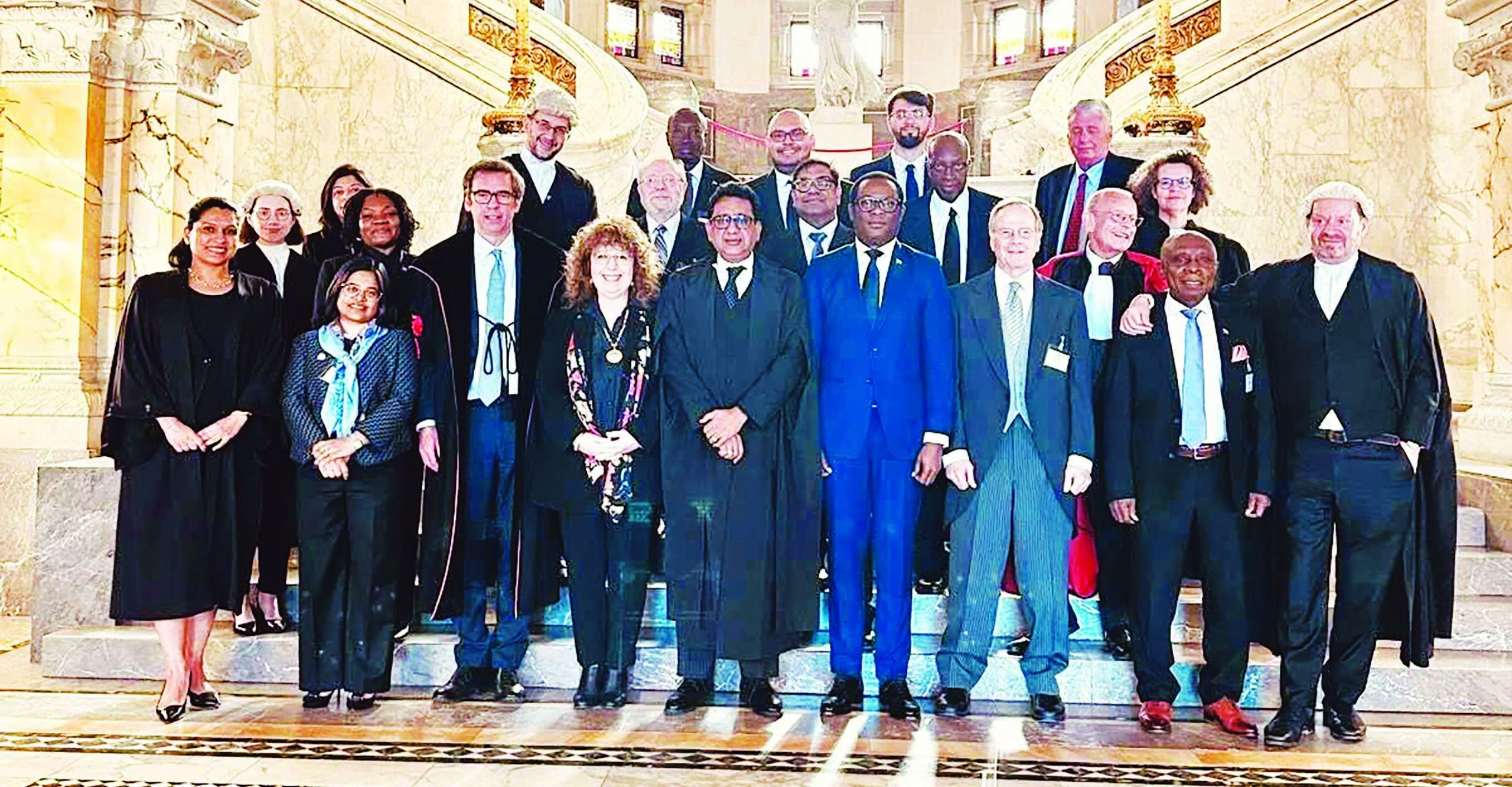
“If the Court accepts Guyana’s arguments, as we are confident it will, then it is essential that the Court’s judgement directly, explicitly, and unambiguously affirms the validity of the 1899 Award in its integrity and the boundary that it established,” Attorney General (AG) Anil Nandlall told the ICJ yesterday during the second round of arguments and as Guyana rebutted Venezuela’s pleadings on Wednesday. Nandlall, who was the penultimate speaker during the hearings at the United Nations’ (UN) highest court, maintained that only a definitive judgement can resolve the matter.
“Any ambiguity or qualification in the Court’s judgement will inevitably be seized upon by Venezuela as a basis for continuing to lay claim to vast swathes of Guyana’s sovereign territory.”
“The clarity and specificity of your judgement are vital to the effective resolution of this longstanding dispute. You will have heard, as we did, the suggestion that a judgement in favour of Guyana would not end the dispute. That suggestion underscores the need for a clear and complete judgement,” he added.
Nandlall emphasised that the dispute is not merely about lines on a map but about the very survival of Guyana as a nation. “The loss of the territory claimed by Venezuela would eviscerate Guyana. Indeed, the country as we know it would cease to exist,” he said.
Echoing with urgency what Foreign Affairs Minister Hugh Todd had said on Monday about the case having “existential quality”, Nandlall stated that for the people of this country, the ICJ represented the final hope of securing peace and stability, while adding that international law remains unshaken.
In its oral arguments on Monday, Venezuela maintained that the Court did not have the right to rule on the merits, to which Nandlall reminded, “Since the start of these proceedings, Venezuela has strained every sinew to avoid the Court delivering a judgement on the merits of Guyana’s application,” he said as he accused Caracas of misinterpreting the Geneva Agreement of 1966, arguing that its claims “find no support in the text or the history of the Geneva Agreement and are contradicted by Venezuela’s previous statements to the Court.”
According to Nandlall, Venezuela’s reluctance is rooted in the weakness of its case. “Venezuela knows that it has no good answer to Guyana’s case, and it knows that a judgement on the merits should bring to an end Venezuela’s claims to almost 160,000 sq km (square kilometres) of Guyana’s territory,” he said.
1899 Arbitral Award
When Guyana’s agent, Carl Greenidge, delivered the closing oral submissions, he firmly restated Guyana’s position that the 1899 Arbitral Award is valid, binding, and definitive in settling the boundary with Venezuela. Greenidge, speaking on behalf of President Dr Irfaan Ali and the Government of Guyana, urged the court to “adjudge and declare” that Venezuela must respect Guyana’s sovereignty and territorial integrity.
“The 1899 Award is valid and binding upon Guyana and Venezuela, and the boundary established by that Award and the 1905 Agreement is the boundary between Guyana and Venezuela,” he said.
He reiterated that Guyana enjoys full sovereignty over the territory between the Essequibo River and the boundary established by the 1899 Award and the 1905 Agreement and that “Venezuela is under an obligation to fully respect Guyana’s sovereignty and territorial integrity.”
Measures
Outlining measures, Guyana recommended that the court also instruct “Venezuela to refrain from asserting or purporting to exercise sovereignty over any part of Guyana’s territory; revoke all measures, including laws, decrees and acts that purport to annex, administer, or control any part of Guyana’s territory; and dissolve entities such as the High Commission for the Defence of Guayana Esequiba and terminate military or administrative activities in Guyana’s territory.
In addition to arguing that Venezuela has failed to prove any historical occupation of Guyana and dispel the notion that the 1899 Award was given through a unanimous ruling, the submissions yesterday from Guyana also asked the Court to recognise Venezuela’s failure to comply with provisional measures ordered on December 1, 2023, and May 1, 2025, and to require Venezuela to withdraw from Guyanese territory, including Ankoko Island, which was attributed to Guyana under the 1899 arbitral award.
“…Venezuela must withdraw from any part of Guyana’s territory as defined under the Award, including the part of Ankoko Island that the Award attributed to Guyana,” he said.
Reaffirming Guyana’s sovereignty, Greenidge further requested that Venezuela cease teaching its population that the Award was fraudulent and withdraw maps depicting Guyana’s territory as Venezuelan. Throughout the second round of oral hearings, Guyana’s counsel hammered at what they believe Venezuela’s rhetoric is and their failure to provide facts, and dismantled the arguments Caracas brought to the court.
Passionate Rhetoric
International lawyer Paul Reichler, who opened the day’s proceedings, dismantled the arguments proffered, which he termed “passionate rhetoric.” He said that Venezuela misconstrued both the 1897 Treaty and the 1966 Agreement and belatedly and groundlessly rejected the 1899 Award, ignoring that it was a historical reality; the aggressor had obstructed and delayed Guyana’s independence and had been threatening the country since then.
Guyana emphasised that Venezuela has failed to produce contemporaneous evidence of Spanish or Venezuelan occupation east of the Essequibo River. Instead, maps and records presented by Guyana showed Dutch and later British settlements across the disputed territory. One striking piece of evidence was the 1897 United States (US)-Venezuela Boundary Commission map, which depicted European settlements as of 1814.
The map confirmed that Spanish presence never extended east of the boundary later upheld in the 1899 Award. The counsel argued that “There is no evidence in the record of this case that Venezuela (or Spain before it) ever occupied any part of it. Venezuela has presented none in this case.” Venezuela’s claim that the Treaty was imposed upon it by Britain and the US was dismissed as Guyana presented 27 documents showing Venezuela actively sought arbitration, appealed to Washington for support and had expressed gratitude when the US compelled Britain to agree.
Then President of Venezuela Joaquín Crespo had declared the lawyer noted that the settlement plan was presented to Venezuela for its consideration, with no coercive intent and in full respect of the sovereignty and independence of the Republic. Guyana argued that Venezuela freely signed the Treaty, contradicting its current claim of coercion.
Geneva Agreement
Turning to the Geneva Agreement, Guyana rejected Venezuela’s recent argument that the accord “set aside” the 1899 Award. The counsel described this interpretation as a “novelty”, noting it was raised only in Venezuela’s 2025 Rejoinder. Guyana pointed to Article V of the Agreement, which explicitly preserved prior claims and rights under the 1899 Award.
“It is undeniable from the text that this preserves all assertions of rights and obligations under the 1899 Arbitral Award,” counsel stated. Guyana’s team accused Venezuela of cynically cloaking its territorial ambitions in the language of decolonisation. They argued that Venezuela’s recent legislation to annex over 70 per cent of Guyana’s territory demonstrates aggression, not victimhood.
“All the myths unravel when confronted by the evidence, the contemporaneous documentary evidence which Venezuela so conspicuously and conveniently ignored,” the counsel told the court.
On Venezuela’s claim that the 1899 arbitral tribunal failed to explain the reasoning behind its decision, Law Professor Alain Pelet countered that, at the time, issuing such a justification was not a legal requirement, even if it might have been considered desirable. He added that the arbitrators could have reached agreement through private deliberations rather than formal written explanations.
He cited part of the tribunal’s text, noting that the panel “investigated and ascertained the extent of the territories belonging to or that might lawfully be claimed by the United Netherlands or by the Kingdom of Spain, respectively, at the time of the acquisition by Great Britain of the colony of British Guiana.”
Professor Philip Sands cautioned that if the ICJ were to side with Venezuela and declare the 1899 Arbitral Award, and by extension the 1905 treaty, invalid, “you would rekindle the embers of dead empires.” He warned that such a ruling would “plunge Guyana into a new form of domination and oppression in relations with its much larger neighbour”.
Sands stressed that the Court would be setting a perilous precedent, one that could “open the gates” to challenges against virtually every colonial-era arbitration award or boundary settlement. He underscored that this would send a global message that even six decades of acceptance is no barrier to overturning an arbitral award or treaty.
“You would rekindle an age of instability and uncertainty, one that would run directly contrary to the wisdom of Africa, one that would threaten to open the gates of challenge to any and every colonial-era arbitration award or boundary settlement,” he said.
Guyana’s application
On March 29, 2018, Guyana filed an application instituting proceedings against Venezuela concerning the legal validity and binding effect of the 1899 Arbitral Award regarding the boundary between the then-colony of British Guiana and the United States of Venezuela.
Guyana brought the case to the ICJ to confirm the validity of the internationally recognised boundary, which was determined by the Award and by a 1905 boundary agreement with Venezuela that adhered strictly to the unanimous decision rendered by the Arbitral Tribunal. The ICJ has already affirmed its jurisdiction to hear this case twice, in judgements issued on December 18, 2020, and April 6, 2023.
The Court has also had to issue two orders, both indicating provisional measures which Guyana had requested, to prevent Venezuela from interfering with Guyana’s lawful control and administration of the territory that is the subject of the controversy while the judicial proceedings are still pending. The written phase of the case concluded last year after Guyana filed two written pleadings on the merits of the case and Venezuela also filed two, the last being in August 2025.
The ICJ will reconvene on Monday to hear Venezuela’s second round of oral arguments.
Discover more from Guyana Times
Subscribe to get the latest posts sent to your email.