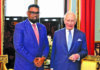
Guyana’s candidate for United Nations Secretary General (UNSG), Ambassador Carolyn Rodrigues-Birkett, has continued her diplomatic engagement with UN member states, presenting her candidacy to Greek Prime Minister Kyriakos Mitsotakis.
The Permanent Mission of Guyana to the UN said in a social media post on Wednesday that Rodrigues-Birkett met with Mitsotakis, with the two engaging in discussions on a number of issues, including the ongoing reform process at the UN.
During the engagement, Rodrigues-Birkett stressed the importance of using the current reform process to strengthen the organisation and make it more agile, efficient and effective.
She also emphasised the need for the UN to improve the impact of its work on the ground, while indicating that she intends to continue engaging with Greece and other member states as she advances her candidacy.
The meeting comes as Rodrigues-Birkett continues to outline the priorities that would guide her tenure if she were selected to serve as SG.
In recent interviews, she identified reform of the international financial system and improved access to development financing for developing countries as important areas of focus.
Rodrigues-Birkett has argued that developing countries have for years advocated for reforms to international financial institutions to create more equitable access to financing.
While acknowledging that the UN is not itself a financial institution, she said the organisation has an important role to play by using its global voice and working with institutions such as the International Monetary Fund and the World Bank.
She pointed out that developing countries play a significant role in the UN’s norm-setting processes, particularly through the Group of 77 and China, but decisions on financing are largely made outside the UN system.
According to Rodrigues-Birkett, reforms are therefore needed to create a fairer playing field for developing countries seeking financing to meet their development goals.
She has also indicated that she would not seek an extensive overhaul of the international financial institutions as the only means of achieving progress.
Instead, she has proposed incremental and systemic changes that could make it easier for developing countries to access financing.
Among the concerns she has highlighted is the disparity in borrowing costs faced by developing countries, including situations where countries with similar challenges can face significantly different financing conditions based on their size.
Rodrigues-Birkett has also pointed to the UN’s work on the Multidimensional Vulnerability Index, which seeks to take greater account of the vulnerabilities of small island developing states when their access to finance is assessed.
She said attention would have to be given to how such measures, or aspects of them, could be incorporated into the decision-making processes of international financial institutions.
She has also called for greater cooperation between the UN and international financial institutions, saying the organisations should approach the issue as partners rather than adversaries.
Apart from financial reform, Rodrigues-Birkett has identified peace and security, development and human rights as interconnected areas that should remain central to the work of the UN.
She has said conflict prevention would be a major priority if she is elected, arguing that the organisation should act before crises fully develop rather than waiting until conflicts escalate.
Rodrigues-Birkett has also pointed to the changing nature of the international environment, including advances in technology and artificial intelligence, geopolitical shifts, climate change, and the spread of misinformation and disinformation.
Against that backdrop, she has argued that the UN must make better use of the tools available to the SG while remaining focused on its three core pillars.
She has also linked development to peace and security, describing development as an important means of preventing conflict.
On the Sustainable Development Goals, Rodrigues-Birkett has said that the goals remain valid but acknowledged that the 2030 targets were highly ambitious.
She said the international community would have to be realistic about the timelines and resources required to achieve the goals, particularly as discussions begin on the post-2030 development agenda.
Rodrigues-Birkett has further identified Private Sector investment as an important component of addressing the development financing gap.
She has argued that the UN could assist developing countries in preparing themselves to attract private investment and better understand the conditions needed to bring private capital into their economies.
She acknowledged that attracting investment would be more difficult in countries experiencing conflict, but said other developing countries could benefit from greater assistance in unlocking private capital.
Her proposed approach combines advocacy for improved financing conditions with technical assistance for countries seeking to attract investment.
Rodrigues-Birkett has said that by the end of a potential five-year term, she would want to see measurable progress in access to finance and Private Sector investment in developing countries.
She has also identified conflict prevention, human rights, and the delivery of UN programmes as areas where she would want to see tangible improvements.
Another objective she has highlighted is the prospect of a woman leading the UN for the first time since its establishment.
President Dr Irfaan Ali in June nominated Ambassador Rodrigues-Birkett to succeed the current UNSG, António Guterres, whose tenure ends on December 31, 2026.
Discover more from Guyana Times
Subscribe to get the latest posts sent to your email.