


Young parliamentarians gathered virtually on Thursday for the 19th Regional Youth Parliament which formed part of the 48th Conference of the Caribbean, the Americas and the Atlantic Region of the Commonwealth Parliamentary Association.
Under the umbrella Conference theme of “Strengthening Parliaments in the Digital Age,” this year’s Sitting focused on the theme, “Youth Leadership in the Age of Artificial Intelligence.” The virtual proceedings were adjudicated by a panel of judges comprising Bermuda’s Shadow Minister of National Security, Governance and AI, Jarion C. Richardson, Justice of the Peace (JP) and Member of Parliament (MP); Founder and Executive Director of the Jamaican Association for Debating and Empowerment, Germaine Barrett; and Jamaican law student and Youth Policy Committee member Jordaina Denton.
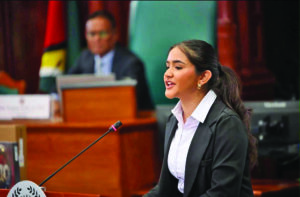
Following the debate, Richardson commended the participants across all benches for the quality of their performance, content and delivery, highlighting that Himanshi Kumar distinguished herself in her content as well as in her style of presentation, which made the judging quite challenging. Himanshi simulated the role of Leader of the Opposition (LOO), challenging the premise that foreign development and ownership of artificial intelligence (AI) technologies pose a threat to Caribbean sovereignty. Opening her presentation, Kumar made clear that the Opposition was not against technological advancement or regional investment in AI. Instead, she argued that the Caribbean’s approach to AI should be centred on regulation, institutional capacity and regional cooperation, rather than an assumption that foreign technology inherently compromises sovereignty. Kumar advanced the argument that sovereignty is fundamentally about a State’s ability to exercise legal and political authority, rather than ownership of every technology it uses. She strengthened this position by pointing to the European Union’s (EU) regulatory influence over global technology companies, referencing the “Brussels Effect” and the EU’s AI Act and General Data Protection Regulation (GDPR). Her argument was that regulatory authority can extend beyond a jurisdiction’s physical borders, allowing countries and regional blocs to influence how multinational technology companies operate.
Kumar also grounded her argument in regional initiatives, pointing to the United Nations Educational, Scientific and Cultural Organisation (UNESCO) Caribbean AI Policy Roadmap 2024 and CARICOM’s digital resilience initiatives as examples of how Caribbean countries can pursue technological development while maintaining domestic legal and regulatory authority. Kumar’s presentation took a further turn as she examined what she described as the more serious democratic risk: the potential misuse of AI by Governments and other actors in positions of power. She cautioned that under the banner of “digital sovereignty,” Governments could potentially seek excessive control over algorithms, surveillance systems and citizens’ data. In conclusion, Kumar drew a distinction between technological dependence and the loss of sovereignty, arguing that dependence can create risks without necessarily amounting to surrender. Instead, she argued that the Caribbean’s digital future would depend on the region possessing “the knowledge to understand it, the laws to regulate it, the institutions to hold it accountable and the political power to decide how it serves our people.” Kumar’s performance demonstrated a strong command of the motion, combining geopolitical analysis, examples of international regulatory practice and Caribbean-specific policy considerations. Kumar was the Best Speaker in the Finals of the Speaker’s National Youth Debating Competition in Guyana.
Discover more from Guyana Times
Subscribe to get the latest posts sent to your email.