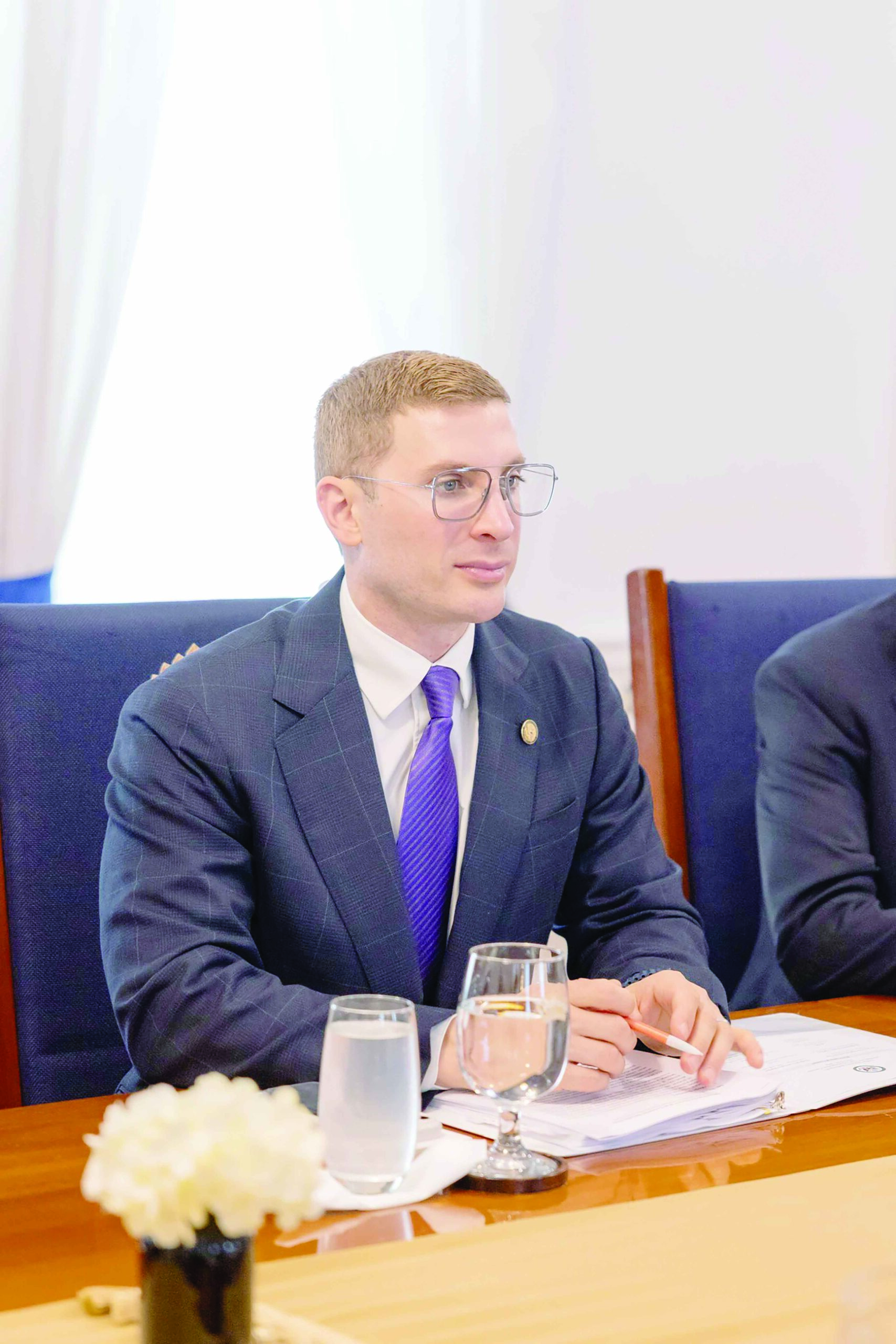
Noting that the United States (US) sees potential in Guyana becoming one of the most prosperous economies in the Western Hemisphere, Under Secretary of State for Economic Affairs Jacob Helberg stressed the importance of intellectual property protection and other governance principles in supporting private sector growth in the country. Helberg told a press conference at the US Embassy in Georgetown on Wednesday that there was “perfect alignment” during his meeting with President Dr Irfaan Ali on the goal to accelerate private investments in Guyana.
“And in order to do that, certain conditions have to be met, including the right to private property, including respecting intellectual property, including, you know, different kinds of principles of governance that the private sector necessarily needs in order to deploy and in order to have the confidence, the predictability, and the certainty to deploy and invest a lot of money,” he noted.
“And so, you know, we focused on the goal; we agreed on the goal; we agreed on next steps, which was the pursuit of technical conversations to discuss, you know, the follow-up details on the approach. And I’m very confident that we have a very strong foundation to work off of,” he added.
Helberg shared those insights in response to questions about the current legislative framework in Guyana surrounding copyright and intellectual property protection. A few years ago, Guyana’s Attorney General (AG) and Minister of Legal Affairs Anil Nandlall held discussions on the intellectual property landscape in Guyana with visiting officials from the US.
Representatives of the US Foreign Commercial Service in Guyana, along with representatives of their sister agency, the United States Patent and Trademark Office (USPTO), are in Georgetown engaging local stakeholders. The USPTO is the federal agency for granting US patents and registering trademarks in key foreign markets. During that meeting, which took place in April 2024, the US officials advocated for the promotion of greater intellectual property protection in Guyana.
In fact, the USPTO had offered assistance necessary to enhance the local intellectual property rights landscape in Guyana and to enhance the ease of access in dealing with intellectual property transactions. In response, AG Nandlall thanked the delegation for initiating the engagement and updated them on the wide-ranging statutory and other legal reforms taking place in Guyana.
He highlighted the modernisation of the commercial architecture as a priority, noting that patents, trademarks, and intellectual property are among the areas for review. Current intellectual property and copyright laws in the country are archaic, dating back to the 1956 British Copyright Act that Guyana inherited when it gained independence from Great Britain in 1966. Though the current act does protect literary, musical, dramatic, and artistic works, the fines are extremely low, ranging mostly from £5 to £50 (GY$1300 to Gy$13,000).
In January 2025, Minister of Culture, Youth, and Sport Charles Ramson Jr recognised that strong copyright legislation is needed to support the work of local creatives and noted that an in-depth analysis is needed before such laws are amended. Vice President (VP) Dr Bharrat Jagdeo has also expressed the view that as the country modernises, so must its copyright and intellectual property protection laws.
“I think it’s time, actually, that we start strengthening our platform because the economy is becoming more modern, and we need new types of business,” Jagdeo told a press conference a few years ago.
Discover more from Guyana Times
Subscribe to get the latest posts sent to your email.