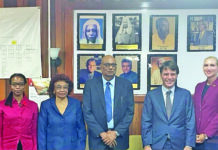


Guyana’s growing leadership in Global Biodiversity Conservation and its efforts to translate ambitious environmental commitments into tangible results, were highlighted and praised by international representatives at the Global Biodiversity Alliance (GBA) Conference, where speakers underscored the importance of international cooperation, sustainable financing and practical action to protect nature.
United Nations (UN) Guyana Acting Resident Coordinator, Katy Thompson; Campaign for Nature Honorary Ambassador Senator Russ Feingold; and World Bank Director of Environment, Valerie Hickey, each recognised Guyana’s role in advancing the global biodiversity agenda, while emphasising the importance of the country’s leadership in creating the GBA and mobilising the resources and partnerships needed to accelerate conservation efforts.
The three speakers emphasised the significance of Guyana’s role in the expanding international biodiversity movement, and the potential of the GBA to help translate political commitments into practical conservation outcomes.
Speaking at the conference, Senator Feingold offered strong recognition of President Irfaan Ali’s leadership in establishing the GBA, describing his international advocacy on biodiversity as significant. He also praised the President’s role in advancing the global 30 by 30 conservation agenda at the United Nations General Assembly (UNGA).
“I want to pay tribute to President Ali, who founded this,” Feingold said. “His role at the United Nations General Assembly as the lead head of state for the Secretary General’s programme on 30 by 30 was masterful,” he said, describing Ali as “a respected international leader on these issues, as well as being a great leader in this country.” Commending the progress being showcased in Guyana, he described the country’s efforts as an example of what can be achieved through strong leadership, partnerships and sustained commitment. “The progress being showcased here today gives us a blueprint for how success is possible,” he said.
Feingold also highlighted the importance of strengthening international partnerships to advance global biodiversity conservation, noting that initiatives such as the GBA and the Commonwealth Nature Initiative can complement each other in elevating the importance of the global 30 by 30 target. He said such efforts reflect a vision of greater international cooperation, where countries and organisations connect, share experiences and support one another in achieving their conservation goals.
“We all need to keep working together to ensure that biodiversity conservation is embraced around the world as a priority,” Feingold said, emphasising the need for a united global commitment to protecting nature. He stressed that achieving the global 30 by 30 target remains feasible, provided countries strengthen political leadership and significantly increase conservation financing. Feingold applauded the GBA Conference as an example of the international cooperation needed to advance the agenda. “Specifically, I’d like to applaud Guyana for advancing plans to protect 1.5 million hectares of rainforest in the Acarai-Rupununi Corridor as part of its commitment to conserve 30 per cent of the country by 2030,” he said.
Held under the theme “Investing in Nature: Accelerating Biodiversity Finance for Sustainable Development,” the 2026 conference builds on the foundation established at the inaugural 2025 Summit, moving the Alliance from its launch phase towards coordinated implementation.
This year’s conference is focused on mobilising public and private financing, strengthening international cooperation and developing practical solutions that turn global biodiversity commitments into measurable results.
The UN’s Thompson, in her address, reaffirmed the UN’s support for Guyana’s environmental ambitions, noting the close alignment between Guyana’s national priorities and the global biodiversity agenda.
“We are very proud as a group to be an ally in the collective effort of the global biodiversity alliance,” she said, recognising Guyana’s contribution to the international effort to protect nature and biodiversity. She described 2026 as a critical year for moving beyond commitments and accelerating implementation, particularly following the first global review of progress under the Kunming-Montreal Global Biodiversity Framework at COP17 in Armenia.
“2026 is the pivotal year for accelerating implementation, mobilising financing and turning global commitments into measurable accountable results,” Thompson said.
She also highlighted Guyana’s participation in the UNDP’s global BioFin programme in 2026, alongside 133 other countries, as part of efforts to better understand biodiversity expenditure, identify financing gaps and develop national solutions to mobilise resources, and emphasised the importance of building confidence among investors and development partners.
From the World Bank Group, Hickey described the GBA as a coalition focused on moving beyond speeches and declarations towards implementation, emphasising that conservation must also improve the livelihoods of families living in the landscapes and seascapes being protected. “Words matter, but action matters more,” Hickey said.
She noted that the World Bank Group invested US$8.8 billion in nature finance last year, with a significant portion directed towards mobilising private capital for nature-related initiatives.
Hickey shared how the UN has been working to develop financial instruments, including blue bonds and biodiversity bonds, that can help channel investment into conservation and sustainable development. She pointed to the growing international interest in these instruments as evidence that capital markets can play a greater role in financing nature.
Turning to the practical requirements for attracting investment, she emphasised the importance of predictable policies, clear regulations and secure land-use arrangements, including community land tenure and concessions.
Hickey also addressed President Ali’s call for an investment vehicle capable of making project-ready financing available. She said that while such a mechanism is important, it must be supported by a strong pipeline of viable projects capable of attracting and utilising the available capital.
“And that means working with the 70 per cent of businesses around the world that are micro and small businesses,” she said, stressing the importance of supporting smaller enterprises with practical requirements such as credit histories and payment systems.
Hickey said these seemingly routine institutional and administrative improvements can make a significant difference in ensuring that local businesses and communities benefit financially from conservation and nature-based economic activities.
Discover more from Guyana Times
Subscribe to get the latest posts sent to your email.