

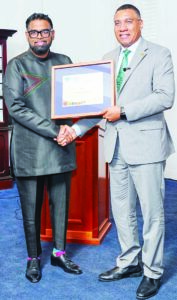
The membership of the Global Biodiversity Alliance (GBA) continues to grow, with Jamaica being the latest country to join the international coalition that is aimed at protecting the world’s biodiversity resources. “I am also very pleased to welcome our newest member of the Global Biodiversity Alliance, Jamaica,” President Dr Irfaan Ali revealed on Friday at State House, standing alongside Jamaican Prime Minister (PM) Dr Andrew Holness.
President Ali presented PM Holness with the official Certificate of Membership at State House on Friday. The Jamaican leader and his team were on a two-day state visit to Guyana, which concluded on Friday with the signing of a number of agreements to further strengthen bilateral cooperation between the two Caribbean nations. The GBA – an initiative crafted by President Ali that seeks to accelerate international financing and technical expertise to conserve the world’s diminishing biodiversity resources – was launched in July 2025 in Guyana with 17 signatories ranging from countries, civil society bodies, the private sector, indigenous peoples and other local and regional organisations.
Membership skyrockets
Jamaica’s accession brings the Alliance’s total membership to 129, less than one year after its launch. Earlier this month, Senior Director of Climate and Reducing Emissions from Deforestation and Forest Degradation (REDD+) in the Office of the President, Pradeepa Bholanath, disclosed that membership of the GBA continues to grow rapidly.
“To date…that membership has expanded to 125 members from 17 members back in July, and that has been really a game changer, because it allows for us to now benefit from growing interests,” Bholanath indicated during an appearance on the Starting Point podcast. She explained that this increased interest is sparking within the private sector. In fact, all the major development banks within the Latin American and the Caribbean (LAC) region – the Inter-American Development Bank (IDB), the World Bank, and the Caribbean Development Bank (CDB) – have joined this initiative. According to the Climate Director, this is particularly significant, especially since the focus at the second GBA summit to be held in Georgetown later this year will be on mobilising financing.
This year’s summit is scheduled to take place sometime in the last quarter, with President Ali slated to announce the dates in the near future. Stemming from the inaugural GBA Summit in Georgetown last July, the GBA Secretariat will be set up in Guyana and will work with key stakeholders to advance its priorities, which include the designation of new protected areas and securing the necessary funding and resources for managing them effectively. President Ali had previously indicated that he intends to significantly increase the Alliance’s membership by the 2026 summit. In fact, the Guyanese leader has been engaging key global officials and organisations to advance the country’s work on biodiversity protection and conservation.
Only back in January, President Ali had engagements with King Charles III and the Commonwealth Secretary-General (SG), Shirley Ayorkor Botchwey – both of whom commended Guyana’s efforts and pledged to the Global Biodiversity Alliance. As a matter of fact, the Commonwealth has agreed to collaborate on strategic initiatives to support the Alliance. A Joint Working Team will advance efforts to establish an International Biodiversity Centre of Excellence based in Guyana. The country is already working with United States (US)-based Yale University to establish this centre and to build a global mechanism through which the facility would be the hub for research, development, policymaking, education, marketing, and developing financing models. Currently, more than 70 per cent of the world’s biodiversity has already been lost over the last 50 years. According to the 2024 World Wide Fund for Nature (WWF) Living Climate Report – a biennial publication – freshwater populations have declined by 85 per cent, followed by terrestrial, 69 per cent; and marine populations, 56 per cent. In the LAC region, 95 per cent of biodiversity loss has been recorded.
Discover more from Guyana Times
Subscribe to get the latest posts sent to your email.