


By Raywattie Deonarine
Residents, parents, educators and other stakeholders gathered on Friday for a consultation hosted by the Education Ministry aimed at discussing the planned construction of the new Suddie Primary School, in Region Two (Pomeroon-Supenaam). The engagement forms part of the Government’s broader push to modernise educational infrastructure while ensuring that communities play an active role in shaping developments that directly affect them. Head Teacher of Suddie Primary School, Venetia Overmola, in welcoming attendees, stressed the importance of collaboration and community involvement in advancing education within the district. She expressed hope that the consultation would generate meaningful discussion and bring the project closer to fruition.
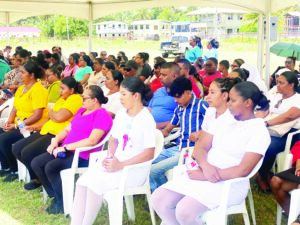
In addition, Regional Education Officer (REDO) Shondelle Hercules highlighted the significance of the project, noting that it addresses longstanding concerns about overcrowding and infrastructure limitations. She emphasised that the new school will better serve the growing student population and improve learning conditions across the community. Providing an in-depth overview of the initiative, Project Coordinator Patrick John explained that the consultation was intentionally designed as an open dialogue rather than a formal presentation, with the goal of gathering community input to guide the project’s development. “The objective here today is to just enter the conversation dialogue with you, to get your thoughts and feedback inputs into the school that will be constructed…” he said
John related that the project falls under the Support to Education Recovery and Transformation Programme, financed through a US$90 million loan secured by the Government in 2024. He emphasised that the initiative is geared toward strengthening human capital and supporting long-term economic growth through improved education systems. “The objective of that loan is to actually contribute to the development of the human capital… necessary to drive economic growth.” he stated. He further detailed that approximately 82 per cent of the funding is allocated to civil works, with a target to construct six new primary schools across Regions One, Two, Four, Five and Six by 2029, in addition to rehabilitating 19 schools nationwide. According to John, the Suddie project was identified based on overcrowding issues and the need to better accommodate students in surrounding areas. Elaborating on the proposed development, he explained that the new school will differ significantly from traditional designs, as it will be guided by newly developed non-academic standards for primary schools. These standards, he noted, outline requirements ranging from land size and classroom capacity to recreational space, safety systems and thermal comfort within classrooms. John also revealed that the facility will incorporate modern features, including digital learning tools and smart classrooms. “All of these schools will have smart classrooms and the classrooms will have digital boards… all the modern amenities that you would expect from a primary school being constructed in the 21st century,” he explained. He noted that the selected site, located at Onderneeming, spans approximately 13 acres, with an application already submitted for five acres to accommodate the project. He encouraged stakeholders to share feedback on the location and overall design.
In addition to infrastructure, John highlighted another key component of the project focused on inclusive education. This includes developing policies and tools to identify students with learning disabilities and creating individualised learning plans supported by trained professionals. Meanwhile, Environmental Consultant, Khalid Alladin of Environmental Management Consultants (EMC) provided further technical details, focusing on the safeguards required for the project’s implementation. He explained that the initiative must comply with the Inter-American Development Bank’s (IDB) environmental and social performance standards, which are designed to ensure that projects are executed responsibly.
Alladin noted that the project has been classified as Category B, meaning that while there may be some environmental and social impacts, these can be effectively managed through proper planning and mitigation. He outlined three key safeguard instruments that must be developed and updated: an environmental and social assessment and management plan, a stakeholder engagement plan, and a sociocultural analysis. These documents, he explained, are essential in identifying potential risks and ensuring that appropriate measures are in place to address them. “The project has to comply with these environmental and social performance standards… to ensure that the project doesn’t negatively impact on the environment or communities.”
Further elaborating, Alladin encouraged participants to provide input in three main areas: the current challenges facing the existing school, recommendations for the design and capacity of the new facility, and any concerns related to construction activities, including environmental, social, and safety issues.
He pointed out that community feedback is critical in shaping both the project design and the mitigation strategies that will be implemented during construction.
Also attending the meeting were Regional Vice Chairman (VC), Humace Oodit, Regional Executive Officer (REO), Susan Saywack, among other regional officials.
Discover more from Guyana Times
Subscribe to get the latest posts sent to your email.