


Nearly six years after the brutal murders of West Coast Berbice cousins Isaiah and Joel Henry, the two men convicted of the killings were on Wednesday each sentenced to two life terms in prison, with Justice Simone Morris ordering that the sentences run concurrently and that they serve a minimum of 35 years before becoming eligible for parole.
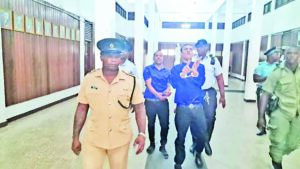
The sentences were imposed on Anil Sancharra, called “Rasta” and “Dan Pole”, and Vinod Gopaul, known as “Magga”, following their unanimous convictions on two counts of murder by a 12-member jury last month.
In handing down sentence in the Berbice High Court, Justice Morris said the punishment had to reflect not only the horrific nature of the killings but also the devastating consequences for the victims’ families and society, while remaining firmly grounded in the evidence presented before the court.
“The sentence of this court must clearly speak to the seriousness of the offence,” the Judge declared.
“It must reflect the value of life, the culpability of the defendants, and the need to deter resorting to violence in moments of conflict or revenge.”
The Judge described the attack as one marked by extraordinary brutality.
“At the time of the attack, Isaiah and Joel Henry posed no threat to either offender,” she said.
“The level of brutality is borne out by the mortal wounds.”
Referring to the medical evidence presented during the trial, Justice Morris observed that the chop wounds inflicted on the teenagers demonstrated the ferocity of the attack.
“The chops were inflicted with great force,” she noted.
Deep public shock
She further stated that while the court was mindful of the immense public outrage which followed the murders, the sentence could only be based on the criminal conduct of the offenders and not on actions taken by others in the aftermath.
“The offence caused deep public shock, fear and grief and unsettled the wider sensibilities of the community and the country in general,” she said.
However, she made it clear that she was careful not to attribute responsibility to the offenders for acts committed by others after the murders.
“I do not take any subsequent unrest or violence, or other intended criminal acts of others, into account.”
Instead, she explained that the sentence reflected the brutality of the murders themselves, the concealment of the bodies, the loss suffered by the families and the need for deterrence.
“Where the attack or killing is carried out with such brutality, the need for deterrence and denunciation is especially strong,” the Judge ruled.
Before sentence was imposed, State Prosecutor Marissa Edwards urged the court to impose a punishment that reflected the gravity of the offences.
She argued that the court should also consider the profound and lasting impact the murders had on the families of the two teenagers and the wider society.
Neither accepted responsibility
Attorneys-at-law Dr Dexter Todd and Chandra Sohan, appearing for the respective defendants, urged the court to consider the personal circumstances of each man before determining sentence.
The court heard that both accused continued to maintain their innocence despite their convictions.
Justice Morris noted that while neither man accepted responsibility for the offences, the court would not treat the absence of remorse as an aggravating factor simply because they maintained their innocence.
In addressing one of the offenders, the Judge observed that he had expressed sympathy for the Henry families while continuing to deny involvement.
“In those circumstances, I do not treat the absence of remorse as an aggravating factor, nor do I punish him for maintaining his position,” Justice Morris explained.
“At the same time, he does not receive the mitigation that would ordinarily flow from accepting responsibility.”
The court also considered extensive probation reports prepared for both offenders.
The report on Sancharra detailed a childhood marked by severe poverty, limited formal education and unstable family circumstances. The offender reportedly left school at an early age to help support his family through fishing and other forms of manual labour.
The probation officer also documented previous convictions, including offences involving larceny and narcotics, and noted that members of the offender’s community described him as someone who frequently became involved in conflicts and confrontations.
The report stated that although the offender expressed sadness over what the Henry families had endured and pleaded for mercy, he denied involvement in the murders and accepted no responsibility for the crimes.
The probation officer ultimately concluded that while the offender had experienced significant social and economic hardship throughout his life, there was no expression of remorse or accountability for the offences for which he had been convicted.
The probation report for Gopaul painted a picture of a troubled upbringing characterised by domestic instability, exposure to violence and chronic deprivation.
The court heard that he grew up in an environment affected by persistent conflict and that his formative years were marked by trauma.
The report also documented a lengthy criminal history, including previous convictions and periods of imprisonment.
Community members interviewed during the preparation of the report expressed fear at the prospect of his eventual return, with some reportedly describing him as a dangerous individual and indicating they would be afraid if he were released.
The probation officer also recorded statements from relatives who described him as caring towards members of his family and continued to insist that he had been wrongfully convicted.
The court further received psychiatric evaluations for both men. Justice Morris noted that neither report identified any mental illness or psychological condition capable of reducing criminal responsibility or explaining the extreme level of violence involved in the commission of the offences.
Instead, the psychiatric evidence found both men fit, mentally stable and capable of understanding the proceedings before the court.
No significant mitigating factor
The Judge said those reports provided no significant mitigating factor capable of reducing the appropriate sentence.
Turning to the victim impact statements, Justice Morris acknowledged the immeasurable suffering endured by the Henry families since the deaths of the two teenagers.
The court heard that the murders devastated both families, with relatives recounting years of grief, emotional trauma and loss.
Shattered family
Joel Henry’s brother told the court that the murders shattered the family, explaining that their mother’s health deteriorated after the killings and she later died. He also spoke of the death of another brother and described December 22 and 23 each year as particularly painful reminders of the tragedy.
He said the family continued to live with the horrific memory of the way Joel and Isaiah lost their lives, adding that while some relatives had chosen forgiveness, they would never forget the brutality of the killings.
Isaiah Henry’s father, Gladstone Henry, described his son as a generous and loving teenager whose death sent shockwaves throughout the West Coast Berbice community.
He told the court that no parent should ever have to bury a child and spoke of the devastating toll the murders had taken on his family. He recounted losing loved ones in the years following the killings and said it was only after the death of his wife that he finally allowed himself to grieve openly, having previously remained strong for the sake of his family.
The Senior Henry nevertheless told the court that despite the pain, he did not harbour hatred towards the convicted men and continued to pray that justice would be done.
In assessing the appropriate sentence, Justice Morris said the court was required to balance the aggravating and mitigating factors applicable to each offender individually.
She noted that while both men had experienced hardship during their lives, neither their personal histories nor the psychiatric evidence diminished their culpability for offences of such gravity.
The Judge also considered each offender’s previous convictions, observing that although they were not for offences of comparable violence, they nevertheless demonstrated a pattern of disregard for the law.
After weighing all of the evidence, the reports and the submissions made by both the prosecution and defence, Justice Morris concluded that life imprisonment was the only sentence capable of reflecting the seriousness of the crimes.
She sentenced each offender to life imprisonment on both counts of murder and ordered that the sentences run concurrently.
Eligible for parole
In accordance with the law, Justice Morris further directed that each man must serve a minimum of 35 years before becoming eligible for parole.
The prosecution’s case rested heavily on the testimony of Akash Singh, who was originally charged alongside the two accused before becoming the State’s principal witness. Singh told the court that he had accompanied the men to a marijuana camp in the Cotton Tree backlands, where cannabis plants were being cultivated. According to his evidence, when they returned to the camp, they discovered that the marijuana crop had been destroyed, prompting a discussion over who was responsible.
Singh testified that Isaiah and Joel Henry later entered the area and were confronted by the two accused. Recounting the attack, he told the jury: “The taller one run and Magga chop he, and Rasta chop the next one”, adding that there were “plenty chops” as the teenagers were repeatedly attacked.
He further testified that after the killings, the bodies were tied onto horses and removed from the scene before being left in nearby vegetation. Singh said he was instructed to dispose of the cutlasses and bloodstained clothing by throwing them into a nearby canal and complied because he feared for his life.
According to Singh, both accused warned that they would kill him if he disclosed what he had witnessed. He remained silent until his arrest months later, after which he gave investigators a statement and later accompanied Police into the backlands, identifying locations that became significant during the investigation.
Medical evidence presented during the trial by Government pathologist Dr Nehaul Singh established that both teenagers died from multiple chop wounds inflicted with considerable force, findings which Justice Morris cited in describing the exceptional brutality of the murders.
Last month, after deliberating on the evidence, a 12-member jury unanimously found both men guilty of the murders of Isaiah and Joel Henry.
Discover more from Guyana Times
Subscribe to get the latest posts sent to your email.