

…pilot recalls spotting unidentified red light during search
None of the 26 persons rescued in the initial hours by Petty Officer of the Guyana Defence Force (GDF) Coast Guard Jeromey Agard following the MV Barima tragedy were wearing a life jacket.

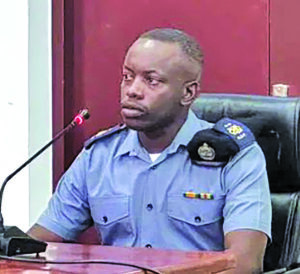
Instead, they were found floating on life jackets or holding on to other nearby materials.
Petty Officer of the Guyana Defence Force (GDF) Coast Guard Jeromey Agard made this revelation during Monday’s hearing of the Commission of Inquiry (COI) into the sinking of the MV Barima.
According to Agard, at about 22:00 H on July 18, 2026, he received a call from Lieutenant Coast Guard Heywood, who instructed him to prepare his team for a possible search-and-rescue operation.
Agard testified that he assembled his team, briefed them on the potential operation, and ensured that their vessel was equipped with sufficient life jackets, ropes and life rings.
At about 22:30h, Agard received another call instructing him to report to the operations centre, where he was informed that a Transport and Harbours Department vessel had sunk and that his team was required to assist in the search-and-rescue effort.
While travelling to the scene, Agard contacted Petty Officer Deon Smith, who was operating another Metal Shark vessel and had already rescued several survivors.
During questioning, commissioners asked Agard whether he recalled stating in paragraph 10 of his testimony that his team had rescued a total of 26 people. He confirmed that the survivors included men, women and children.
When asked to describe the life rafts, he saw floating in the water, Agard described them as “floating object.”
In paragraph 16 of his testimony, Agard also indicated that he had assisted in transporting French divers from Charity to the scene. He explained that he was tasked only with transporting the divers and their equipment to the area of operation and was not required to make direct contact with them.
While rescuing survivors, Agard recalled seeing groups of approximately three people who were not wearing life jackets but were instead floating alongside them, while others were holding on to nearby objects, including pieces of wood.
Describing the rescue operation, Agard explained that after reaching the designated area, he instructed the vessel’s operator to reduce speed and switched on the searchlight.
He said two team members were positioned at the bow and two at the stern. As the searchlight swept across the water, the team members at the bow used a rope and life ring to assist people in the water.
Once the survivors had secured themselves to the life ring, the rope was pulled towards the stern, where Agard and the other team members helped pull them aboard the vessel.
Safe speed
The Commission was keen to establish the speed at which Agard had been travelling during the operation. However, he could only provide the speed they had been advised to maintain, which he described as a “safe speed”.
He noted that he slowed down after the team realized that people were nearby. His vessel, which was equipped with a 350-horsepower engine, was slowed to avoid striking anyone in the water.
“Whilst doing training, we’re being taught safe speed, and if there is limited visibility, then we should operate within the safe speed, so if anything is to pop up in front of us, we’re able to deviate or divert. I would speak to the operator, tell him to reduce speed, and we manoeuvre slowly within the water in order to be safe and make sure that we don’t hit anyone,” he testified.
Meanwhile, the Commission questioned Agard about whether he had sufficient supplies, including blankets and first-aid materials, to assist survivors who may have suffered cuts, bruises or other injuries and to care for them until they were handed over, to this end he notified them that there was no use for first aid for the person’s he rescued.
The commissioner noted that the 26 survivors may have spent varying periods in the water and sought to establish whether Agard had the necessary resources to address their needs. In response, Agard said he could not recall all the details but confirmed that he had a first-aid kit aboard the vessel.
First Aid response
The questioning grew more probing as the Commission sought to understand how the search-and-rescue operation unfolded, including how Agard determined the search area and the patterns used to locate survivors.
Agard explained that he established a search perimeter around the coordinates he had received and conducted the search within that area. As the questions continued, commissioners also sought to establish whether the operation initially focused on saving lives and whether the urgency of those efforts diminished as fewer people were spotted in the water.
Aerial response
Meanwhile, the inquiry turned to the aerial response, with Guyana Defence Force (GDF) pilot Major Lloyden Layne recounting a nighttime reconnaissance mission during which he spotted a red light offshore following the MV Barima tragedy. He said he circled the area for approximately 20 to 25 minutes, attempting to determine what lay behind the unexplained light in the darkness.
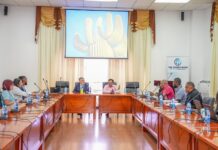
During his appearance before the five-member Commission at the Arthur Chung Conference Centre (ACCC), Layne detailed a reconnaissance mission that lasted approximately one hour and ten minutes, during which he descended to about 500 feet.
The mission began after he received a call from his commanding officer, Lieutenant Colonel Joslyn Hassanah, informing him that a vessel had sunk off the coast and requesting a flight from Ogle to Anna Regina, Essequibo Coast.
Layne told the commissioners that upon reaching the designated coordinates, he observed what appeared to be a red light offshore. The position was marked on the GPS, and the coordinates were relayed to his headquarters. He also presented the Commission with a visual representation of the light he had observed.
“When I arrived at the area of the coordinates, I saw what appeared to be a red light in that general area. That area was offshore. The position was marked in the GPS, and that position was relayed to my headquarters. I flew in the area for about 20 to 25 minutes, and the red light was there at all times. I was over the red light, circling it for about 25 minutes. There wasn’t anything that I saw; it was pitch black,” Layne testified.
He said he had no idea what the red light was and subsequently did not find out its source, despite circling the area for approximately 20 to 25 minutes.
When Hassanah asked about deploying to Hampton Court instead, Layne said he explained that the airstrip there was also unlit.
Layne also stated that the Anna Regina airstrip did not have lighting to illuminate the area at night. The airstrip, located on the Essequibo Coast, is fenced and paved and can accommodate aircraft landings, but it does not have its own lighting infrastructure.
The MV Barima capsized and sank on July 18, 2026, approximately 9.3 nautical miles off Devonshire Castle on the Essequibo Coast.
The passenger and cargo ferry had departed the Kingston Goods Wharf in Georgetown at about 15:15h on its scheduled journey to Port Kaituma in the North West District.
However, at about 23:01h, the vessel transmitted a distress signal after encountering difficulties off the Essequibo Coast, near the mouth of the Pomeroon River.
A total of 179 people, including 18 crew members, were on board.
The disaster claimed 73 lives, while 76 people survived and approximately 30 remain unaccounted for.
The CoI was set to examine the causes and contributing factors to the disaster, including the loading of the vessel, passenger boarding procedures, conditions on board, the vessel’s seaworthiness, maintenance history, compliance with maritime laws and safety standards, the conduct and competence of the master and crew, passenger management and lifesaving arrangements, as well as the roles of weather, sea conditions and other operational factors. Further, the commission will undertake a review of the search, rescue, and recovery operations, assessing the adequacy, coordination, and effectiveness of the response by all agencies and stakeholders involved.
Discover more from Guyana Times
Subscribe to get the latest posts sent to your email.