

– says “All we could see were our flares…”
As day-two of the Commission of Inquiry (COI) into the MV Barima tragedy commenced on Thursday at the Arthur Chung Conference Centre commenced, Roraima Airways pilot Captain Learie Barclay recounted his involvement in the search and rescue operations one day after the vessel sank.
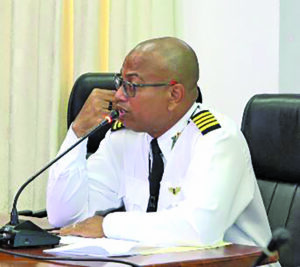
According to Barclay, after receiving the coordinates from National Security Advisor Gerry Gouveia Snr. during the wee hours of the day of the incident, he flew a Roraima Airways Highlander aircraft to the location.
The aircraft departed Ogle at 01:26h and reached the Hampton Court area approximately 30 minutes later. The CoI previously heard that the MV Barima emitted a distress signal as it was sinking at around 22:43h on July 18.
However, the coordinates were inaccurate, and he eventually located the correct area within 30 minutes of the operation approximately three miles from the initial location provided.
He explained that, in the pitch darkness, he saw a flare at approximately 02:09h, followed by two more flares in the sky. These were the only signs that persons were at that particular site.
During his testimony, Barclay revealed that the aircraft lacked external search lighting and thermal imaging equipment that could have helped identify people in the water following the sinking of the vessel.
Better equipment
Barclay further noted that the aircraft’s visual search capabilities were limited at night, making it difficult to locate people in the water. He said that forward-looking infrared (FLIR) technology on an air-search-and-rescue platform would have helped them locate those in distress.
“With the equipment we had, what I would say is that the technology needs to be acquired, and forward-looking infrared is that technology… the forward-looking infrared that, actually, on that night would have done a much better job than we would have because the forward-looking infrared would have been able to pinpoint every single body in that ocean.”
According to him, they were basically using the old but reliable technology of the Mark 1 eyeball and effectively hoping that they would see a flare.
“We didn’t have things like forward-looking infrared or so on that could have detected the warm bodies swimming or floating underwater, holding on to something. So, all we could see were our flares at night. That’s all we were capable of doing. And thankfully, I’m happy that we were able to see that. That we were able to find the flares. But at that point, based on the equipment we had and the capability we had, our mission was effectively over at that point, considering the equipment we had.”
Room for search & rescue improvement
Barclay, who admitted that he was not trained in search and rescue, added that there was room for improvement with regard to response time.
On this note, Rear Admiral (Ret’d) Hayden Pritchard questioned whether, in hindsight, more sorties should have been conducted and whether the other four available aircraft should have been deployed to support the operation.
Barclay replied, “I think we are now determining what is. What I can say is, for our side of things, for the aviation side of things, it worked. Because you get a call, you respond. That is how it has always been. Every emergency, you get a call, you respond. We have been able to perfect that, to respond very quickly to calls, 24 hours a day.”
Admiral Pritchard challenged his point of view, asking, “May I challenge you on that…point? You got a call at 00:16. You departed at 01:36. Do you think there is anything that could be done to improve that response time?”
Barclay admitted that there was a need for improvement.
“Yes, there is always room for improvement. At that specific time, we were not set up for that type of operation. Usually, you would have a standby pilot.”
In addition, Commissioner Dr Andrzej Jasionowski questioned Barclay about the role of the crew member who was not present at the hearing but had been responsible for conducting the search operation. The commissioner explained that the crew member’s duties would have included looking for survivors, life rafts and other signs of life.
The commissioner further asked whether the crew member had been unable to see anything that night despite having the equipment available.
When asked about the range of the night-vision equipment and how far it could detect persons or other signs of life, Barclay explained that he was not the person using the equipment and could not confirm its effective range.
The commissioner then pointed out that, regardless of the equipment’s range, the search had failed to locate anything.
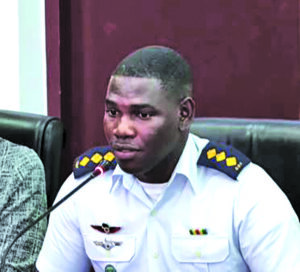
In addition, Captain Andio Crawford of the Guyana Defence Force (GDF), who said his role was to provide support as co-pilot to Lieutenant Colonel Wicks, also testified about the search-and-rescue operations.
During the proceedings, it was noted that Crawford had served as co-pilot and that another officer on board had been equipped with night-vision goggles.
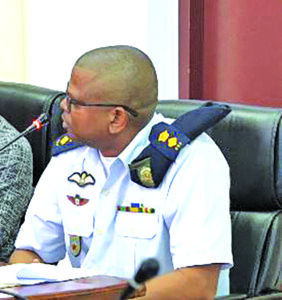
Meanwhile, Lieutenant Colonel Anson Weekes, a senior command pilot in the GDF Air Corps, testified that the Bell 407 is a single-engine helicopter and that operational restrictions prevented the aircraft from conducting searches over open water at night.
On July 18, the MV Barima departed the Georgetown stelling at about 15:00 hrs on its scheduled voyage to Port Kaituma, North West District, carrying 179 persons, including 18 crew members, as well as cargo.
According to officials, the vessel encountered rough sea conditions off the Essequibo Coast, near the mouth of the Pomeroon River, late that night and capsized.
The COI into the MV Barima tragedy continues at the Arthur Chung Conference Centre (ACCC), Greater Georgetown.
Justice Godfrey Phillip Smith is chairing the inquiry alongside Commissioners Alfonso, Pritchard, Captain Hamada Fouda and Dr Andrzej Jasionowski. They are supported by counsel and attorneys Teni Housty and Arudhanath Gossai.
Discover more from Guyana Times
Subscribe to get the latest posts sent to your email.