

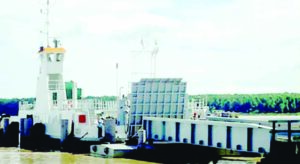
The MV Canawaima has been cleared to continue operating between Guyana and Suriname following a reinspection on Thursday, just eight days after Surinamese maritime authorities claimed that the majority of previously identified deficiencies aboard the vessel had not been remedied.
Surinamese online publication Waterkant reported Thursday that the threatened sailing ban was lifted following a reinspection of the vessel on August 13. The ban had been due to take effect at midnight on August 14 if stipulated safety requirements were not met.
The ferry was operating at Moleson Creek on Friday, removing, at least for now, the prospect of an interruption to the vital cross-border service used by passengers, transportation providers and businesses moving goods between Guyana and Suriname.
According to the report, Canawaima Ferry Service Inc (CFS) and Canawaima Management Company NV (CMC) said the ferry was reinspected and was again permitted to sail.
The companies said the safety of passengers, crew and the vessel remained paramount and indicated that technical follow-up of the MV Canawaima would continue in keeping with arrangements that had been made.
However, the announcement did not detail which of the deficiencies identified during an August 5 inspection were subsequently corrected, what work remains to be completed under the continuing technical follow-up, or whether the vessel was granted a temporary exemption from mandatory dry-docking.
No prolonged interruption
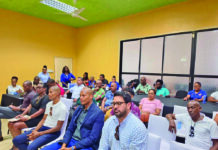
The development has been welcomed by persons whose businesses depend on the ferry connection, even as they supported the insistence by Surinamese maritime authorities that the vessel satisfy the required safety standards.
President of the Upper Corentyne Chamber of Commerce and former Mayor of Corriverton Hemchand Jaichand, speaking in his personal capacity as a businessman, said passenger safety must take precedence.
Jaichand said that based on his understanding of the arrangement between the two countries, Suriname has responsibility for areas including inspection and dry-docking of the vessel.
“I agree that the boat should have certain prerequisites in the interest of safety,” he said.
Jaichand said he has received complaints on several occasions about problems affecting the ferry and welcomed the intervention.
At the same time, he stressed that any prolonged interruption to the service could have implications for trade between the neighbouring countries.
“I believe the Canawaima playS an integral part in it, in terms of transportation. Vehicles that come with goods and services from Suriname, likewise Guyana, travelling to Paramaribo. So if there is a downtime with the Canawaima, it definitely would affect commerce,” Jaichand explained.
Transportation providers who depend on passengers using the ferry had also been closely following the possibility that the vessel could be prevented from operating.
Donald Shepard of Donald Transportation Service said operators had concerns when information emerged that the vessel could be grounded if it failed to satisfy the requirements imposed by the Maritime Authority Suriname (MAS).
Shepard said transportation providers subsequently received information that the ferry would continue operating and were at Moleson Creek on Friday providing their normal services.
Another transportation provider operating at the crossing said the possible suspension had caused concern but maintained that safety could not be compromised simply to keep the service running.
“Safety comes first, and safety comes last,” he said, adding that maritime authorities were within their rights to insist that the necessary requirements be fulfilled.
He pointed out, however, that an interruption to the ferry service, including when the Canawaima eventually enters dry dock, could directly affect the livelihoods of transportation providers who depend on passengers travelling through Moleson Creek.
Lifting threat of sailing ban
The lifting of the threatened sailing ban follows weeks of concern over the condition of the ferry and a warning from MAS that it could be prohibited from operating unless specific safety requirements were addressed.
According to reports based on correspondence from MAS, the authority had written to CMC on July 26, requiring the company to submit within one week an action plan addressing deficiencies identified during an inspection of the vessel.
MAS carried out another inspection on August 5, and found that the majority of the previously identified deficiencies had still not been remedied.
Two days later, on August 7, MAS gave the company a final opportunity to act, setting August 13 as the deadline for several safety requirements to be satisfied. Failure to comply would have resulted in the ferry being prohibited from sailing from midnight on August 14.
Among the requirements, all legally prescribed safety equipment had to be aboard the vessel and ready for use, while firefighting equipment had to be present, inspected, and immediately usable.
The fire-detection and firefighting systems also had to be fully operational.
MAS further required crew members to possess valid Basic Safety Training and Crowd Management certificates. Where certificates were outstanding, written proof had to be provided showing that the relevant training would be completed within one month.
Additionally, an independent, recognised ship surveyor was required to inspect and assess the watertight integrity of the vessel’s hull and cofferdams.
A positive report was required before consideration could be given to a temporary exemption from mandatory dry-docking.
The company had also been required to provide an action plan containing a timetable for rectifying the identified deficiencies, carrying out major repairs and undertaking the planned dry-docking of the vessel.
While Thursday’s reinspection removed the immediate threat of the Canawaima being prohibited from sailing, the information released following the inspection has not provided a detailed accounting of the remedial work undertaken between the August 5 inspection and the August 13 reinspection.
Joint venture
The issue had prompted a response from Guyana’s Ministry of Public Works on Tuesday, which pointed to the division of responsibilities under the joint venture governing the ferry service.
The Ministry said that under the agreement, Guyana provides the fuel, lubricants and batteries necessary for the ferry’s daily operations, while Suriname is responsible for maintenance and dry-docking.
At the time, the Ministry said the Guyanese side of the joint venture had been engaging its Surinamese counterparts over the preceding several days and anticipated that those engagements would result in a resolution.
Guyana also reaffirmed its commitment to the joint-venture agreement and to ensuring that the two countries maintain a safe transport link through an efficient and seaworthy ferry.
The planned dry-docking of the Canawaima was already under discussion before the latest safety concerns became public.
In July, officials from the two countries had discussed the planned dry-docking and an overhaul of the ferry’s main engines, with arrangements for a replacement vessel during the maintenance period also contemplated.
Discover more from Guyana Times
Subscribe to get the latest posts sent to your email.