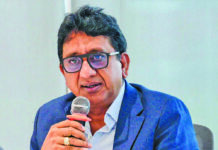
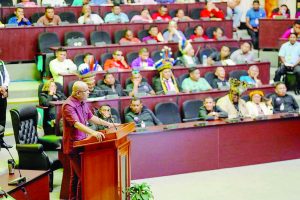
Vice President (VP) Dr Bharrat Jagdeo has called on Indigenous leaders to help steer the next phase of development in Guyana’s hinterland communities by placing greater emphasis on job creation, income-generating activities and housing, while assuring that Government support through the Low Carbon Development Strategy (LCDS) will continue over the next six years. Jagdeo made the remarks on Monday during an interactive session with Toshaos attending the 2026 National Toshaos Council (NTC) Conference, where he outlined the Government’s vision for strengthening village economies and improving livelihoods across Indigenous communities. Addressing the gathering at the Arthur Chung Conference Centre (ACCC), the VP reflected on the People’s Progressive Party/Civic’s (PPP/C) victory at the 2025 General and Regional Elections, noting that the party increased its parliamentary majority from one seat to seven. He said the outcome demonstrated public confidence in the Government’s development agenda. “The development of our country is not an easy task and development doesn’t come overnight,” Jagdeo said. “We have had to walk a long road together from one of the poorest countries in the world, one of the most heavily indebted countries in the world, to today one of the shining examples of how a country should manage progressively its economy and its national affairs.” He said Guyana’s progress had been achieved despite political challenges and criticism from the opposition, stressing that meaningful development requires careful planning rather than rhetoric.
Oil wealth misconceptions
Jagdeo also addressed what he described as misconceptions surrounding Guyana’s oil revenues, saying many people assume the country’s oil wealth is sufficient to fund every national need. He explained that all of the oil revenues collected to date are still insufficient to finance even 40 per cent of the national budget. “I keep saying to them that until this year, all of the oil money that we collected can’t fund 40 per cent of our budget. Every cent of oil money that we collected can’t fund 40 per cent of our budget,” he said. According to the VP, this demonstrates the importance of prudent financial management and continued economic growth outside of the petroleum sector.
Hinterland benefiting
Jagdeo said the Government has worked to ensure that Indigenous communities receive a fair share of national resources through investments in infrastructure, education, healthcare and direct financing. He pointed to the LCDS as one of the major programmes supporting village development, noting that approximately $14 billion has been allocated directly to Indigenous villages over the past three years.
Those funds, he said, have financed more than 3,000 community projects across over 250 villages. Jagdeo commended village leaders for managing those projects efficiently. “We have been able to directly allocate funds to the villages through the LCDS for the villages to spend this money in a way that the people of the villages see fit, and that has yielded enormous benefits,” he said. He contrasted the progress made by village councils with projects previously managed by international agencies, arguing that local leadership had delivered results more efficiently. “If we had given external agencies this responsibility, it would take 100 years to do what the people and leadership of these villages have done in three short years,” he told the gathering.
Focus on jobs
While acknowledging improvements in roads, schools, health facilities and public services, Jagdeo said the Government believes the next phase of development must focus on creating employment opportunities within hinterland communities. He noted that six years ago unemployment was one of the country’s biggest concerns. Today, however, labour shortages exist across many coastal regions because of economic expansion. The situation in the hinterland, he said, remains different. “In the hinterland, we still have unemployment in many of the villages,” Jagdeo said. “One of the things we’ll be discussing is how we can work with you to generate more employment opportunities in the villages.”
He encouraged Toshaos to identify sustainable economic activities that match the strengths of their individual communities. Recognising that each village has different resources and environmental conditions, Jagdeo said development plans cannot follow a one-size-fits-all approach. Communities located in forested areas, savannahs or along rivers, he noted, will require different economic models.
Sustainable opportunities
Jagdeo said discussions throughout the conference would centre on identifying projects capable of generating long-term income rather than short-lived ventures. Among the possibilities he suggested were expanding coconut cultivation in Region Two, honey production using beehives in forested communities, livestock rearing and other agricultural enterprises with established markets. Using coconut production as an example, Jagdeo said villages could establish large-scale plantations capable of generating tens of millions of dollars annually while creating dozens of jobs. He stressed that any project selected must be supported by reliable markets to ensure long-term sustainability. “We need to go for the things that have the market in the long run,” he said.
Innovation hubs
To support economic diversification, Jagdeo announced that the Government intends to establish innovation and technical support hubs in every administrative region. These centres, he explained, will provide technical guidance and help communities develop sustainable enterprises. He said traditional extension services alone would not be enough to drive the level of diversification Government is seeking.
Zero-interest loans
Jagdeo also highlighted plans for the establishment of a Development Bank, which he said will play a major role in supporting Indigenous entrepreneurs. The bank will provide zero-interest loans without requiring collateral, addressing one of the major challenges faced by residents of Amerindian villages where communal lands cannot be used as security for commercial loans. He said discussions would examine ways of making small loans more easily accessible through partnerships between village councils and the Development Bank. The Government, he added, also wants feedback from village leaders on how best to administer community credit programmes after previous revolving loan initiatives experienced repayment challenges. “You can’t develop a business environment without credit,” Jagdeo said.
Building village capacity
The VP also proposed expanding opportunities for village councils to undertake public infrastructure projects. Rather than relying heavily on outside contractors, Jagdeo said Government wants Indigenous communities to build the technical capacity to construct roads and other public works themselves. He acknowledged that this would require investment in heavy equipment, training and maintenance.
Equipment valued at tens of millions of dollars, he noted, must be properly managed by trained operators to ensure it remains functional over the long term.
“We have to make sure that we don’t break up that equipment,” Jagdeo said, adding that building technical skills within villages would create additional employment while strengthening local capacity.
Housing support
Housing was another major area identified for discussion during the conference.
Jagdeo said the Government wants to work with Indigenous leaders to develop more effective ways of providing housing assistance. Rather than issuing small cash grants that are sometimes diverted to other purposes, he said Government is considering alternative approaches that would ensure assistance directly improves people’s homes. He urged Toshaos to provide recommendations on how housing programmes can better meet the needs of residents in their respective communities.
Preparing village proposals
Jagdeo encouraged every village to use the conference to develop proposals identifying at least three economic initiatives capable of generating jobs and increasing household incomes. Those proposals, he said, will be examined by the Government to determine their costs, sustainability and the type of support required for implementation. He said while Government will continue investing in schools, healthcare, roads and other traditional infrastructure, the focus must now expand to creating lasting economic opportunities within villages. “We have to make a transformation,” Jagdeo said. “We have to focus on income-generating activities, employment creation, economic infrastructure, housing and access to credit so that people can build better lives without having to leave their communities.”
Discover more from Guyana Times
Subscribe to get the latest posts sent to your email.