


…task force set up after 3 children killed in 3 weeks
Pres. Ali sets up Task Force to look into comprehensive actions for children’s welfare, safety
With at least three children killed across Guyana over the past three weeks, President Dr Irfaan Ali has commissioned a broad-based Task Force to develop comprehensive recommendations and actions to address the welfare and safety of the country’s most precious assets – its children.
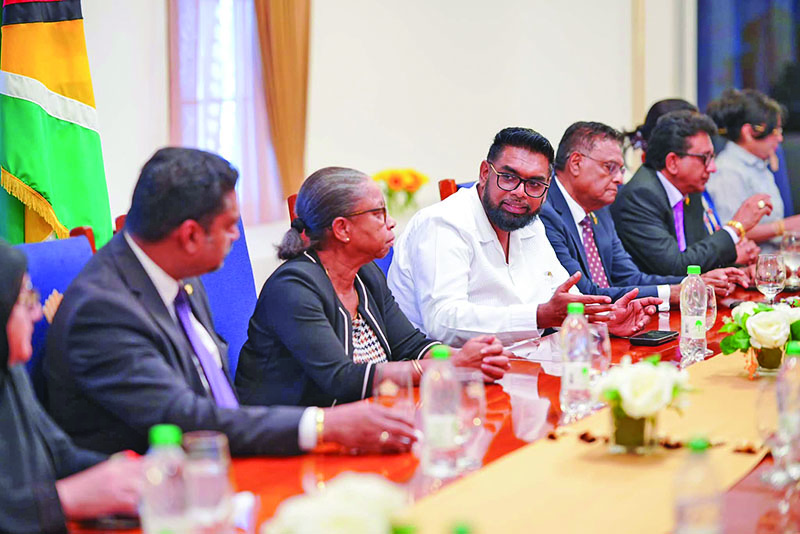
The Head of State convened the consultative engagement on Friday with representatives from Government, the Judiciary, the Speaker of the National Assembly, constitutional commissions, law enforcement agencies and civil society organisations, during which a number of key and critical issues concerning the mental health, welfare and safety of Guyanese children were discussed.
Based on recent events, the stakeholders at the meeting agreed that several segments of society must take immediate, drastic, and coordinated action to address the wide range of factors that have led to the current situation.
It was further recognised that this approach must include the parents, the Government, the school system, the social and religious organisations, law enforcement, the Judiciary, and every other important stakeholder organisation in society.
Public awareness, education, parental support, activities at schools, psychosocial support, mentoring, the promotion of healthy, recreational activities, regulating exposures to music, social media and other such influences, revision of laws, reviewing law enforcement approach and adjustments in the administration of justice, among other measures, were all considered key and critical to addressing this national problem.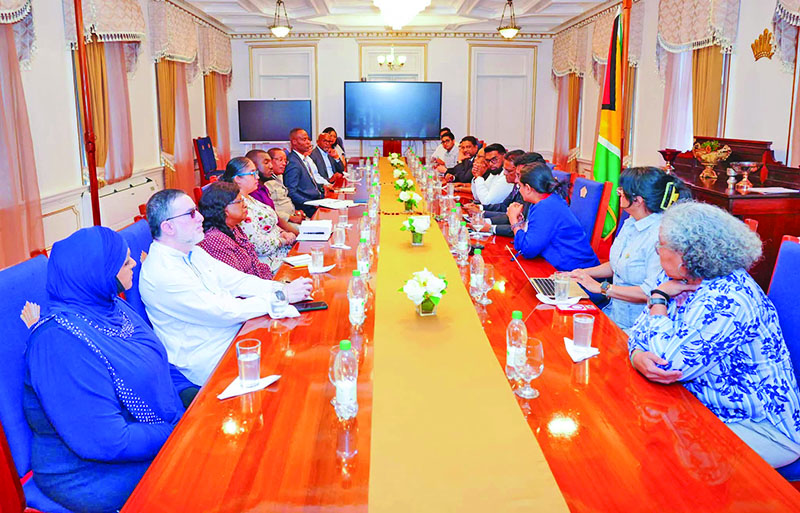
To address all the issues discussed and in fashioning a comprehensive approach, President Ali directed Attorney General (AG) Anil Nandlall, S.C., to coordinate an inter-agency task force that will comprise representatives from Government, the judiciary, law enforcement, the religious organisations, civil society and other relevant stakeholders to conceive and design a comprehensive plan of recommendations and actions for review and implementation.
Child killings
This multiple-stakeholder engagement comes after three children were killed recently in separate incidents in Guyana.
Only last Tuesday, October 20, six-year-old Orlando Jaikarran’s decomposed and headless body was recovered from the Waterloo Main Canal, West Coast Berbice (WCB)–five days after he was first reported missing from his Bath Settlement, WCB, home.
The child’s father, 45-year-old Bharrat Jaikarran, was arrested subsequently after the disappearance and later confessed to killing his son. He took investigators early Tuesday morning to the location, where he had dumped the boy’s body after allegedly being told by a local pujari that the child was not his biological son.
The father, a cane harvester of Bath Settlement, was charged and arraigned on Friday at the Weldaad Magistrate’s Court. He was not required to plead to the indictable Murder charge and was remanded to prison.
A second suspect, the pujari, is also in police custody and is likely to be charged for the child’s death as well.
Then on October 19, a three-year-old boy, Keron Latchman, and his mother, 29-year-old Donette Albert, both perished in a fire at their home in David James Housing Scheme, Essequibo Coast. The child’s father, and the now dead woman’s reputed husband, was later arrested.
The suspect told investigators that he and Albert had an argument during which the woman allegedly threatened to burn the house down. He claimed that he had left to go downstairs, when he heard a loud explosion and noticed that the house was on fire.
According to the man, he had run upstairs to rescue his wife and child but was the house was already engulfed in flames, preventing him from entering.
However, the dead woman’s sister claimed that she received a call from Albert that morning telling her to rush to the house immediately. But when the sister arrived about 15 minutes later, the building was on fire.
Meanwhile, on September 30, six-year-old Zi Feng Cao of Johnson Street, Parika, East Bank, Essequibo (EBE), was chopped to death by a 76-year-old Chinese national, who had a dispute with the child’s parents over money.
It was reported that the child was chopped to the neck and was pronounced dead at the De Kinderen Regional Hospital after he was rushed to there by his parents.
The suspect, upon his arrest, did not only confess but also led investigators to the area where he had disposed the 12” stainless steel blade murder weapon.
The elderly Chinese man, who has since been charged and remanded to prison, had told the police that he was arguing with the child’s parents over money they allegedly owed him. During the confrontation, the boy returned from school and upon seeing him, the man whipped out a knife from his bag and fired one chop at the child. The accused then left and went to the police station.
Stronger punishment
These incidents have sparked widespread public outrage with mounting calls for harsher punishment as a deterrent to crimes against children.
In fact, President Ali during an interview with the Newsroom on Tuesday last, argued that certain crimes demand a stronger response from the justice system. Condemning the killing of six-year-old Orlando Jaikarran, the Guyanese Leader noted that there needs to be a serious examination of the death penalty as a possible response to heinous crimes against children.
“No, it’s atrocious. You know, as President, you have to deal with many things. But what took place there is not only heinous, you can’t be human,” President Ali said.
The Head of State added that this incident, along with other crimes of an extreme nature, has prompted him to consider whether existing penalties are sufficient to deter such acts and convey the seriousness with which society views them.
While acknowledging the human rights considerations surrounding capital punishment, the Guyanese Leader maintained that the country must confront the question of how best to respond to crimes that shock the conscience of the nation.
“I believe that, you know, we really need to look at this,” he stated, adding that he had asked the AG to examine the matter carefully.
The President stressed that the judicial process must take its course but argued that, once justice has been served, the country should consider whether more severe penalties are warranted in the most extreme cases.
Asked directly whether he believed the death penalty was the stronger measure required, President Ali responded emphatically: “One hundred per cent.”
Discover more from Guyana Times
Subscribe to get the latest posts sent to your email.