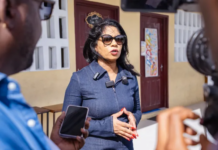
Nominee for United Nations Secretary General (UNSG) and Guyana’s current Permanent Representative to the body, Ambassador Carolyn Rodrigues-Birkett, on Thursday said that should she be appointed, she would ensure that the top world organisation for peace and protection of human rights be reformed and be “fit for purpose”.
Giving insight into an agenda for her first 100 days in office, she promised a five-pronged focus which includes humanitarian action, support for vulnerable countries, reform, conflict prevention, and financing. The foundation for these goals to be realised, she contended, will be by beginning with the appointment of a senior team that reflects competence, geographical balance and gender balance.
“The first order of business, obviously, will be deploying my senior team,” Rodrigues-Birkett said at the United Nations headquarters in New York, where a two-hour Town Hall debate was held with the six nominees vying for the post of SG.
“And then I’ll focus on five things. First, it’s reform, advancing the reform of the secretariat, which will be under my authority. But another aspect of that reform is providing the member states with the neutral information that they need to make the structural reforms, because that reform is in the hands of member states. Secondly, it will be on conflict resolution and prevention, and there I would look how the tools at the disposal of the Secretary General, mediation or the good offices can be used or can be better used and start deploying those,” she added.
The five other nominees are María Fernanda Espinosa Garcés, who was nominated by Antigua and Barbuda; Rafael Mariano Grossi, nominated by Argentina; Rebeca Grynspan Mayufis, nominated by Costa Rica; and Macky Sall, nominated by Burundi.
The former minister of government here that has also received support from some CARICOM countries underscored that equity must be the compass of global governance as she distinguished between reforms that can be advanced by the SG and structural reforms that require decisions by Member States.
“Another aspect of that reform is providing the Member States with the neutral information that they need to make the structural reforms, because that reform is in the hands of Member States,” she said.
On the focus of conflict resolution and prevention, she said that she would examine how the SG’s existing diplomatic tools could be used more effectively.
Singling out mediation and the SG’s good offices as mechanisms that could be strengthened and more actively deployed, she promised to use these in the execution of her works.
“There I would look how the tools at the disposal of the Secretary General, mediation or the good offices can be used or can be better used and start deploying those,” she said.
Her third priority, she highlighted, would be the humanitarian situation, which she described as a major global concern that needs continued improvements and noted that the United Nations must become more effective at translating its principles and decisions into tangible improvements in people’s lives. “We have a really terrible humanitarian situation,” Rodrigues-Birkett said.
While acknowledging that work is already under way to improve humanitarian assistance, she said a new Administration would need to examine the barriers preventing aid from reaching people in need.
“But I would want to advance that, looking at what are the impediments, political, logistical, and how we can deliver better.”
Ambassador Rodrigues-Birkett also identified the concerns of unrepresented and under-represented countries as an issue requiring early attention, and she pledged “addressing the unrepresented and under-represented countries”.
That the issue had been raised by a number of Member States during the interactive dialogue, she emphasised that that work would have to begin early in a new Administration.
She explained that the legitimacy of the UN depends not only on what it says but also on whether people see the organisation as relevant to their daily concerns such as peace, development, climate change, inequality, human rights, and economic opportunity. It is why she stressed too that “delivery” has to be seen and that the UN must connect global commitments with implementation at the national and local levels.
“I will have to commence that because that came up from a lot of Member States in the interactive dialogue,” Rodrigues-Birkett said.
Also, on the 100 days agenda would be including discussions with international financial institutions, particularly on ways to improve access to concessional financing for vulnerable countries.
The Guyanese envoy said that even limited changes to the system could provide meaningful relief.
“As I mentioned before, even small steps that are systemic that can bring relief to countries, especially when it comes to concessional financing, would make a huge difference, even as we work for greater reforms,” she said.
She stressed, however, that engagement with international financial institutions would be based on partnership. “But I want to do that in partnership, not from a pedestal speaking to the IFIs, but working in partnership and, of course, with Member States,” she said.
Rodrigues-Birkett also pointed to the Multidimensional Vulnerability Index as a possible mechanism for improving how countries are assessed for access to financing.
She noted that international discussions have already begun on moving beyond GDP as the sole measure of a country’s development or vulnerability.
“We have the multidimensional vulnerability index, and work has already started on going beyond GDP,” she said.
The challenge, she said, is determining how such tools can be applied to improve access to concessional financing for the countries most in need.
“But how do we use the MVI, for example, to work on concessional financing for the most vulnerable countries?” she asked.
And when asked what she would do if diplomacy within the United Nations Security Council failed to produce agreement, she argued that the SG must not simply accept paralysis, acknowledging that while there are limits imposed by geopolitical divisions, those limitations could not become an excuse for inaction.
“I believe that there is space for the Secretary General when there is no agreement by members of the Security Council to present options that could possibly be utilised to dialogue with the conflict parties,” she said.
Pointing to the current situation in the Strait of Hormuz, as an example, she reasoned, “We have not been able to see the results we want to see in ending the conflict in the Strait of Hormuz,” she said. Nevertheless, she emphasised that the SG retains an important political and diplomatic role even when the Security Council cannot reach agreement, and she would exhaust using all the tools at her disposal and try to create openings for dialogue and keep the possibility of a peaceful settlement alive.
Discover more from Guyana Times
Subscribe to get the latest posts sent to your email.