

The unmistakable sound of traditional African drums filled the air along Main Street, Georgetown, drawing scores of onlookers as the Annual Emancipation Expo celebrated African heritage, culture, and entrepreneurship.
The avenue was transformed into a vibrant showcase of rich culture and history, featuring beaded handcrafted jewellery, African clothing, and mesmerising paintings and sculptures. The highlight of the event was the tapping of the drums, which brought back distinct memories of what we were once taught about slavery and its abolition.
Good discussion over a tasty African dish served with mauby or mixed fruit juices also added to the atmosphere along Main Street. We cannot forget the incense, which brought the cultural history to life. The event, planned to remember and showcase our African ancestry, did justice to patrons who were not too stingy with their wallets, and to those who just went window shopping.
For many – both patrons and exhibitors – the annual event to celebrate our history is filled with untold stories. From the beating of the drums to weaving the well-articulated outfits to mixing the ingredients to make cassava pone or conkie, one cannot forget the contributions of our African ancestors.
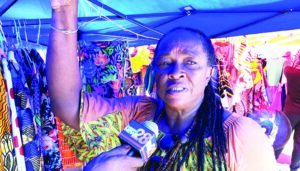
Speaking with Guyana Times, Rosalyn, a maker of traditional African drums, explained the significance of the instruments and the power they hold in celebrating African heritage and identity.
The rhythmic sounds of drums crafted from cow, sheep, or goat skins echoed along Main Street as anticipation built for this year’s Emancipation Day celebrations. However, the drumming was more than just a performance.
A woman identified only as Sister Rosalyn shared the history and significance of the African drum.
“So, the African drums are very, very, very, very sacred to the cultural heritage of the original people of this earth, which we call Africans. We’re actually abstracts of the original man, which is the melanated people, which we call Africans, and that covers every shade under the sun, from the red shade to the brown shade to the dark melanin. You name it, we’re all a part of one family.”
In simpler terms, Rosalyn explained that she believes African drums are deeply connected to ancestry, identity, and spirituality. She said the instrument was used by forefathers as a sacred form of communication with ancestors.
She explained that, traditionally, the drum was used to express requests and connect with ancestral energies, adding that people would beat the drum when seeking guidance or making specific requests.
Rosalyn said she believes it is important for people to understand the connection between the spiritual and physical aspects of life, noting that both positive and negative energies exist in the world.
She also added, “What I would like to say to my brothers and sisters at home and in the diaspora of this beautiful gem land called El Dorado City is we need to get more sacredly grounded. Stop trying to fight the battles of oppression, the battles of colonisation. Physically, it has to be a balance. You have to balance the spiritual with the physical. I’m talking to you; my whole skin is growing. The spiritual rules the physical. It cannot work by itself, nowhere. Just like negative cannot work without positive to create electricity. We’re all a part of this energy force. So don’t fight it physically; balance it.”
The drummers were not the only ones celebrating African culture. This publication also spoke with Patricia Hellwig, a local fashion designer, who showcased her business and explained how her handcrafted clothing helps preserve and promote African heritage.
“When I’m preparing for the Emancipation season, I get a wide range of African prints so that I can create head wraps. The head wraps, for me, are very, very important.”
In fact, she sources her African-print fabrics directly from Africa.
“I have someone who is in Africa, and she sends her things to Michigan, and I get the original fabrics from her. But I like to have my own pieces, you know, and when people come, they must see me in my clothing.”
Shifting gears to the cultural aspect, her focus was similar to Sister Rosalyn’s in that she also stressed the importance of the Emancipation celebrations.
“Emancipation is talking about us as a people coming out of slavery and being emancipated. I would not say that we are fully free, but we’re getting there. As a people, if we do not know where we came from, we cannot know where we’re headed. So, I think culture is very important for Guyanese.”
She also strongly believed Afro-Guyanese should do more, particularly the older generation, to pass their culture on to the nation’s youth.
“A lot of Afro persons are not proud of who they are. They’re not proud of where they came from, you understand? So for me, it’s a deep, deep feeling. I think we should put more into our culture. Look, we’re here as Guyanese, and you have Africans and Nigerians coming here and making it such a big thing. Our own people are not seeing it the same way, you know? So, for me, it’s big. It’s deep.”
In fact, she also had a message for the youth.
“For the youths, I would say the first thing is you’ve got to be proud to be Black. If you’re not proud of being Black, if you’re not proud of your culture, no one would respect you. If you do not like yourself, no one will love you. First, self-love. Teach your children self-love. Stop relaxing their hair. Stop putting them into all this nonsense. Some people think, ‘How could you dye your hair like that all the time? ‘I’m proud of who I am, and this gives me an identity. Don’t bleach your skin or change your hair. Be you. And if people see you being yourself and proud of who you are, you’ll get more respect.”
Food certainly wasn’t left out of the discussion. Chef Glennis Agard, who prepared a wide variety of traditional dishes ranging from conkie to pone and sugar cakes, had a lot to say about the key ingredients behind some of her African-inspired cuisine while also sharing a strong message with the public.
“In this time of emancipation, I just feel so good because I’m not ashamed of my culture, the different types of food, and the different African wear. We Africans should be proud during this time because, remember, our fore parents struggled to get freedom. So, we all have to celebrate Emancipation and feel good during this season.”
Discover more from Guyana Times
Subscribe to get the latest posts sent to your email.